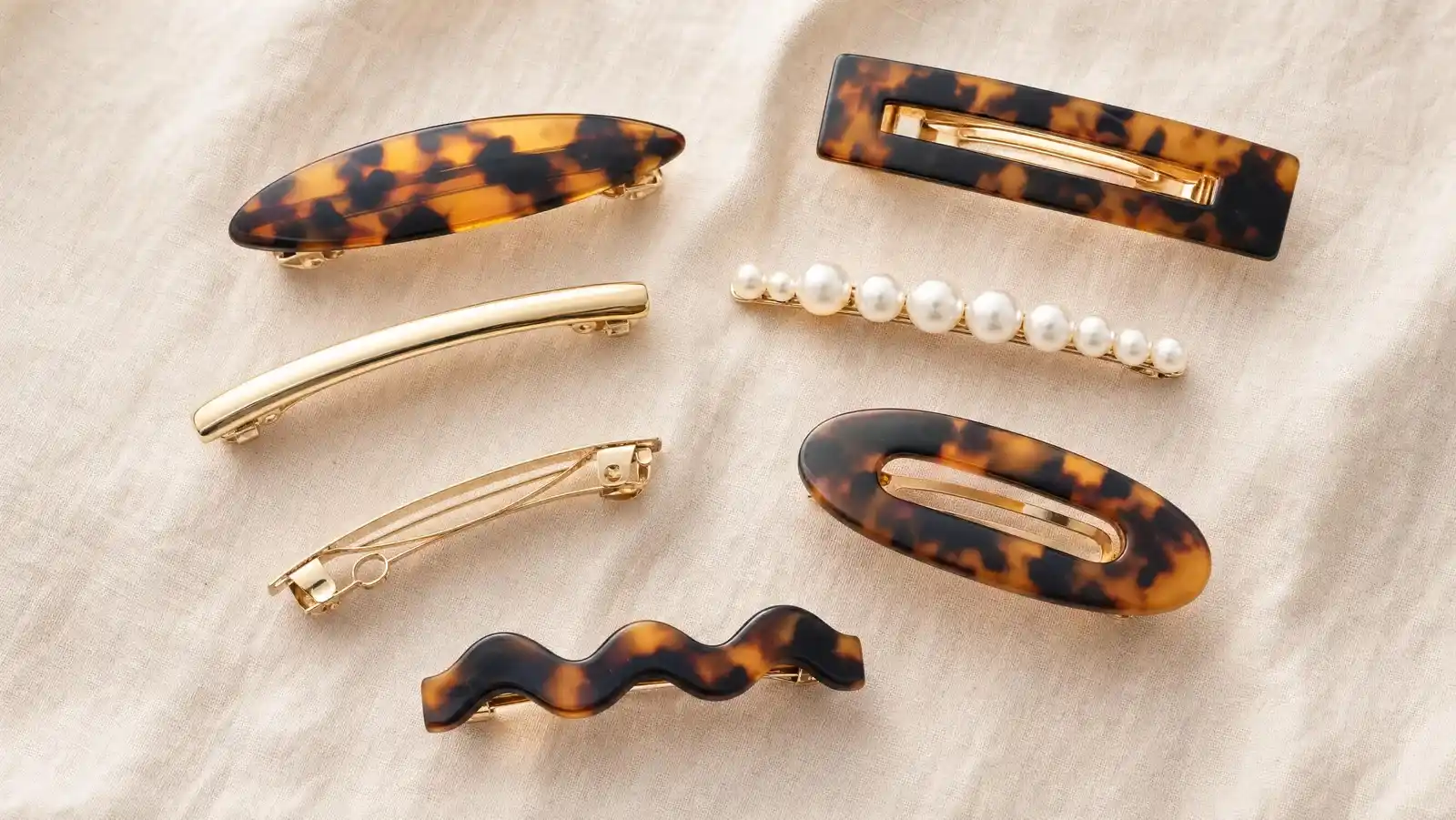
- Best Barrettes for Fine Hair
- Best Barrettes for Thick Hair
- French Barrettes: Timeless Elegance
- How to Wear Barrettes
- Barrette Hairstyles for Every Occasion
- Types of Barrettes
- Are Barrettes Bad for Your Hair?
- Why Barrettes Slip (and How to Fix It)
- Wearing Barrettes with Short Hair
- Barrettes vs Claw Clips vs Bobby Pins
- Explore the full series
Barrettes are the most underrated tool in the hair drawer. Hair barrettes are hinged or clasped clips that press a section of hair between a decorative top and a bar underneath, holding it flat and secure. They run from tiny snap clips to spring-loaded French designs, and the right one holds a half-up style all day without a single bobby pin.
Best Claw Clips is reader-supported. When you buy through links on our site, we may earn an affiliate commission at no extra cost to you. We test hair accessories the boring way, on real heads over real days, and below we share what actually holds, starting with our overall pick, the Goody Stay Tight Hair Barrettes.
This is the hub for our entire barrette series. Use it as a map: each section is a short, honest overview, and the deeper roundups link out from here as they publish. Whether you are shopping for your first everyday clip or trying to figure out why yours never stays put, start here.
Across the series we lean on four everyday picks that cover the common needs: the flat metal Goody Stay Tight set as our all-rounder, the Amariver Vintage French Barrette Clips for a dressier hold, the coated Scunci No-Slip Grip barrettes for slippery hair, and the acetate Fumwase Shell set for when the clip is meant to be seen. None of them costs much, which is the point. A good barrette should be a low-stakes buy you can own in several finishes rather than a single precious clip you are afraid to lose.
Best Barrettes for Fine Hair
Fine hair is the hardest hair to keep a clip in, and it is not your technique. According to QueenMee Accessories, fine hair has a naturally smooth, silky texture that gives a clip very little to grip, so even a tight barrette works its way loose over the day. The fix is matching the clip to the texture rather than fighting it.
For our full roundup of the best barrettes for fine hair we go deeper, but the short version is simple: choose small, lightweight barrettes with teeth that overlap, and lean toward flat styles. QueenMee Accessories recommends smaller clips with a strong grip for finer hair, and flat barrette shapes work well here because they clasp the hair securely and sit close to the head, which reduces the leverage that pops a bulkier clip open.
Two of our picks are built for exactly this. The Scunci No-Slip Grip Metal Barrettes are lined with a grip coating that adds friction without snagging, and reviewers with fine hair specifically note they stop sliding out through the day. The Goody Stay Tight Hair Barrettes are flat metal with a slide-in design and a deliberately gentle hold, so they secure a thin section without the pinch that makes fine-haired people give up on clips.
A few habits help too:
- Add grip before the clip. A light mist of texture spray or dry shampoo at the roots gives the barrette something to bite into.
- Take enough hair. A too-small section has nothing to anchor to.
- Keep it low-profile. Flat and small beats big and decorative when your hair is slippery.
One more habit: fine hair does better with two small clips than one large one, because the load spreads across more contact points and nothing has the leverage to work loose.
Best Barrettes for Thick Hair
Thick hair has the opposite problem: plenty for a clip to grip, but enough volume to overwhelm a small or weak one. The failure mode here is a clasp that will not close, or one that closes and then springs open an hour later under the weight.
Our full guide to the best barrettes for thick hair focuses on two specs: length and spring strength. Longer barrettes span a wider section so the hold is spread out instead of concentrated in one straining point. According to Tegen Accessories, barrettes come in small, medium, and large sizes matched to hair type, with larger curved barrettes made to secure a lot of thick hair comfortably, so reaching for the bigger end of the range makes an immediate difference.
For a genuinely thick half-up, a French barrette is often the better tool. The Amariver Vintage French Barrette Clips run roughly 3.2 inches with an internal metal spring, and buyers highlight that the spring clasp holds thicker sections without popping open, which is the exact complaint people have about flimsy snap clips. If you prefer metal that disappears into the hair, the Goody Stay Tight Hair Barrettes are described as suiting both thick and thin hair, so a couple stacked side by side can corral a heavy section.
It also helps to split a thick section in two and clip each half separately rather than forcing everything into one barrette. Two secure holds beat one straining clasp, and the finished style usually looks neater because the hair is not bunched under a single overloaded clip.
The rule of thumb: when in doubt, size up. A barrette that is slightly too big holds thick hair far better than one that is slightly too small.
French Barrettes: Timeless Elegance
If you buy one barrette to keep for years, make it a French one. The word barrette comes from the French for small bar, and the French barrette earns the name through its mechanism. According to France Luxe, a curved shape and a strong spring clasp hold the hair between a tension bar and an arm whose prongs latch shut for a secure hold. You press the ends to open it, slide it under the hair, position the top, and release, and the bar traps the hair against the shell.
That latching clasp is why French barrettes hold where snap clips slip. France Luxe describes the tension bar and strong spring clasp as gripping firmly for a secure, comfortable hold, which makes the style a favorite for thick, fine, or slippery hair alike. There is real heritage behind it, too. According to Junyi Beauty, French artisans in Oyonnax, often called the cradle of French plastics, perfected the modern barrette in the 19th century, and the town has specialized in robust clip mechanisms since the 1890s.
Our pick for the category, and the anchor of our guide to the best French barrettes, is the Amariver Vintage French Barrette Clips. The four-pack has a crossover shape, a matte coating, and neutral colorways that read as polished rather than flashy, so one holds a low twist for work and another dresses up a half-up for dinner. It is the closest thing to a do-everything barrette we tested, which is why it is our "Also Good" runner-up to the Goody set overall. Because the hold comes from a metal spring rather than a simple plastic hinge, a well-made French barrette also tends to outlast snap clips by years, which is why the style is treated as an heirloom rather than a disposable clip.
How to Wear Barrettes
There is no single answer to how to wear barrettes, because the same clip does several jobs. But a few placements cover ninety percent of everyday styling, and they all start with taking the right amount of hair. A reliable rule of thumb is to pick up at least the width of the barrette, if not a little more, so the clip has a solid base and does not immediately slide free.
Four go-to placements:
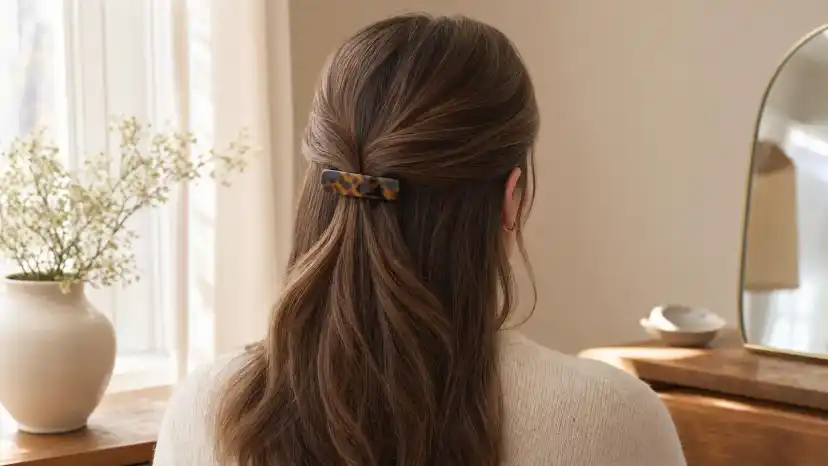
- The half-up. Gather the top third of your hair, twist it a quarter turn, and clip it at the crown. This is the fastest polished look there is.
- The side sweep. Sweep one side back off your face and secure it just behind the ear, where the hair is denser and the clip anchors better.
- The pin-back. Fold back a single front section, flat against the head, to keep grown-out layers or bangs out of your eyes.
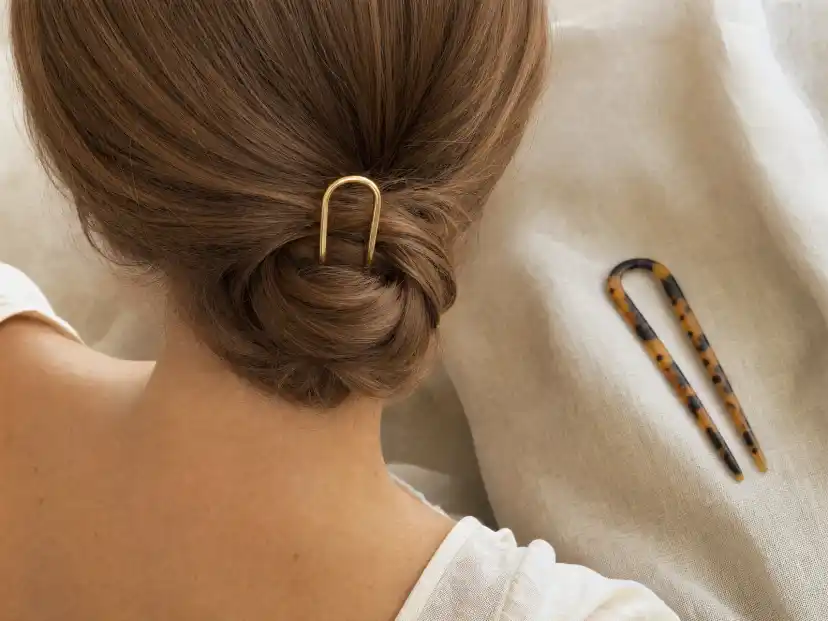
- The low twist. Twist all your hair to one side, roll it up, and hold it with a French barrette for an instant chignon.
- The tuck-and-pin. Roll the ends of a low ponytail under and clip the roll flat against your neck for a faux bob that takes about a minute.
Mechanics matter. For a snap barrette, open it fully, lay it over the gathered hair, and press until it clicks; do not force it over more hair than it can close around. For a French barrette, squeeze the clasp, seat the bar under the section, then release so it locks. And if a clip pulls or pinches, you have taken too much hair or set it too tight, so reposition rather than tolerate it.
Barrette Hairstyles for Every Occasion
Once the placements are second nature, barrette hairstyles become a five-second way to change a look. The trick is matching the clip's finish to the moment.
For everyday and work, keep it quiet: a single metal barrette in a low half-up, or grown-out bangs pinned flat. The Goody Stay Tight set in a brushed metallic finish reads as intentional without shouting. For anything you would call an outfit, decorative clips do the talking. The Fumwase Shell Hair Barrettes come in tortoiseshell and marbled acetate, and shoppers love the range of patterns and how light they feel, which makes them an easy upgrade over plain metal for dinner, a wedding, or a night out.
Three occasion-based ideas from our styling notes:
- The cluster. Line up two or three small barrettes in a row along one temple. It is the trend-forward look that works on second- or third-day hair.
- The stacked twist. Do a low side twist and stack a French barrette over a small snap clip so the pretty one shows and the sturdy one holds.
- The polished pony. Sweep back both sides with matching clips before gathering a ponytail, hiding the elastic and smoothing the crown.
For hair worn down, remember you do not need an updo to use a barrette at all. Clip a single decorative one an inch above your ear on the fuller side, leave the rest loose, and it reads as styled with almost no effort. It is the move that makes second-day hair look intentional in ten seconds, and where a patterned acetate set like the Fumwase earns its place over plain metal.
Our full barrette-hairstyles guide goes deeper; think of these as the reliable starting points you can build on.
Types of Barrettes
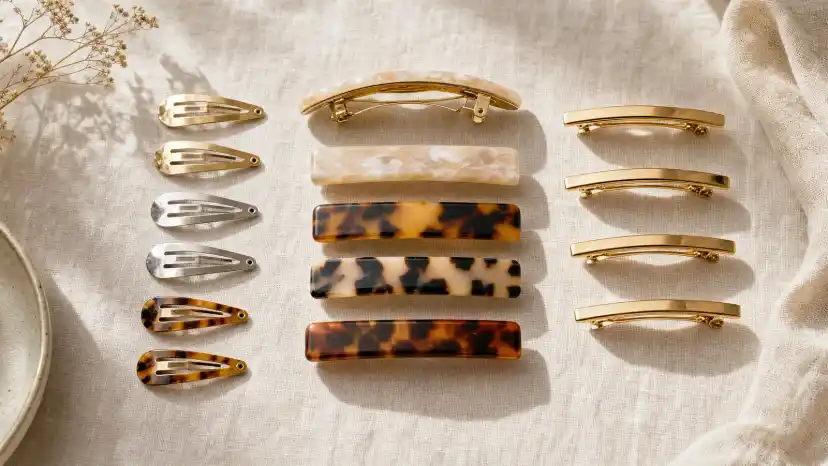
Barrettes get lumped together, but the category covers several distinct mechanisms, and knowing the types of barrettes makes shopping far less confusing. According to Tegen Accessories and Wikipedia's hair-clip entry, the main families break down like this:
- Snap barrettes. Small, usually rectangular clips with a hinged lever that snaps shut across the section, pressing hair between the decorative face and the lever underside. They come in a range of sizes, so there is a size for everything from a baby fringe to a thick half-up.
- French barrettes. Curved clips with a spring-loaded tension bar and an auto-locking clasp on one end, prized for a firm hold and a low, flat profile.
- Auto-clasp and spring clips. Variations on the French idea, with a bar that slides or latches through the frame to lock hair flat.
- Decorative acetate barrettes. Any of the above dressed in molded, patterned cellulose acetate for looks, like the Fumwase set.
Material is the other axis. Metal barrettes such as the Goody Stay Tight and Scunci No-Slip Grip sets are slim and disappear into the hair; acetate barrettes like the Fumwase set are the showpieces. The mechanism decides how it holds, and the material decides how it looks, so read both before you buy.
A durability note worth knowing before you spend: the weak point on any barrette is the mechanism, not the shell. Simple snap hinges are the cheapest and usually the first to loosen, while spring-bar and French clasps hold their tension far longer. If you want a clip to last, put your money into the mechanism and treat the finish as the extra rather than the reverse.
Are Barrettes Bad for Your Hair?
Short answer: barrettes are among the gentler accessories, but any clip can cause damage if you misuse it. The concern dermatologists raise is traction, the low, constant pulling that stresses the follicle. According to the American Academy of Dermatology, hairstyles that repeatedly pull on the hair, including tight clips and barrettes, can lead to a type of hair loss called traction alopecia, especially when the same tension is applied in the same place over time.
So are barrettes bad for your hair? Not inherently. The risk comes from three habits: clipping too tightly, wearing the clip in the identical spot every single day, and using rough or degraded clips that snag. The encouraging part, according to Aglow Dermatology, is that traction alopecia is reversible in its early stages if you catch it and ease the tension, though long-standing pulling can eventually become permanent.
Wearing barrettes safely is straightforward:
- Loosen the hold. It should feel secure, never painful. Pain is the warning sign.
- Move the placement. Rotate where you clip so no single patch takes the strain daily.
- Choose smooth materials. According to Your Health Magazine, acetate accessories can be polished to an extremely smooth finish that resists the micro-rough edges plastic can develop, so gentle materials snag less. Coated metal like the Scunci No-Slip Grip set works on the same principle.
Keep it in perspective, too: a loosely worn barrette puts far less sustained tension on the hairline than a tight ponytail or a slicked-back bun, the styles most often linked to traction problems. Used sensibly, a barrette is one of the lower-risk ways to get hair off your face. If you ever notice tenderness or thinning at your hairline, that is the cue to give the area a rest.
Why Barrettes Slip (and How to Fix It)
The most common barrette complaint is not comfort, it is that the thing will not stay put. If you have ever wondered why barrettes keep slipping, the answer usually starts with your hair, not the clip. According to QueenMee Accessories, fine and silky hair simply lacks the texture a clip needs to grip, so without added friction even a well-made barrette slides free over the course of a day.
Five fixes, in order of how much they help:
- Add texture first. According to Beautiful With Brains, a spritz of dry shampoo, texture spray, or light hairspray at the roots creates the grip fine hair is missing before the clip goes in.
- Use a bobby-pin anchor. Beautiful With Brains recommends sliding a bobby pin into place where you want the barrette, then clipping the barrette over it so the pin acts as a little anchor for the clip to hold onto.
- Take enough hair. Pick up at least the width of the barrette so it has a proper base.
- Pick a grippier clip. A coated barrette such as the Scunci No-Slip Grip set adds friction by design; reviewers with fine hair say it is what finally kept clips from sliding out.
- Go flat and small. Low-profile barrettes have less leverage working against them than big, heavy ones.
One overlooked culprit: freshly washed hair is the slipperiest hair there is. If a style genuinely has to hold, second-day hair or a light dry-texture spray will always cooperate better than squeaky-clean strands, so time your washes accordingly on days you plan to clip.
Work down that list and almost any slipping problem gets solved without buying ten different clips.
Wearing Barrettes with Short Hair
Short hair is barrette territory, even if it does not feel like it. You are not building an updo, you are managing pieces: bangs, grown-out layers, and the front sections that fall into your face. The whole game with wearing barrettes with short hair is choosing small clips and pinning flat.
Reach for the smaller end of the size range; Tegen Accessories describes small, lightweight barrettes as the ones suited to fine hair and accent styling. On a bob or lob, a single small barrette sweeping one side back reads instantly intentional, and a matched pair on both sides tames a grow-out phase. Because short hair shows the clip more, this is where a decorative set earns its keep. The Fumwase Shell Hair Barrettes are light acetate, so they will not drag down a short style, and the tortoiseshell patterns look deliberate rather than utilitarian against a cropped cut.
A couple of short-hair-specific tips:
- Clip against the grain. Pinning a section back slightly toward the crown holds shorter pieces better than pinning straight down.
- Double up. Two tiny clips close together hold a stubborn layer that one cannot.
The one short cut where barrettes struggle is a very short pixie, where there simply is not enough length for a clip to close around anything. There, tiny snap clips used purely as decoration along a longer top section are your best bet. On a blunt bob, by contrast, almost any small barrette works, because the weight of the blunt line gives the clip a stable base to grip.
Short hair with barrettes is less about coverage and more about small, well-placed accents, and it is one of the easiest ways to make a simple cut look styled.
Barrettes vs Claw Clips vs Bobby Pins
These three do overlapping jobs, so the honest question is which one for which task, not which is best. Thinking about barrettes vs claw clips vs bobby pins as a toolkit, not a competition, gets you dressed faster.
- Barrettes hold a defined section flat and visible. They are the styling accent: half-ups, side sweeps, pinned-back bangs. The hold is secure but low-profile, and the clip is meant to be seen.
- Claw clips grab your whole length and twist it up. They are the volume tool, best for a full updo or getting long, thick hair off your neck in seconds. For the deep dive, see our complete guide to claw clips.
- Bobby pins are the invisible anchors that hold everything the other two cannot, tucking flyaways and locking a twist in place. They vanish into the hair rather than decorate it; our complete guide to bobby pins covers sizing and technique.
In practice they work together. A French barrette holds your twist, a couple of bobby pins secure the tail, and a claw clip is what you grab when you just want it all up and out of the way. The simplest decision rule: reach for a barrette when you want the clip to show, a claw clip when you want your whole length up fast, and bobby pins when you want the hold to disappear. Most people end up owning all three not out of indecision but because each solves a problem the others cannot.
Build a small kit of all three and you will rarely be stuck. If you are choosing only one to start, a versatile flat set like the Goody Stay Tight Hair Barrettes is the most flexible first buy.
Explore the full series
- Best Barrettes for Fine Hair: Lightweight Picks That Actually Hold — small, lightweight clips that grip slippery strands
- How to Wear Barrettes: 12 Easy Ways to Style Any Hair — placements and technique for any hair type
- Best Barrettes for Thick Hair That Won't Slip or Snap — length and spring strength for heavy sections
- Best French Barrettes for Elegant Everyday Style — made-in-France picks and acetate classics
- Barrette Hairstyles: 10 Effortless Looks for Every Occasion — ten looks from work-ready to evening
- Types of Barrettes Explained: French, Snap, Automatic & More — every clasp mechanism, decoded
- Are Barrettes Bad for Your Hair? What Stylists Say — what the evidence says about tension, breakage and safe wear
- Why Do My Barrettes Keep Slipping Out? 8 Fixes That Work — eight fixes for clips that will not stay put
- How to Wear Barrettes with Short Hair: Styles That Stay — placements that hold on a pixie, crop or bob
- Barrettes vs Claw Clips vs Bobby Pins: Which to Use When — which of the three tools fits which job
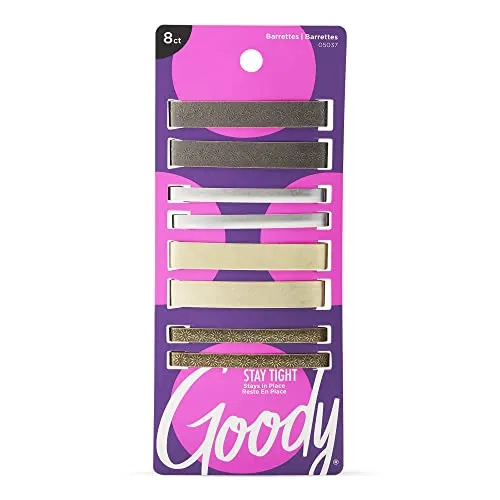
Goody Stay Tight Hair Barrettes (8 Ct)
Non-slip flat metal barrettes in assorted metallic finishes. The slide-in design grips securely without snagging, and the gentle hold suits both thick and thin hair.
“Reviewers consistently praise the secure hold and how easily they slide in for quick everyday stylin...”
We tested dozens of claw clips to find the very best options. Below you'll find our complete ranking, with detailed reviews and real customer feedback for each pick.
The Complete Ranking
Goody Stay Tight Hair Barrettes (8 Ct)
“Reviewers consistently praise the secure hold and how easily...” — Verified Buyer
Non-slip flat metal barrettes in assorted metallic finishes. The slide-in design grips securely without snagging, and the gentle hold suits both thick and thin hair. A versatile, low-cost everyday workhorse.
“Reviewers consistently praise the secure hold and how easily they slide in for quick everyday styling.”
— Verified Buyer
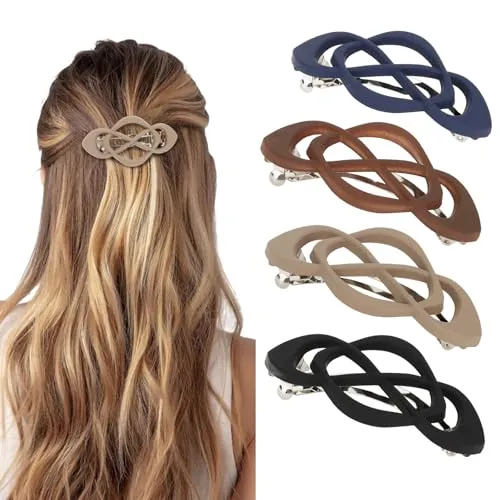
Amariver Vintage French Barrette Clips (4 Pack)
“Buyers highlight the elegant vintage look and a spring clasp...” — Verified Buyer
A four-pack of matte-coated French barrettes with a crossover shape and internal metal spring. At roughly 3.2 inches they hold a half-up section or a low twist, and the neutral colorways read as polished rather than flashy.
“Buyers highlight the elegant vintage look and a spring clasp that holds thicker sections without popping open.”
— Verified Buyer
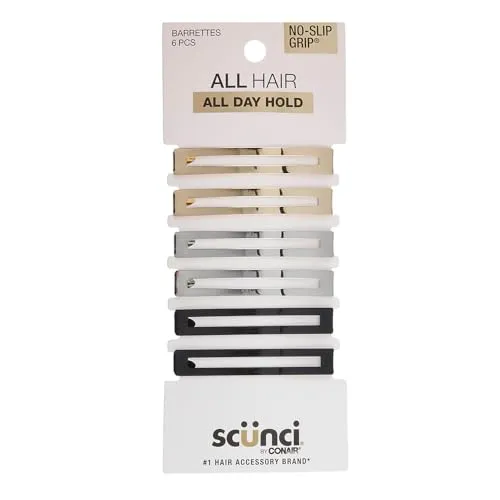
Scunci No-Slip Grip Metal Barrettes (6 Count)
“Reviewers with fine hair note the grip lining actually keeps...” — Verified Buyer
Metal barrettes lined with Scunci's No-Slip Grip coating so they hold without snagging or pulling delicate strands. The mixed gold, black, and silver set covers everything from taming flyaways to accenting an updo.
“Reviewers with fine hair note the grip lining actually keeps these from sliding out through the day.”
— Verified Buyer
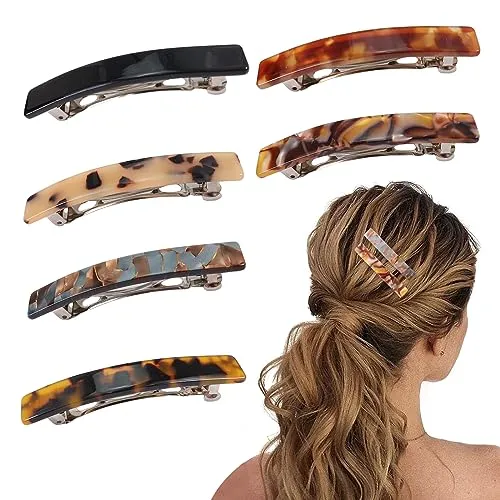
Fumwase Shell Hair Barrettes (6 PCS)
“Shoppers love the range of tortoiseshell patterns and how li...” — Verified Buyer
A six-piece set of lightweight acetate barrettes in tortoiseshell and marbled patterns. The smooth spring clasp is gentle on hair, and the varied finishes make them an easy decorative upgrade over plain metal clips.
“Shoppers love the range of tortoiseshell patterns and how light they feel for all-day wear.”
— Verified Buyer
Reviewers consistently praise the secure hold and how easily they slide in for quick everyday styling.
Quick Comparison
A side-by-side look at our top picks
Frequently Asked Questions
A barrette is a bar, by design
Match the barrette to the hair, not the outfit
Placement is a hair-health decision

Donna Miller
Enjoyed This Guide?
Get more hair tips and product recommendations delivered weekly.