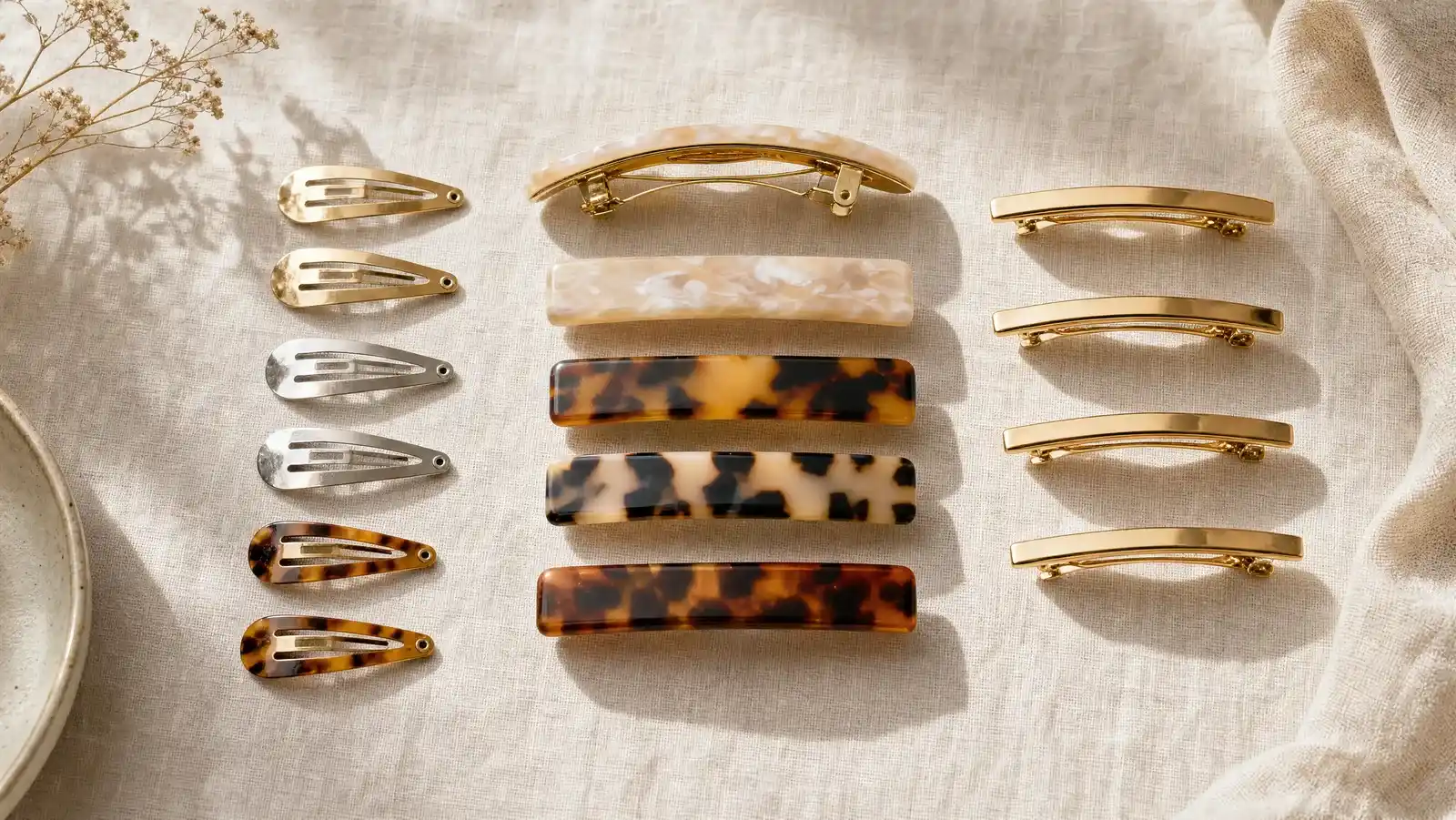
- The 7 types of barrettes at a glance
- French barrettes: the classic tension-bar clasp
- Automatic barrettes: the spring-loaded cousin
- Snap clips (tic-tacs): one flexing plate, zero bulk
- Acetate and tortoise rectangle barrettes: a material, not a mechanism
- Banana clips: two hinged combs for maximum volume
- Alligator clips: the stylist's sectioning tool
- Stick barrettes: the woven wildcard
- How to choose among the different kinds of barrettes
- The bottom line on barrette clasp types
The main types of barrettes differ by their clasp: French barrettes close over a spring-tension bar, automatic barrettes add a spring that snaps shut one-handed, snap clips are a single flexing metal plate, and acetate rectangles, banana clips, alligator clips, and stick barrettes round out the family. Below, we explain each mechanism, the hair it suits, and where it earns its keep.
Best Claw Clips is reader-supported. When you buy through links on our site, we may earn an affiliate commission at no extra cost to you.
Our complete overview of hair barrettes covers materials, sizing, and styling in one place; this guide zooms in on the clasp types, because the clasp — not the decoration on top — is what decides whether a barrette holds your hair for ten hours or slides out by lunch. We have tested every type below on fine, medium, and thick hair, and the differences are mechanical, not cosmetic.
The 7 types of barrettes at a glance
| Barrette type | Clasp or mechanism | Best for |
|---|---|---|
| French barrette | Tension bar with two latching prongs | Half-up styles, medium to thick hair |
| Automatic barrette | Spring-loaded clasp that closes in one squeeze | Anyone who re-clips during the day |
| Snap clip (tic-tac) | Single flexing metal plate | Fine hair, bangs, small sections |
| Acetate rectangle | French or snap hardware under a cellulose acetate top | Polished daily wear |
| Banana clip | Two hinged rows of interlocking teeth | Thick or long hair, ponytail volume |
| Alligator clip | Long tapered jaw with interlocking teeth | Sectioning hair while styling |
| Stick barrette | A stick woven through the frame and under the hair | Low buns and vintage looks |
Nearly every barrette we have handled is a variation on one of these seven.
French barrettes: the classic tension-bar clasp
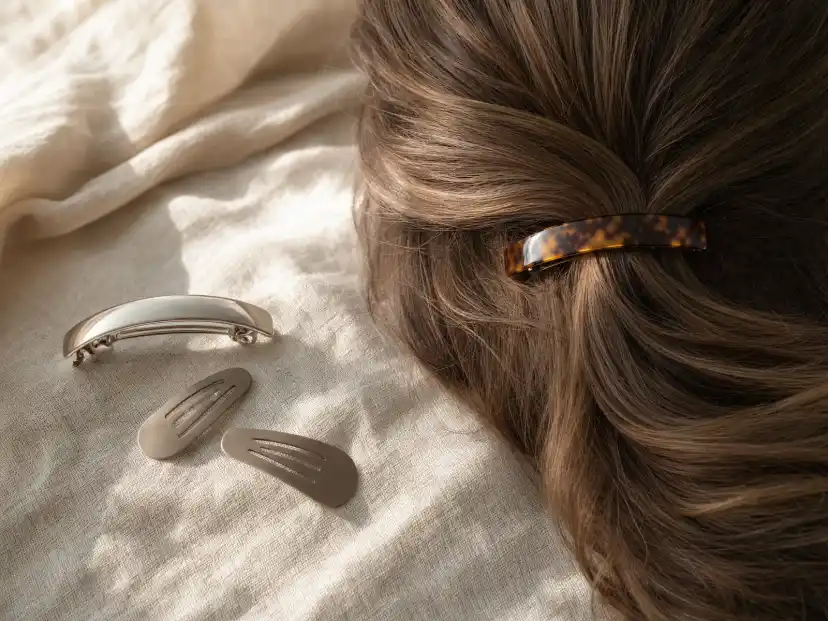
The French barrette is the reference design — when a stylist says "barrette" with no qualifier, this is usually the one she means. According to France Luxe, a French barrette holds your hair between an arm and a tension bar, and the clasp is made of two prongs that latch onto the arm, keeping it closed until you undo the clasp. The bowed tension bar presses your hair against the arm along the barrette's full width the entire time you wear it.
The name is older than most people guess. Merriam-Webster traces "barrette" to French, a diminutive of barre — literally a small bar — with a first known English use in 1901.
Fit matters more with this type than any other. According to Tegen Accessories, finer hair types usually suit flat barrette styles, which clasp the hair securely to prevent slipping, while arched barrette clips are the best style for thick, long, or textured hair — the curve leaves room for the extra bulk. In our testing, a roughly 3-inch French barrette is the everyday sweet spot: big enough for a half-up section, small enough not to sag. The Amariver Vintage French Barrette Clips, a four-pack of matte crossover-shaped barrettes at about 3.2 inches, are a textbook example of the type, and our full roundup of the best French barrettes compares five more, including made-in-France acetate picks.
One common use case: anchoring a half-up style or a low twist that has to survive a full workday.
Automatic barrettes: the spring-loaded cousin
What sellers commonly call an automatic barrette (or auto-clasp) keeps the same arm-and-bar architecture but adds a spring to the clasp, so the closure snaps shut in one squeeze instead of the classic two-step press-and-click. Craft suppliers sell the bare hardware as automatic spring clasps, and the label makes sense in the hand: you squeeze, and it clicks itself closed.
That is the whole automatic vs. French barrette question in practice. Closed, the two hold hair the same way, with a tension bar pressing along the full width. The difference is the opening and closing motion:
- Classic French clasp: two steps — press the tension bar down, then latch the prongs. Slightly more deliberate, nothing to wear out but the bar itself.
- Automatic clasp: one squeeze to close, one press to release. Faster, and realistic to do one-handed with a phone in the other hand.
We reach for automatic clasps when we know we will re-clip during the day — after the gym, in the car, before a meeting. If your style goes in at 7 a.m. and comes out at bedtime, the classic French clasp gives up nothing.
One common use case: commuters and gym-goers who take their hair down and re-clip it several times a day.
Snap clips (tic-tacs): one flexing plate, zero bulk
Snap clips are the small metal clips most of us wore in grade school, and the mechanism could not be simpler. Tegen Accessories describes snap barrettes as small, rectangular-shaped barrettes that snap open and closed — the "tic-tac" nickname comes from that push-to-pop motion. Hair-accessory manufacturer JUNYI's snap clip guide explains the mechanism: press the raised curve of the metal plate and it reverses direction and snaps down, gripping the hair beneath it. That satisfying pop is one piece of springy metal flipping between two shapes — there is no separate clasp at all.
The design's strengths are its thinness and its scale. A snap clip sits nearly flat against the head, which is why it is the default choice for bangs, baby hairs, grown-out layers, and face-framing wisps. It is also the type that works best on the finest hair: a small clip closing on a small section grips where a big barrette would slide straight out. The Cptots Small No-Slip Metal Snap Barrettes — a 20-pack of roughly 2-inch water-drop-shaped clips with smooth edges — are the textbook version, and we cover more slip-proof options in our guide to the barrettes we recommend for fine hair.
Two honest caveats from our testing: a snap clip was never built to anchor a heavy updo, and a plate that has been popped open hundreds of times can gradually lose some of its snap.
One common use case: pinning back bangs or baby hairs so they stay out of your face without flattening the rest of your style.
Acetate and tortoise rectangle barrettes: a material, not a mechanism
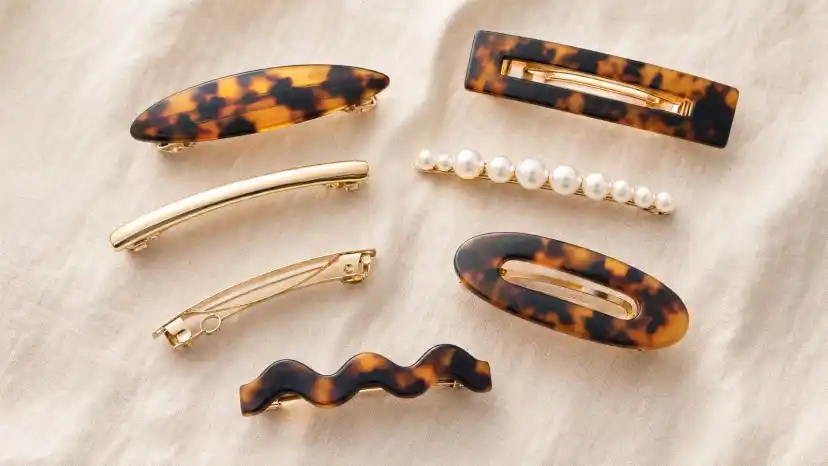
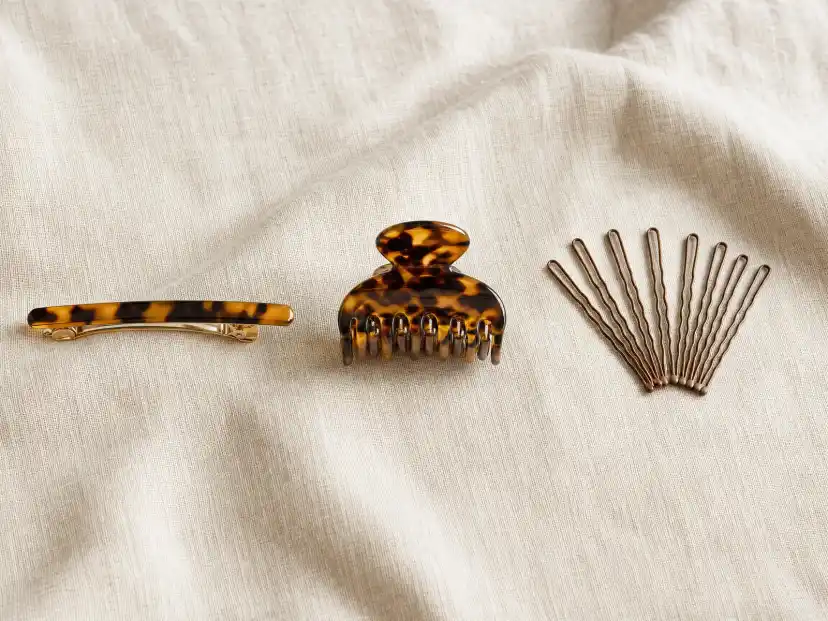
The rectangular tortoiseshell barrette all over social media is technically a French or snap barrette underneath — what defines the category is the cellulose acetate top. According to French accessories brand Coucou Suzette, cellulose acetate is a plant-based material made from wood or cotton pulp, which means it contains no petroleum the way conventional plastic does. The practical payoff is visual and tactile: tortoise and marble patterns run through the acetate sheet itself rather than being printed on the surface, so the finish has a depth that molded plastic cannot fake, and the polished edges drag less against strands.
The DF DUALFERV Acetate French Tortoise Barrettes, an eight-piece set of 3-inch rectangles with a tooth-shaped grip over a metal spring, show why the format took off: the teeth bite into the section so the barrette does not rely on clamp pressure alone, and the rectangle reads polished with a blazer or a sweatshirt. We have written a full comparison of acetate versus plastic accessories and how each affects hair health; the short version is that if you wear a barrette daily, acetate is the upgrade your hair notices. One care note: acetate is commonly described as heat-sensitive, so store these in a drawer rather than a hot parked car.
One common use case: a polished half-up for work that photographs like real tortoiseshell.
Banana clips: two hinged combs for maximum volume
The banana clip is the outlier that holds a whole ponytail's worth of hair without an elastic. Hairstyle guide site Hairstyle Picks describes the design as a curved, flexible plastic back with two rows of teeth that you open like a banana peel; slide it up under gathered hair, close the two toothed arms, and the teeth interlock along the clip's full length. The same guide notes the result — a voluminous, cascading ponytail — was popular in the 1980s, and the style has cycled back hard.
Because the grip is distributed along the full length of both toothed arms rather than concentrated at one clamp point, banana clips are one of the few types that get better as hair gets thicker and longer. If your usual complaint is that barrettes pop open or slide out, start with our picks for the best barrettes for thick hair, where hold strength is the whole scorecard.
One common use case: getting thick, long hair fully off the neck with volume instead of a tight, crease-leaving elastic.
Alligator clips: the stylist's sectioning tool
Alligator clips (also called sectioning or crocodile clips) are the long, spring-hinged clips clipped all over your head at the salon. Hairstyle Picks describes them as having a long, flat shape with strong interlocking teeth, narrowing to a point like an alligator's snout, and notes that hairstylists use them to section hair during cutting or coloring — the narrow tip allows precise placement at the roots.
That is exactly how we suggest you use them at home: parking sections while you blow-dry, curl, or braid. The strong pinch that makes them excellent styling tools is concentrated at one spot, which is why we do not recommend them as all-day decorative wear, especially on fragile or fine hair. Buy a handful, keep them at your mirror, and let them do backstage work.
One common use case: holding the top layers out of the way while you work through the under-layers with a curling iron.
Stick barrettes: the woven wildcard
The stick barrette is the least common type on this list but easy to recognize: a decorative frame plus a separate pin. Tegen Accessories defines stick barrettes as long, thin barrettes with a stick on one end, and explains the mechanism — the stick winds through the barrette front, under the hair, then back through the barrette on the other side, which suits small to medium sections of hair. There is no clasp and no spring; the woven stick is the closure.
The appeal is comfort and looks. With no metal bar pressing against the scalp, a stick barrette can hold a loose low bun or half-up twist with almost no pressure point, and the exposed stick reads handmade in a way stamped hardware does not. The trade-off is security: it will not survive a workout, and it takes a few tries to weave quickly.
One common use case: dressing up a loose low bun for dinner without the pressure of a clamped clasp.
How to choose among the different kinds of barrettes
After years of testing, our decision process comes down to three questions:
- How much hair is going in it? A wisp of bangs wants a 2-inch snap clip; a half-up section wants a 3-inch French, automatic, or acetate barrette; a full head of thick hair wants a banana clip.
- How often will you open it? Re-clipping all day favors an automatic clasp; a set-and-forget style is happy with a classic French clasp or a stick barrette.
- Is it doing a job or making a look? Alligator clips are tools for styling sessions; acetate rectangles and stick barrettes are the ones worth showing off.
Placement decides the other half of the outcome — the same barrette behaves differently at the crown than at the nape — so once you have picked a type, our companion guide on how to wear barrettes walks through positioning for each style.
The bottom line on barrette clasp types
Barrette shopping gets simple once you read the hardware instead of the marketing photo. A tension bar with latching prongs means all-day French-style hold; a spring in that clasp means one-handed automatic convenience; a single flexing plate means a light-duty snap clip; interlocking teeth mean sectioning or volume. Match the clasp to the amount of hair and the number of times you will open it, and nearly any well-made barrette in that category will do its job. For materials, sizing rules, and every other accessory category we cover, our complete barrette guide is the place to go next.
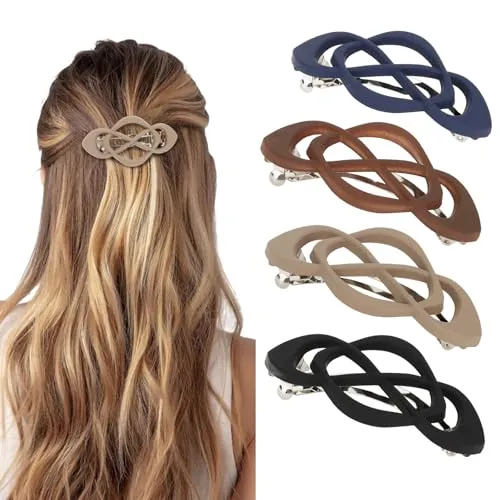
Amariver Vintage French Barrette Clips (4 Pack)
A four-pack of matte-coated French barrettes with a crossover shape and internal metal spring — the archetypal French barrette described in this guide. At roughly 3.
“The vintage crossover shape and internal spring show exactly what a French barrette should feel like...”
We tested dozens of claw clips to find the very best options. Below you'll find our complete ranking, with detailed reviews and real customer feedback for each pick.
The Complete Ranking
Amariver Vintage French Barrette Clips (4 Pack)
“The vintage crossover shape and internal spring show exactly...” — Verified Buyer
A four-pack of matte-coated French barrettes with a crossover shape and internal metal spring — the archetypal French barrette described in this guide. At roughly 3.2 inches they hold a half-up section or a low twist.
“The vintage crossover shape and internal spring show exactly what a French barrette should feel like — secure, flat, and comfortable.”
— Verified Buyer
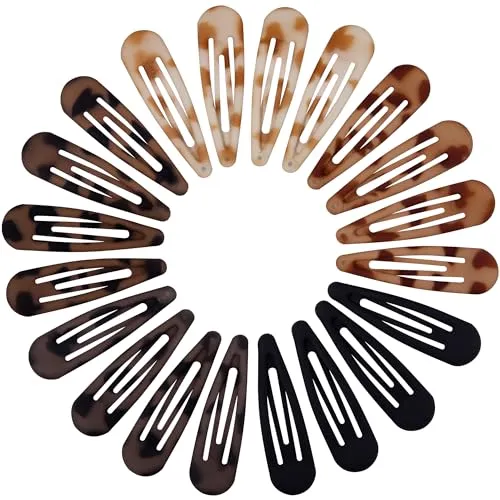
Cptots Small No-Slip Metal Snap Barrettes (20 PCS)
“Fine-haired reviewers say these grip a small section securel...” — Verified Buyer
Small ~2-inch metal snap barrettes in a 20-piece pack — the textbook snap clip (tic-tac) covered in this guide. The water-drop shape and smooth edges pin back bangs, baby hairs, and small sections without bulk.
“Fine-haired reviewers say these grip a small section securely where larger barrettes just slide out.”
— Verified Buyer
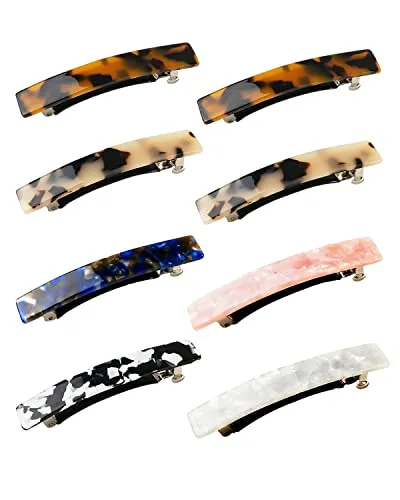
DF DUALFERV Acetate French Tortoise Barrettes (8 Pcs)
“Reviewers call out the quality acetate look and a comfortabl...” — Verified Buyer
An eight-piece set of 3-inch acetate rectangle barrettes with a tooth-shaped grip and metal spring — a clean example of the acetate tortoise style covered in this guide, with a warm depth that molded plastic can't match.
“Reviewers call out the quality acetate look and a comfortable grip that stays put without pinching.”
— Verified Buyer
The vintage crossover shape and internal spring show exactly what a French barrette should feel like — secure, flat, and comfortable.
Quick Comparison
A side-by-side look at our top picks
Frequently Asked Questions
French vs. automatic in one sentence
Which type of barrette is gentlest on hair
Match the barrette to the section, not the outfit

Donna Miller
Enjoyed This Guide?
Get more hair tips and product recommendations delivered weekly.