- Match the barrette to your exact length first
- Style 1: The single side sweep
- Style 2: Double-clipped sides, the half-up you cannot make
- Style 3: Pinning back grown-out bangs
- Style 4: Stacked parallel clips
- Style 5: One side tucked behind the ear
- Style 6: The tiny twisted crown section
- Style 7: The faux half-up on a chin-length bob
- Style 8: A barrette over a low nape twist
- When bobby pins beat barrettes on short hair
- Two comfort notes worth knowing
- What to do next
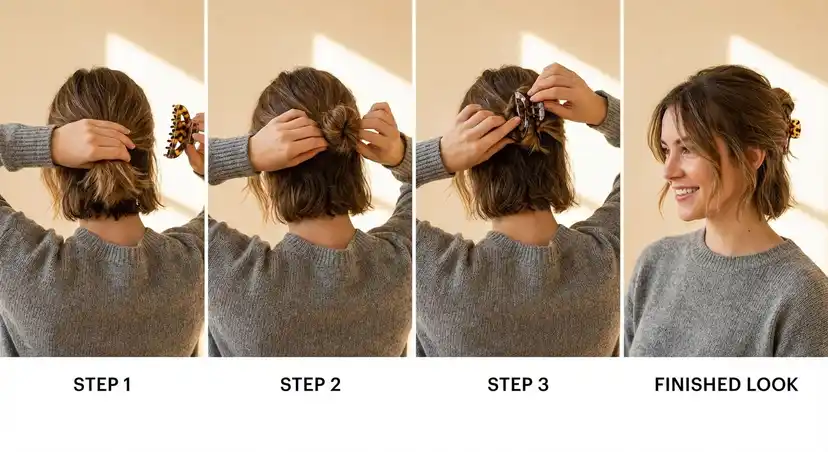
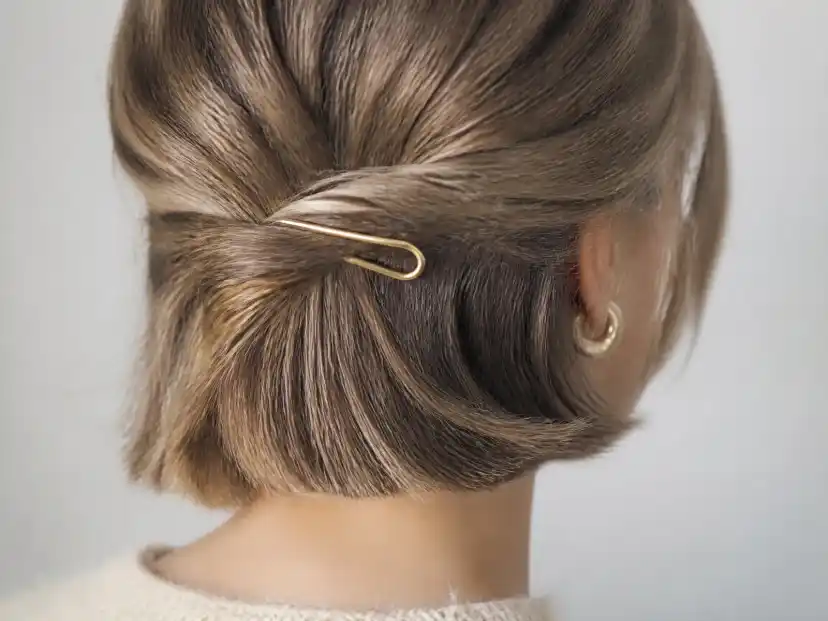
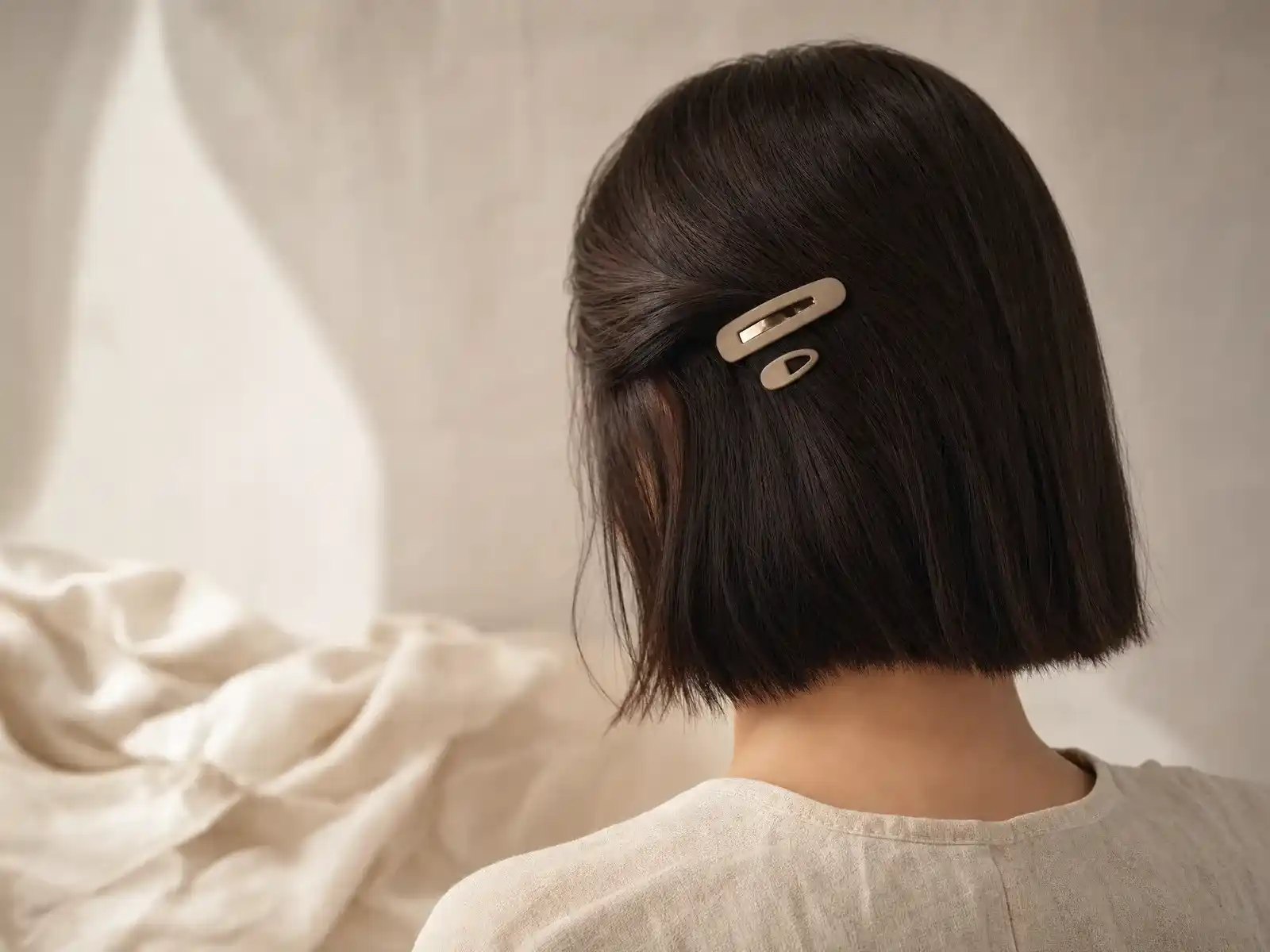
Short hair changes what a barrette is actually doing. Instead of gathering a mass of hair and holding its weight, you are pinning one small section flat against your head. That means a smaller clip, a different anchor point, and a different set of styles. Below are eight that stay put on a pixie, a crop, or a bob.
Best Claw Clips is reader-supported. When you buy through links on our site, we may earn an affiliate commission at no extra cost to you.
Most advice on how to wear barrettes with short hair is long-hair advice, scaled down. It does not scale. A 3-inch clasp needs a section thick enough to fill the space between its two halves, and a pixie has no such section to give it. If you want the groundwork first — clasp types, spring tension, sizing — start with a broader look at hair barrettes, then come back for the styling.
Match the barrette to your exact length first
Readers arrive here knowing precisely which haircut they have, so we will be precise back. These are the four lengths that behave differently, and the clip size we reach for at each.
| Your cut | Usable length | Clip size we use | What holds |
|---|---|---|---|
| Pixie (under ~2 in on top) | 1 to 2 in | 1.5 to 2 in snap clip | Side sweeps, front fringe, single graphic clips |
| Ear-length crop | 2 to 4 in | ~2 in snap clip | Both sides back, stacked clips, one side tucked |
| Chin-length bob | 5 to 7 in | 2 to 2.2 in clasp | Faux half-up, crown twist, asymmetric tuck |
| Grown-out bob (collarbone) | 8 in and up | Up to 3.25 in barrette | True half-up, nape twist, everything above |
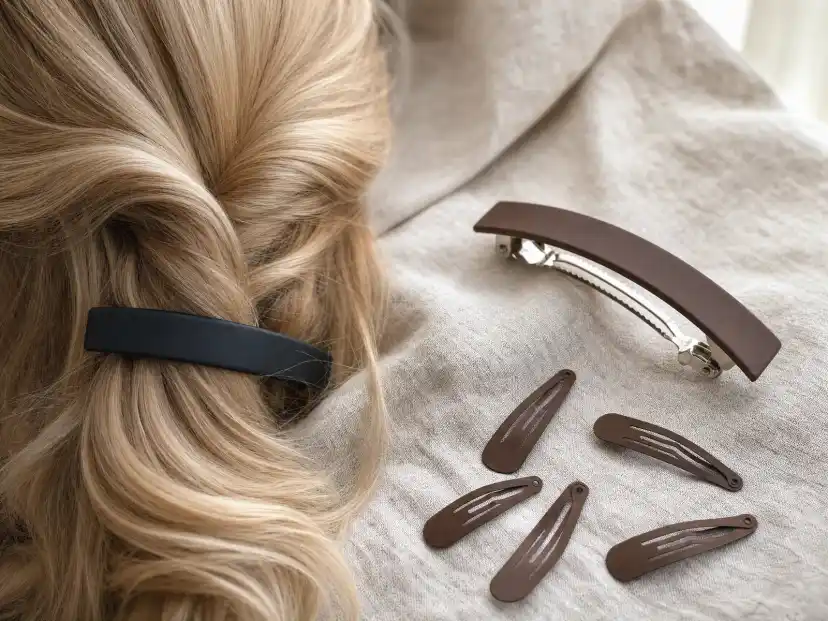
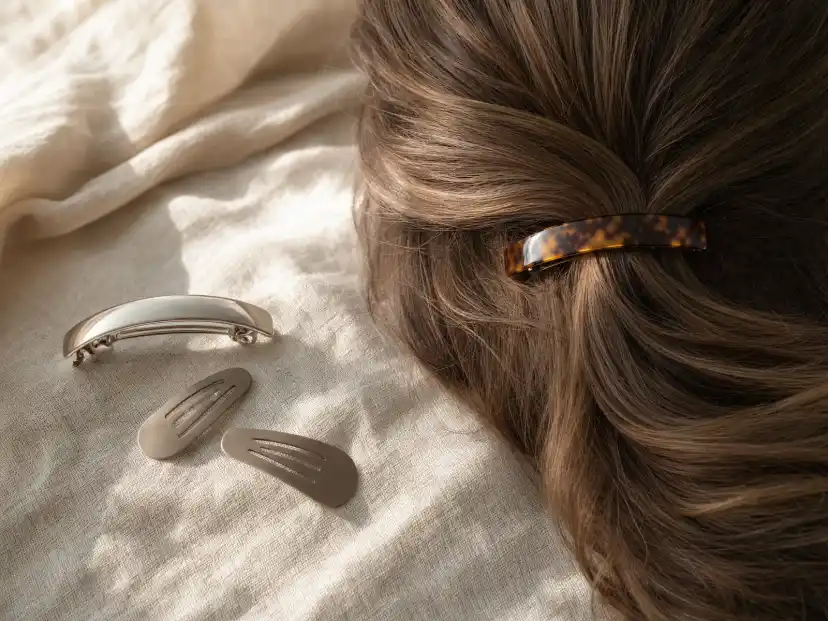
The pattern is simple. Under about four inches, you want the smallest hardware you can find, which is why a set of 1.97-inch snap clips like the Cptots Small No-Slip Metal Snap Barrettes does more real work than one beautiful statement clip. Past the collarbone, a full-size clasp such as the Goody Classic Metal Domed Barrettes starts earning its place again.
One more variable worth naming: your cut is a moving target. According to the StatPearls chapter Physiology, Hair from the NIH National Library of Medicine, scalp hair grows at roughly 0.35 mm per day, about 1 cm per month or 15 cm per year. That is a little under half an inch a month, so a pixie reaches ear-length crop territory in roughly four to six months. Buy for the cut you have, not the one you are growing into.
Style 1: The single side sweep
The one style that works at every length, including a pixie.
- Part deeply on one side, wherever your hair already wants to break.
- Sweep the heavier side back and slightly down, so it follows the curve of your skull rather than standing away from it.
- Set a small snap clip about an inch behind your temple, closing it with the direction the hair falls.
The key detail is depth, not width. Take a thin sheet of hair rather than a wide one — a thin sheet compresses into something the clasp can actually bite, while a wide one flattens into a ribbon and slides free by lunchtime.
Style 2: Double-clipped sides, the half-up you cannot make
On a crop or a short bob there is not enough length to gather a true half-up. Clip each side independently instead and the eye reads it as one.
- Take a section from temple to just above each ear.
- Sweep both straight back and clip them separately, roughly level with each other.
- Check the mirror from behind: symmetry is what sells it.
We keep two clips of the same size in a bag for this. If you have the length for a real gathered half-up, our roundup of barrette hairstyles covers the longer-hair version of this move.
Style 3: Pinning back grown-out bangs
The most common reason anyone buys barrettes for short hair, and the least forgiving placement — everything happens on your face.
- Let the fringe dry in its natural direction before you touch it.
- Push it back and to one side with your palm, not a comb, so it keeps a little lift at the root.
- Clip at the hairline where the fringe meets the rest of the hair, not out in the middle of it.
Clipping mid-fringe leaves a visible hinge where the hair kinks over the clasp. Clipping at the join hides that seam entirely.
Style 4: Stacked parallel clips
Two or three small clips in a row, set parallel with even gaps, turn a plain sweep into a deliberate detail. This is the style short hair does better than long hair, because the clips stay visible instead of disappearing into volume.
- Sweep one side back as in Style 1.
- Place the first clip, then a second about half an inch below it, teeth pointing the same way.
- Stop at three. Four starts to look like a mistake.
Matching finishes matter more than matching colors here. Two mattes read as intentional; one matte and one glossy reads as whatever was in the drawer.
Style 5: One side tucked behind the ear
Asymmetry is the fastest way to make a short cut look styled rather than simply short.
- Tuck the lighter side of your part fully behind the ear.
- Clip immediately behind the ear, low and close to the scalp.
- Leave the other side completely alone.
The skull curves inward behind the ear, which gives the clasp a natural shelf to sit on. In our testing it is the most secure placement available on short hair.
Style 6: The tiny twisted crown section
A small structural detail that adds height where short cuts tend to go flat.
- Take a section about two fingers wide at the crown.
- Twist it a half turn — no more, or it will pull.
- Clip across the base of the twist, letting the ends fan out above the clip.
Keep the twist loose enough to slide a finger under. The American Academy of Dermatology warns that hairstyles that pull can lead to a form of hair loss called traction alopecia, and advises changing the style immediately if you notice pain from tightly pulled hair, stinging on the scalp, or tenting, where sections of scalp are pulled up like a tent. Their rule of thumb is blunt and useful: if the hairstyle feels painful, it is too tight.
Style 7: The faux half-up on a chin-length bob
A true half-up needs enough length for the gathered section to lie down behind the clip. A chin-length bob does not have it, so we fake the silhouette.
- Gather only the top layer, from the crown forward — skip the sides.
- Twist a quarter turn and press the section flat against the back of your head.
- Clip horizontally, close to the scalp, with a 2-inch or 2.2-inch clasp.
The ends will stick up slightly. That is the look, not a failure of the look. A slightly larger plastic clasp such as the AURORA PIN Barrettes for Fine Hair covers more of the section and hides the transition better than a tiny snap clip.
Style 8: A barrette over a low nape twist
Reserved for a grown-out bob at or past the collarbone, where you finally have enough length to twist and secure at the nape.
- Gather everything low at the back of the neck.
- Twist upward once and hold the twist flat against the scalp.
- Set a full-size domed barrette vertically over the twist, catching hair on both sides of it.
Below collarbone length there simply is not enough hair to complete the twist, and a smaller clip will pop open under the tension. This is the one style where the full-size 3.25-inch clasp is the right answer.
When bobby pins beat barrettes on short hair
Be honest about the floor. Under roughly an inch and a half of usable length, a barrette has nothing to close on — the section slides out of the clasp as it shuts. Two crossed bobby pins hold the same wisp with a fraction of the hardware, and they disappear.
We drew that line from testing rather than from a manufacturer spec, so treat it as our rule of thumb. If you are deciding what to keep in the drawer, we put the three tools side by side in barrettes, claw clips, and bobby pins compared. Claw clips are a separate conversation on short cuts, covered in how to use a claw clip on short hair.
Two comfort notes worth knowing
In our experience, metal edges catch short hair more than long hair. Short layers put more cut ends near the clasp, and every cut end may be a chance to snag. If you keep losing strands to a clip, the finish is usually the culprit rather than your technique.
Nickel is a genuine consideration in hair hardware. According to DermNet, nickel allergy is one of the most common causes of allergic contact dermatitis, and everyday items including hair-pins are likely to contain nickel. The American Academy of Dermatology puts nickel allergy at more than 18 percent of people in North America. If a clip leaves an itchy patch on your scalp, a metal-free plastic barrette may be worth trying, and a dermatologist can confirm whether nickel is actually the trigger.
What to do next
Buy small before you buy beautiful. A multipack of sub-2-inch snap clips will teach you more about what your cut can hold in a week than one expensive statement barrette will in a year, and it costs less than lunch.
Then work the list in order: side sweep, double-clipped sides, fringe. Those three cover most days. Add the stacked clips and the crown twist when you want the accessory to be the point rather than the fastener. And when you are ready to think about finishes, spring tension, and materials in more depth, our full guide to choosing the right barrettes for your hair picks up where this one stops.
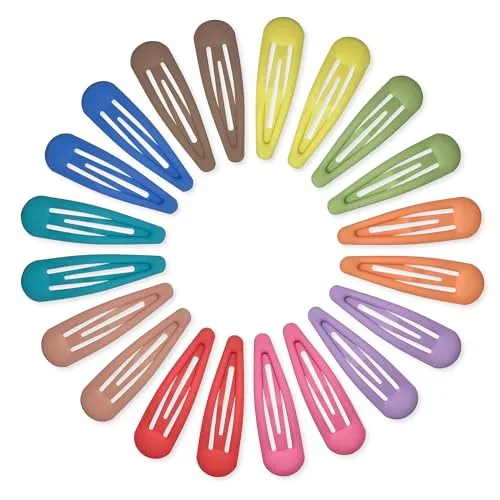
Cptots Small No-Slip Metal Snap Barrettes, 1.97 in (20 PCS)
Twenty snap clips just under two inches long — the size that actually fits a short section. On a pixie or a chin-length bob, a full-size 3-inch barrette has nothing to close around; a 1.
“The maker lists short hair and fine hair among the intended uses, and the water-drop shape sits flat...”
We tested dozens of claw clips to find the very best options. Below you'll find our complete ranking, with detailed reviews and real customer feedback for each pick.
The Complete Ranking
Cptots Small No-Slip Metal Snap Barrettes, 1.97 in (20 PCS)
“The maker lists short hair and fine hair among the intended ...” — Verified Buyer
Twenty snap clips just under two inches long — the size that actually fits a short section. On a pixie or a chin-length bob, a full-size 3-inch barrette has nothing to close around; a 1.97-inch clip does.
“The maker lists short hair and fine hair among the intended uses, and the water-drop shape sits flat enough to disappear into a bob.”
— Verified Buyer
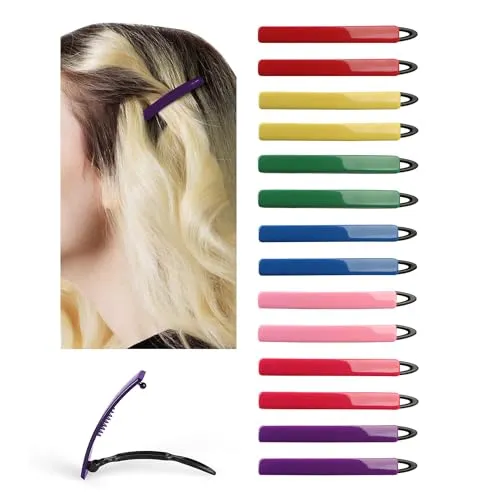
AURORA PIN Barrettes for Fine Hair (14 Pack)
“Being 100% BPA-free plastic with no sharp metal edges makes ...” — Verified Buyer
Handmade Korean 2.2-inch plastic barrettes with no exposed metal. Short layers slip out of hardware more than long hair does, so a 2.2-inch clip with a strong closure hits the useful middle ground between a tiny snap clip and a full-size clasp.
“Being 100% BPA-free plastic with no sharp metal edges makes these a sensible pick if you react to nickel or keep catching short hairs on a metal clasp.”
— Verified Buyer
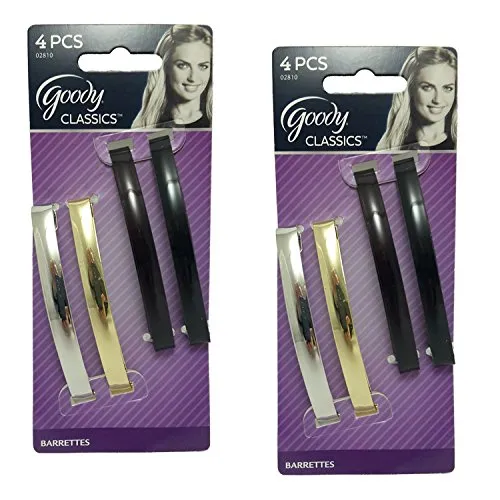
Goody Classic Metal Domed Barrettes, 3.25 in (2 Packs of 4)
“A dependable classic that costs under ten dollars and lies f...” — Verified Buyer
The full-size 3-1/4-inch domed metal barrette, worth keeping once your bob passes the collarbone and a small snap clip stops being enough. The domed edge closes flat and holds a proper half-up section.
“A dependable classic that costs under ten dollars and lies flat enough to wear under a helmet or a hood.”
— Verified Buyer
The maker lists short hair and fine hair among the intended uses, and the water-drop shape sits flat enough to disappear into a bob.
Quick Comparison
A side-by-side look at our top picks
Frequently Asked Questions
The shortest hair a barrette can hold
Why a big barrette fails on a bob
On short hair, placement beats grip

Donna Miller
Enjoyed This Guide?
Get more hair tips and product recommendations delivered weekly.