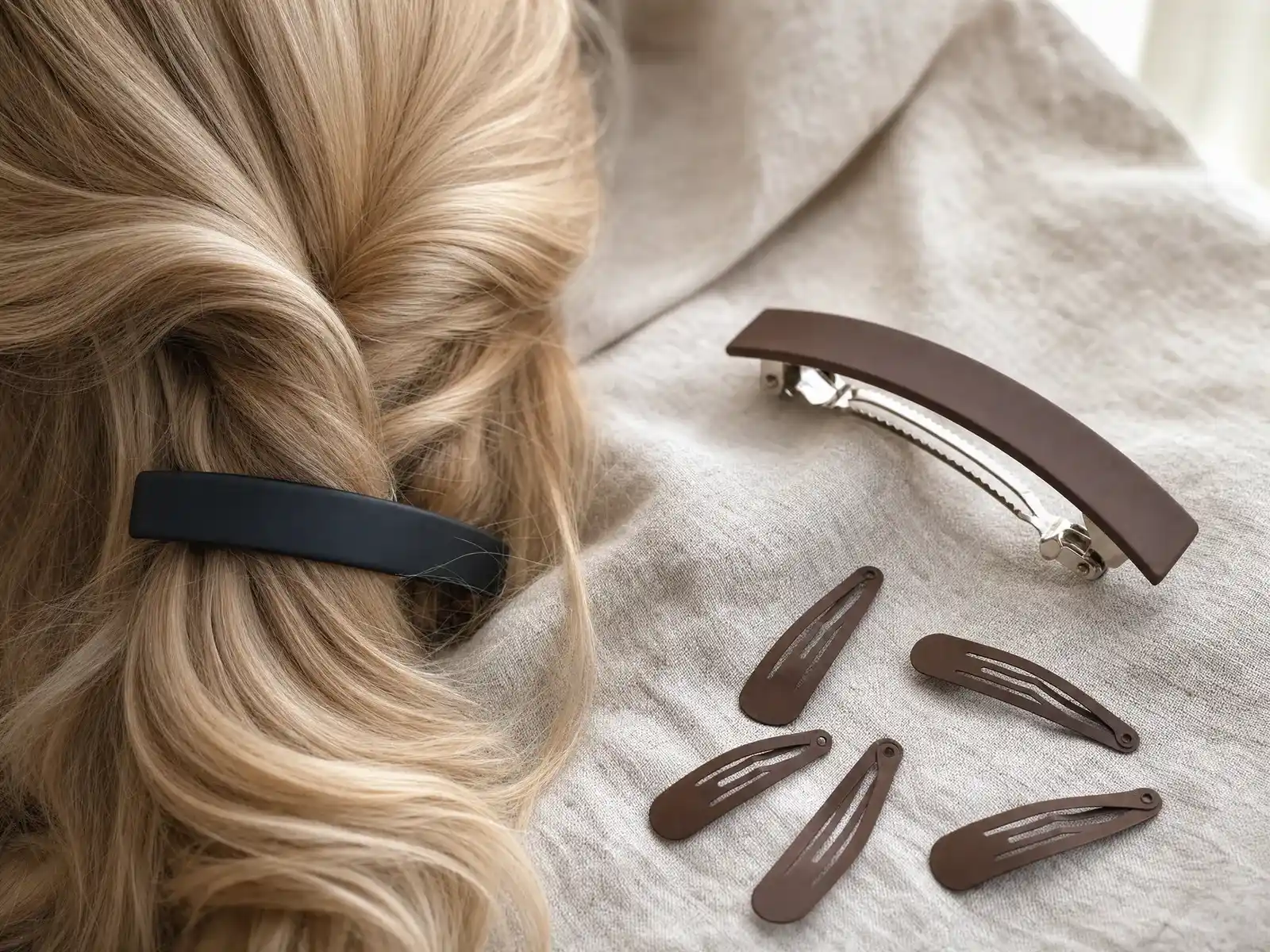
- Fix 1: Match the clip length to the section
- Fix 2: Add grip to freshly washed hair
- Fix 3: Twist or backcomb the section so the clasp has something to close on
- Fix 4: Clip against the direction of hair fall
- Fix 5: Choose a matte or coated finish over a glossy one
- Fix 6: Test the spring — and replace barrettes that will not stay shut
- Fix 7: On fine hair, use two small clips instead of one big one
- Fix 8: Anchor a slippery style with a bobby pin crossed underneath
- How to keep barrettes in place: quick triage
- The bottom line
Barrettes slip out for three reasons, and only three: the clip is the wrong size for the section you put it in, your hair is too smooth for the clasp to bite, or the spring inside the clip has gone soft. Every other explanation is a variation on one of those. Diagnose the right one and the clip stays put.
Best Claw Clips is reader-supported. When you buy through links on our site, we may earn an affiliate commission at no extra cost to you.
In our experience, the most common mistake is not technique at all. It is a mismatch. A 3-inch French clip set into a section meant for a 2-inch snap will slide down within the hour no matter how carefully you place it, because the clasp never fully closes on anything. If you are not sure which clasp style you own, start with the basics of hair barrettes and then come back here.
Below are eight fixes, in the order we would actually try them.
Fix 1: Match the clip length to the section
Most slippage is a sizing error, and it goes in both directions.
Too big is the more common failure. A wide barrette needs a section thick enough to fill the gap between the two halves of the clasp. Put a 3.2-inch French clip on a wispy half-updo and the clasp bottoms out against itself with a thin ribbon of hair rattling around inside. Nothing is gripped. Gravity does the rest.
Too small fails differently. Cram a thick section into a 2-inch snap clip and the spring cannot travel far enough to lock, so it sits under constant outward pressure and pops open on the first head turn.
The working rule we use: the clip should close with a definite click and still have a little tension left in it. If it shuts easily and loosely, size down. If you have to force it, size up or take a smaller section.
There is a hair-health argument too. Every time a clip slides and you yank it back into place, you apply tension to the same strands. According to the American Academy of Dermatology, styles that pull on the hair can cause tension that leads to breakage, and if the tension continues, permanent hair loss can develop. We go deeper on that in are barrettes bad for your hair.
Fix 2: Add grip to freshly washed hair
If your hair barrettes stay put on Wednesday and slide out on Sunday, your wash schedule is the variable.
Conditioner is designed to do exactly the thing that defeats a barrette. According to Tribonet's overview of hair-conditioner tribology, effective conditioning performance is best characterized by the product's capacity to reduce the coefficient of friction and enhance hair lubricity. Lower friction means easier combing and better shine. It also means less for a clasp to hold.
The fix is to add a little texture back before you clip:
- Dry shampoo at the section you plan to clip, not all over. According to WebMD, dry shampoos are made with a base of alcohol or starch that soaks up oil and grease; in our experience that same powder also leaves behind a bit of drag.
- Texture or grit spray, worked into the mid-lengths with your fingers.
- A day of patience. Day-two hair genuinely holds better.
One caution: WebMD also notes dry shampoo is not a replacement for washing, and that experts recommend using it no more than two days in a row. Treat it as a styling aid, not a substitute.
Fix 3: Twist or backcomb the section so the clasp has something to close on
A flat sheet of hair is the hardest shape for a barrette to hold. A rope is the easiest.
Give the section a half-turn or full twist before you set the clip. That converts a wide, thin ribbon into a denser cylinder, which fills the clasp and gives the teeth real volume to close around. One twist is usually enough on a half-up; twist each side separately on a full clipped-back look.
If you would rather not twist, a light backcomb at the base of the section does the same job by tangling strands into a small cushion. Keep it gentle: the AAD advises avoiding pulling and tugging on hair as you brush, comb, or style it, so undo backcombing that evening with conditioner and a wide-tooth comb rather than force.
Fix 4: Clip against the direction of hair fall
This one sounds fussy and is the single biggest technique upgrade most people can make.
Your hair's outer cuticle is a layer of overlapping scales, attached at the root end and pointing toward the tip, like shingles on a roof. Because of that geometry, friction on hair is directional. According to hair-tribology research published on bioRxiv, friction forces on hair are anisotropic due to the overlapping nature of the outer cuticle cells, and friction is much higher when hair is rubbed in the tip-to-root direction, where the cuticles lock together.
Translated to styling: a clasp whose teeth push up the strand meets those raised scale edges and catches. Set with the fall of the hair, it slides along the smooth side of the shingles instead.
So take the section, lift it slightly, and close the clip so its teeth travel toward the scalp rather than toward the ends. For a full walkthrough with placement angles, see how to place a barrette correctly.
Fix 5: Choose a matte or coated finish over a glossy one
Two clips of identical shape can behave differently based on surface finish alone. In our experience a high-gloss lacquered shell gives hair very little to key into, while a matte or soft-touch coating adds enough micro-roughness across the contact patch to slow a section down.
It is the cheapest fix here, because it is a purchasing decision rather than a technique. For slick hair we look for a matte exterior plus long inner teeth: the teeth reach into the section, the matte shell stops the outside of the section from sliding across the clip.
The CENTSTAR French Flat set is the shape we reach for here; the maker describes it as a lay-flat design with a soft-touch matte coating and long inner teeth. The words No-Slip in its name are the maker's marketing claim, not a measured result — what we like is the finish and the tooth length, both of which you can check by touch.
Fix 6: Test the spring — and replace barrettes that will not stay shut
Springs wear out. This is not a hair problem, it is a metals problem.
According to spring manufacturer Tevema, springs lose tension over time through relaxation: when a spring is subjected to continuous load or repeated cycles, the material gradually undergoes plastic deformation, and fatigue from repeated loading and unloading cycles further reduces its ability to withstand stress. A barrette you open and close twice a day runs more than 700 cycles a year.
The 30-second test: hold the clasp closed, then try to pry it open with a single thumb. A healthy clip resists and snaps back with an audible click. A tired one drifts open quietly. If it fails, no amount of dry shampoo will rescue it.
Replace it with a clip whose tension comes from steel rather than the flex of the plastic itself. The Amariver Vintage French clips are the crossover shape we suggest — the maker specifies high-quality plastic with a metal spring under a matte coating, at roughly 3.2 x 1.56 inches.
Fix 7: On fine hair, use two small clips instead of one big one
Fine hair is not simply less hair — the individual strands are physically narrower. According to iRestore's hair-thickness guide, fine hair measures under about 60 microns across, while coarse hair runs above 80. A section of fine hair simply occupies less space inside a clasp.
In our experience the fix is arithmetic, not technology: split the section and use two clips instead of one. Each smaller clasp closes on a denser bundle, and the two together distribute the load so neither does all the work. Set a half-inch apart on a diagonal, they read as intentional styling rather than a compromise.
This is where a bulk pack earns its keep. The PIDOUDOU 2-inch metal snap barrettes come 40 to a bag, which means you stop rationing clips and start using the right number. For a full roundup of clasp styles that suit narrow strands, see best barrettes for fine hair.
Fix 8: Anchor a slippery style with a bobby pin crossed underneath
When a style has to survive a full day, add a second anchor the clip can brace against.
Slide one bobby pin into the section where the barrette will sit, running perpendicular to the way the clip closes, then set the barrette on top of it. The pin creates a small ridge of gathered hair — a physical stop that keeps the whole section from migrating downward.
For a very slick style, cross two pins into an X and clip over the intersection. Ten extra seconds, and in our experience it is the difference between a style that drops by lunchtime and one that holds through the evening.
How to keep barrettes in place: quick triage
| Symptom | Most likely cause | First fix to try |
|---|---|---|
| Clip slides down within an hour | Clip too large for the section | Fix 1 — size down |
| Only happens on wash day | Hair too slick, low friction | Fix 2 — dry shampoo the section |
| Clip pops open | Section too thick, or spring failing | Fix 1 or Fix 6 |
| Holds at first, then creeps | No anchor, hair falling forward | Fix 4 and Fix 8 |
| Nothing has ever held | Fine hair, single wide clip | Fix 7 — two small clips |
The bottom line
Work the list in order. Size first — it fixes most cases on its own. Then friction: texture spray, or a day of unwashed hair. Then technique: twist the section, clip against the fall of the hair, cross a bobby pin underneath. If a clip still fails after all that, test the spring and retire it. A clasp that has lost its tension is a consumable, not a repair job.
A clip that stays put may also be the gentler choice. The AAD warns that styles which pull on the hair can cause tension that leads to breakage, and a clip you are not constantly re-seating is one less thing tugging at the same strands all day.
If you want to go deeper on clasp types, materials, and which shape suits which hair, our full guide to hair barrettes covers the rest.
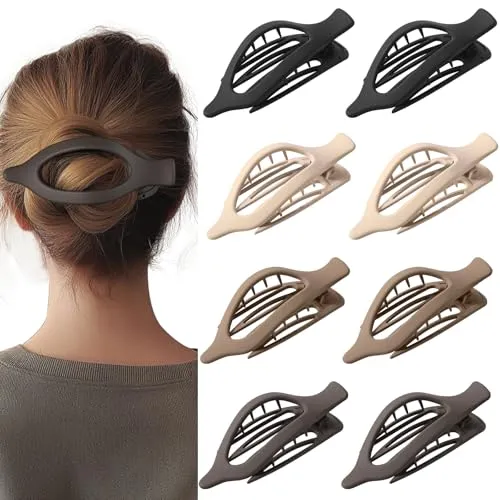
CENTSTAR French Flat No-Slip Barrettes (8 Pack)
A lay-flat French clip with a strong spring and long inner teeth, sold eight to a box in four neutral mattes. The matte coating matters for grip: a glossy shell is the most common reason a clip skates out of clean, fine hair.
“The lay-flat shape means nothing presses into the back of your head when you sit against a headrest,...”
We tested dozens of claw clips to find the very best options. Below you'll find our complete ranking, with detailed reviews and real customer feedback for each pick.
The Complete Ranking
CENTSTAR French Flat No-Slip Barrettes (8 Pack)
“The lay-flat shape means nothing presses into the back of yo...” — Verified Buyer
A lay-flat French clip with a strong spring and long inner teeth, sold eight to a box in four neutral mattes. The matte coating matters for grip: a glossy shell is the most common reason a clip skates out of clean, fine hair.
“The lay-flat shape means nothing presses into the back of your head when you sit against a headrest, and the long teeth reach far enough into the section to actually anchor it.”
— Verified Buyer
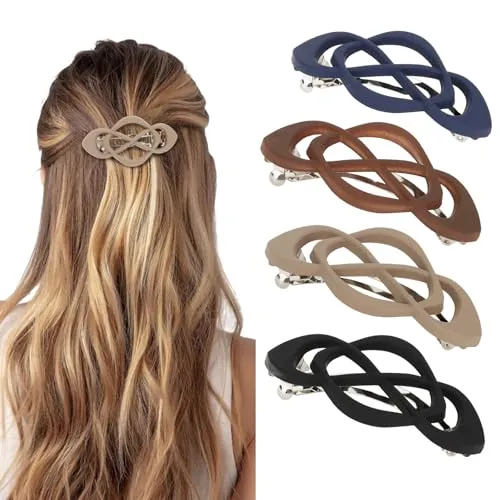
Amariver Vintage French Barrette Clips (4 Pack)
“A real metal spring under the matte shell gives this the kin...” — Verified Buyer
A 3.2 x 1.56-inch crossover-shape French clip with an internal metal spring under a matte coating. When a barrette slips because its spring has gone soft, this is the shape to replace it with — the tension comes from steel, not from friction alone.
“A real metal spring under the matte shell gives this the kind of positive click that tells you the clasp is actually closed.”
— Verified Buyer
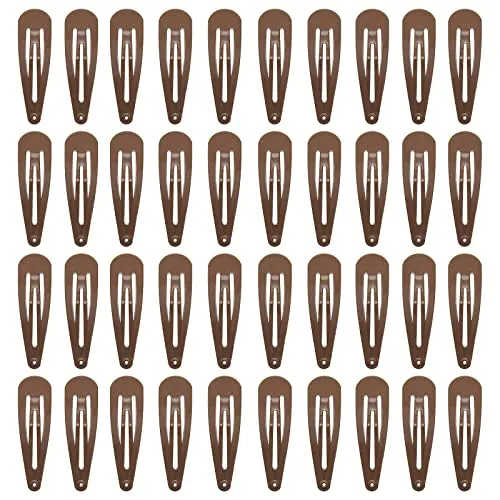
PIDOUDOU Brown Metal Snap Barrettes, 2 in (40 Count)
“The extra-thick coating resists chipping, which keeps the cl...” — Verified Buyer
Forty 2-inch iron snap clips in brown with a thick, chip-resistant painted finish. Buying snap clips in bulk is the practical fix for slippage caused by using one clip where three small ones would hold better.
“The extra-thick coating resists chipping, which keeps the clip from developing the rough spots that snag hair as it ages.”
— Verified Buyer
The lay-flat shape means nothing presses into the back of your head when you sit against a headrest, and the long teeth reach far enough into the section to actually anchor it.
Quick Comparison
A side-by-side look at our top picks
Frequently Asked Questions
The 30-second spring test
Clean hair is the worst hair for barrettes
Two small clips beat one big one

Donna Miller
Enjoyed This Guide?
Get more hair tips and product recommendations delivered weekly.