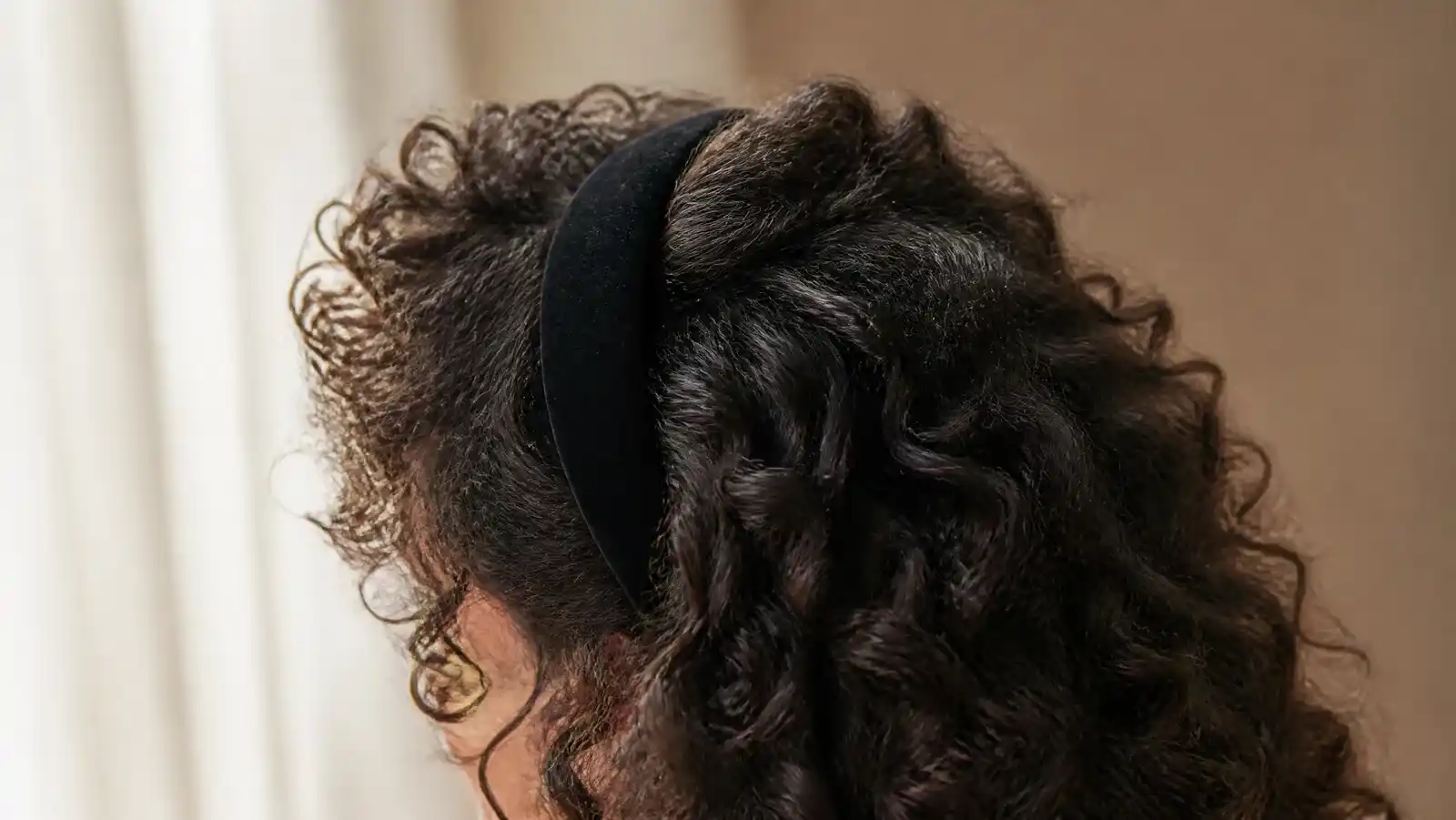
- Why curls defeat a band that works on straight hair
- Teeth versus no teeth on natural hair
- Placement is the whole game for headbands that don't flatten curls
- Width and padding: spreading the crush on coily hair
- Material and friction: velvet grips without teeth
- Wet curls set the dent: the dry-versus-damp rule
- How to rescue a flattened section without rewashing
- Best headbands for curly hair: three no-teeth picks
- What you can and cannot fix
Headbands for curly hair fail in one of two ways: the band skates off the springy outside of your curls, or it presses one line of them flat and leaves a dent you cannot restyle without rewetting. Both failures come from the same geometry, and both get better when you change three things — width, surface and where on your head the band sits. We earn a commission from links on this page, at no cost to you.
Be warned up front: some flattening at the contact line is physics, not a product defect. The realistic goal is controlling where the crease lands, not abolishing it. For the wider category view — widths, shapes, grip mechanisms across every texture — start with our guide to choosing a headband for your hair type. This page is only about curls.
Why curls defeat a band that works on straight hair
Straight hair gives a headband a continuous surface to hold: the band lies against a dense sheet of fibre along its whole arc, and the friction of that contact does most of the work.
A curl pattern is mostly air. The band touches the outer face of a few curl clumps and nothing else, so the contact patch is a fraction of what it would be on straight hair. Less contact means less friction, which is why the instinctive fix is to pull the band tighter — and tightening is exactly what creases the curls.
Then there is spring-back. According to the review of curly hair by Elsabe Cloete, Nonhlanhla Khumalo and Malebogo Ngoepe in Proceedings of the Royal Society A, curly hair fibres exhibit a distinct lag in what they call the toe-region before heeling into elastic deformation, whereas straight hair fibres show immediate elastic responses when load is applied. In plain terms, a curl gives up its coil before the fibre itself begins to stretch. Under a headband that means modest pressure is enough to pull a coil open — and the coil keeps pushing back, levering the band up and away.
The same review notes an inverse correlation between fibre curliness and strength in the African fibres studied, so the tension you add to stop the slipping lands on hair with less to spare. Slip and dent are one problem, not two: add grip the wrong way and both get worse.
Teeth versus no teeth on natural hair
A toothed headband is a comb you wear for eight hours. On straight hair that is an efficient way to grip. On natural hair it is a way to undo your styling.
The American Academy of Dermatology is direct about dry manipulation: avoid brushing your hair while it is dry to prevent your hair from breaking and frizzing. Its detangling guidance for curly hair is the opposite of a headband install — wet the hair thoroughly, apply a leave-in conditioner, then work through it with your fingers or a wide-toothed comb. The AAD also notes that thick, curly hair is more prone to breakage and dryness than other hair types.
Teeth pushed into a dry curl clump do two things at once: they separate the clump into individual strands, which is what frizz is, and they drag on the hairs that catch. You lose the clump definition you spent a wash day building, and you leave short broken hairs behind at the line.
So the first specification to filter on is the absence of a feature: no teeth, no comb, no plastic points. Grip has to come from surface friction and width instead. When you do need to secure one defined section without combing through it, that is a job for pinning curls without dragging teeth through the clump, not for a band.
Placement is the whole game for headbands that don't flatten curls
If you change one habit, change where the band sits.
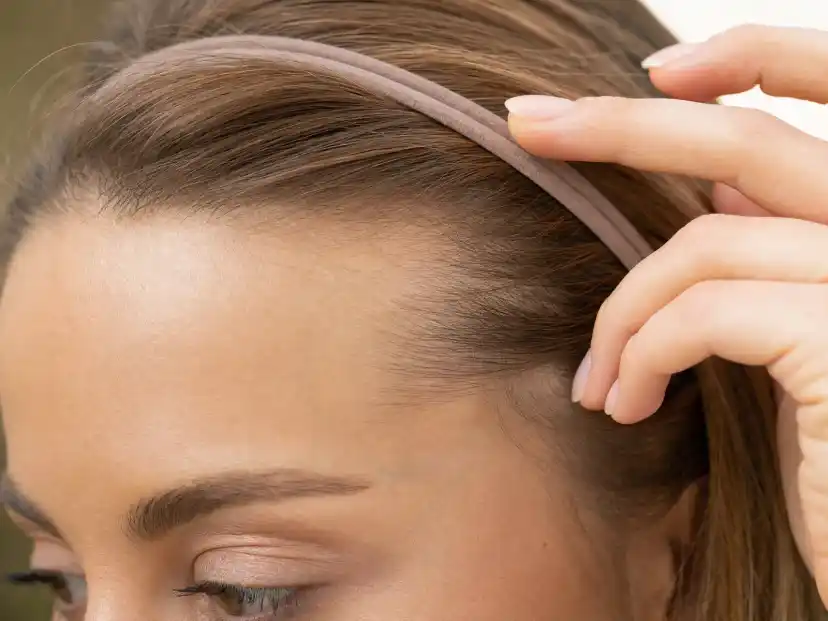
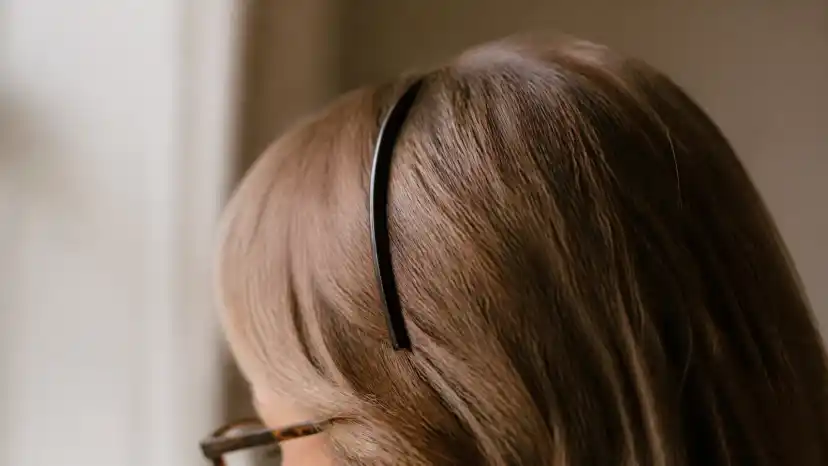
At the hairline, a band does maximum visible damage. The hair there lies flattest, the crease reads as a shiny line, and the face-framing curls — the section you look at most — get pulled straight. Move the band back an inch or two and two things happen: the curls above the band fall forward over the contact line and hide it, and the crease lands in a part of the pattern where a bend is unremarkable anyway.
Then move it again tomorrow. Half an inch of variation may be enough to stop a permanent groove forming, and it lets each strip of curls recover between wears. The AAD advises switching up your hairstyle regularly so hair can recover from tight styles, and the same logic applies at a smaller scale to the line a band occupies day after day.
Placement also fixes slipping in a way tension cannot. Too far forward, a band fights the whole mass of your curls pushing it off the front of your head. Back in the crown, it sits in the widest part of the skull with volume on both sides holding it there. If your hair is shorter and there is not much mass behind the band to lean on, the trade-offs shift — we go through those in what makes a band stay put on a bob.
Width and padding: spreading the crush on coily hair
Pressure is force divided by area, so width decides how hard a given hold presses on any one curl.
A narrow band concentrates its grip into a single line — precisely the shape of the dent you are trying to avoid. A wide band spreads the same force across several curl clumps, and none is creased hard enough to hold the bend. On coily and tightly textured hair, width does double duty, because more surface against the outside of the pattern also means the band holds at a tension that would let a thin one slide.
Our floor for textured hair is about an inch, and wider is better as long as the band is soft. Padding is the other half: a padded band deforms around the curls instead of forcing the curls to deform around it. A hard plastic hoop does the opposite.
The caveat: wide does not mean tight. A wide band that grips hard still leaves a wide dent. Width is what lets you wear it loose.
Material and friction: velvet grips without teeth
The reason velvet keeps coming up in bands sold for curls is that it solves the grip problem without a comb.
Cloete, Khumalo and Ngoepe report that compared with European fibres, African fibres have a higher friction coefficient, alongside higher torsional rigidity and more surface damage in general. High surface friction is usually framed as a problem — it is part of why detangling is harder — but for a headband it is an asset. A textured band against a textured fibre does not need to squeeze to stay in place.
The trade-off is the same property seen from the other side: friction is abrasion. A grippy surface that holds well can also rough up the cuticle at the contact line, especially when the band shifts through the day. That is the case for smoother linings against the hair itself, and for the satin and silk surfaces we cover in smoother fabrics and what they do for hair health.
Velvet, ribbed knit and padded fabric hold. Smooth plastic and satin slide. For the rest of the map, see a breakdown of headband styles by construction.
Wet curls set the dent: the dry-versus-damp rule
This is the mistake that turns a dent into an all-day dent.
Michelle Wong, the chemistry PhD who writes Lab Muffin Beauty Science, sets out the styling cycle as: add water or heat to break hydrogen bonds, change the hair shape, then remove the water or let it cool so new hydrogen bonds form and lock the style into place. Hair dries into the shape it is held in.
A headband pushed onto soaking-wet curls is not resting on your hair. It is setting it. The crease dries in with the rest of your style, and shaking it out later will not rebuild the coil, because the bonds that would have to move have already reformed.
Wait until the hair at the contact line is dry to the touch before the band goes on. Barely damp is a workable compromise on a rushed morning, since residual moisture also means the pattern can be coaxed back later. Soaking is not.
How to rescue a flattened section without rewashing
The same chemistry that sets a dent is what removes it, which means you never need a full wash to fix one.
- Spot-wet only the flattened section. A spray bottle on the crease line breaks the hydrogen bonds holding the flat shape, and the section can be reformed.
- Reshape while it is wet. Rake or twist the clump back into its neighbours, then leave it alone. Handling a curl while it dries is how you get frizz instead of a clump.
- Dry it lifted. Hold or clip the section away from the scalp while it dries so the root has room to spring back rather than drying pressed flat.
- Or hide it. Move the band forward over the crease, change the side of your part, or lift the section with a clip. On a day with no time, a clip that holds a curl clump without crushing it is the faster fix.
What does not work is dry-brushing the dent out. That is the AAD's dry-manipulation warning in action: you will trade one flat line for a frizz halo across the whole section.
Best headbands for curly hair: three no-teeth picks
All three are chosen for the same reasons — no teeth, soft padding, surface friction instead of clamping force. None of them will leave your curls untouched.
The AUDTOPE Velvet Padded No-Teeth Headbands are our pick because of what they leave out. AUDTOPE says the velvet surface creates gentle friction to hold hair without teeth and that the design avoids hair pulling and tangling; that is maker copy, but the construction matches the claim. The useful part is the pack: 0.6, 0.8 and 1.2 inches, so you can find the width your curls tolerate without buying three separate bands. Three for $7.99 as of September 2026.
The Uchyius Wide Velvet Padded Headband is the width play, a velvet-wrapped hoop listed at 5.7 x 6.69 x 1.18 inches. Uchyius states the memory-elastic frame will not leave a dent in hair even worn all day and that the edges and corners do not hurt behind the ears. Read the no-dent line as marketing rather than physics, but the wide padded face is the right shape for spreading a hold across several curls. It is $8.99 as of September 2026.
The DiyJibb Thick Non-Slip Headbands are the rotation buy: a 1-inch padded polyester band, listed by DiyJibb as stretchable and elastic, six to a pack in six colours. DiyJibb markets them as non-slip and long-wear without hair strain, and lists them for curly hair among other textures. Six bands for $8.99 as of September 2026 is cheap enough to keep the placement moving day to day, which is the habit that protects your hairline. The limitation is the width: at a listed inch, it sits at our floor rather than above it.
What you can and cannot fix
You cannot wear a headband on curly hair and leave no trace. Anything that holds is pressing, and anything pressing on a coil flattens it while it is there.
What you can do is make the trace irrelevant. Set the band back from the hairline so the curls above cover the line, move it slightly every day, choose width and padding over tension, let velvet or ribbed knit do the gripping, and never install a band on wet hair. Five habits and one purchase, and the habits matter more.
If your band also hurts, deal with the pressure before the curl pattern — pain is the AAD's own signal that a style is too tight. For everything else about fit and construction, our complete headband guide is the place to go next.
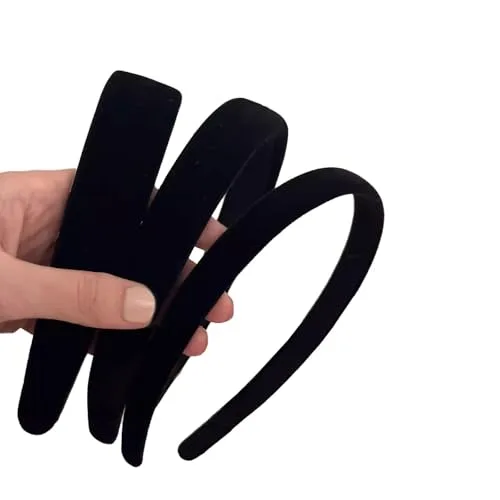
AUDTOPE Velvet Padded No-Teeth Headbands (3 Pack)
No teeth at all, which is the whole point on textured hair — nothing to comb through a curl pattern. Velvet over a padded cushion grips by friction instead, and the pack includes 0.
“No teeth anywhere on it, and the pack covers listed 0.6, 0.8 and 1.2 inch widths — so you can go nar...”
We tested dozens of claw clips to find the very best options. Below you'll find our complete ranking, with detailed reviews and real customer feedback for each pick.
The Complete Ranking
AUDTOPE Velvet Padded No-Teeth Headbands (3 Pack)
“No teeth anywhere on it, and the pack covers listed 0.6, 0.8...” — Verified Buyer
No teeth at all, which is the whole point on textured hair — nothing to comb through a curl pattern. Velvet over a padded cushion grips by friction instead, and the pack includes 0.6, 0.8 and 1.2 inch widths so you can match the band to how much hair you are holding.
“No teeth anywhere on it, and the pack covers listed 0.6, 0.8 and 1.2 inch widths — so you can go narrow where a crease would show.”
— Verified Buyer
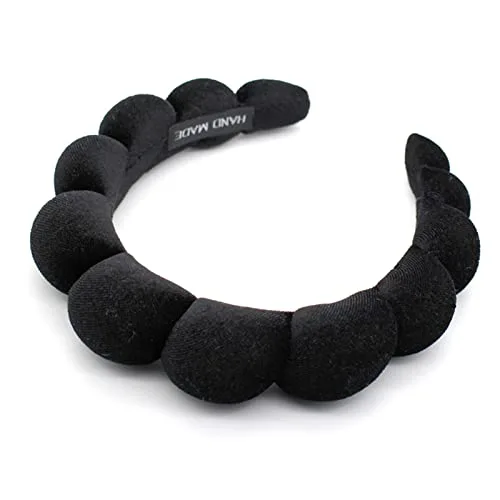
Uchyius Wide Velvet Padded Headband
“According to Uchyius, the memory-elastic frame will not leav...” — Verified Buyer
A wide velvet-wrapped hoop at 5.7 x 6.69 x 1.18 inches. Uchyius says the memory-elastic frame will not leave a dent and that the edges do not press behind the ears — the claim to test if rigid bands have bothered you.
“According to Uchyius, the memory-elastic frame will not leave a dent even worn all day, and the velvet-wrapped edges are shaped not to press behind the ears.”
— Verified Buyer
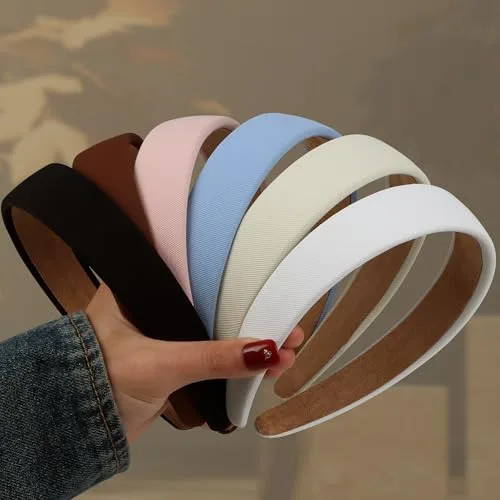
DiyJibb Thick Non-Slip Headbands (6 Pack)
“Six padded bands to a pack, which is enough of a rotation to...” — Verified Buyer
A 1-inch padded polyester band that stretches rather than clamps, six to a pack. Listed for curly hair among others, and cheap enough to keep one at every mirror in the house.
“Six padded bands to a pack, which is enough of a rotation to move the band off the same line of curls each day.”
— Verified Buyer
No teeth anywhere on it, and the pack covers listed 0.6, 0.8 and 1.2 inch widths — so you can go narrow where a crease would show.
Quick Comparison
A side-by-side look at our top picks
Frequently Asked Questions
Some flattening at the contact line is unavoidable
Wet curls set whatever shape they dry in
A painful band is doing more than denting your curls

Donna Miller
Enjoyed This Guide?
Get more hair tips and product recommendations delivered weekly.