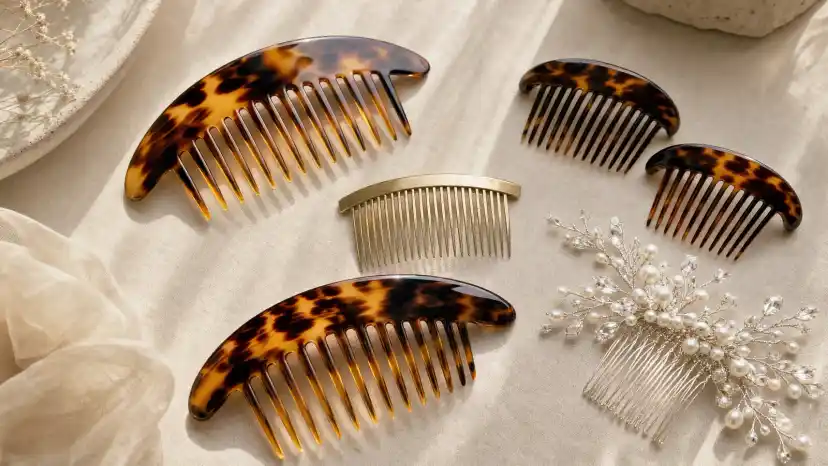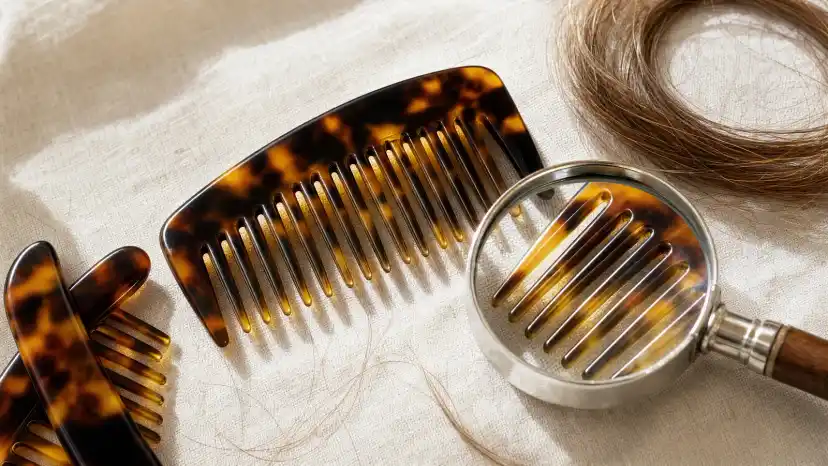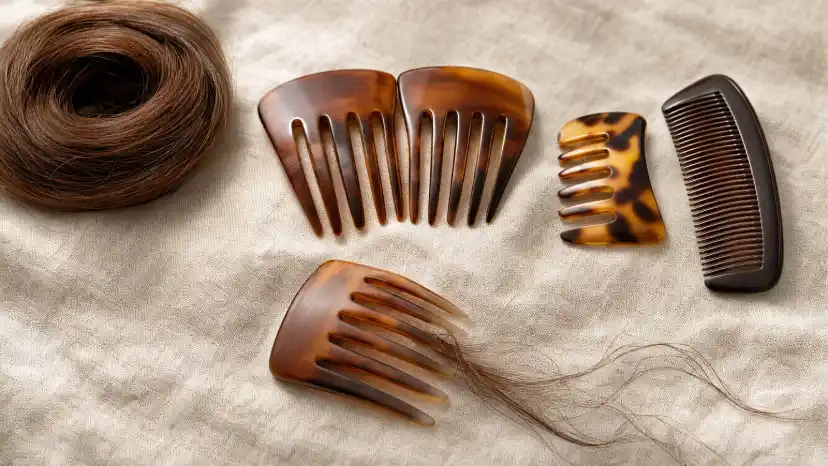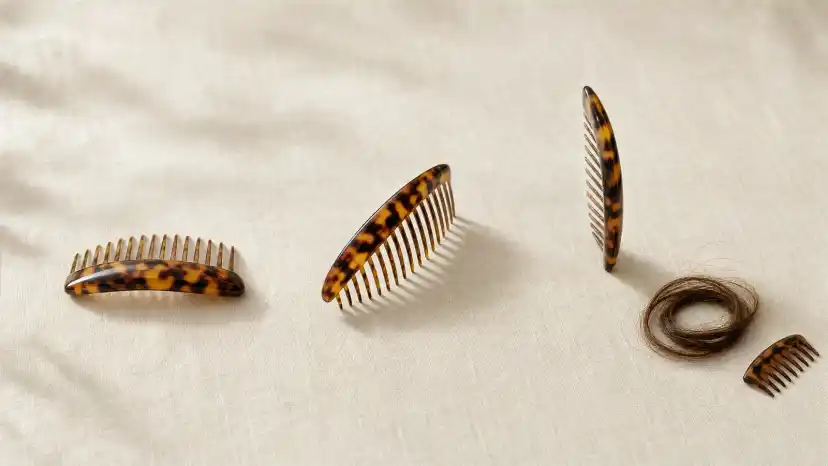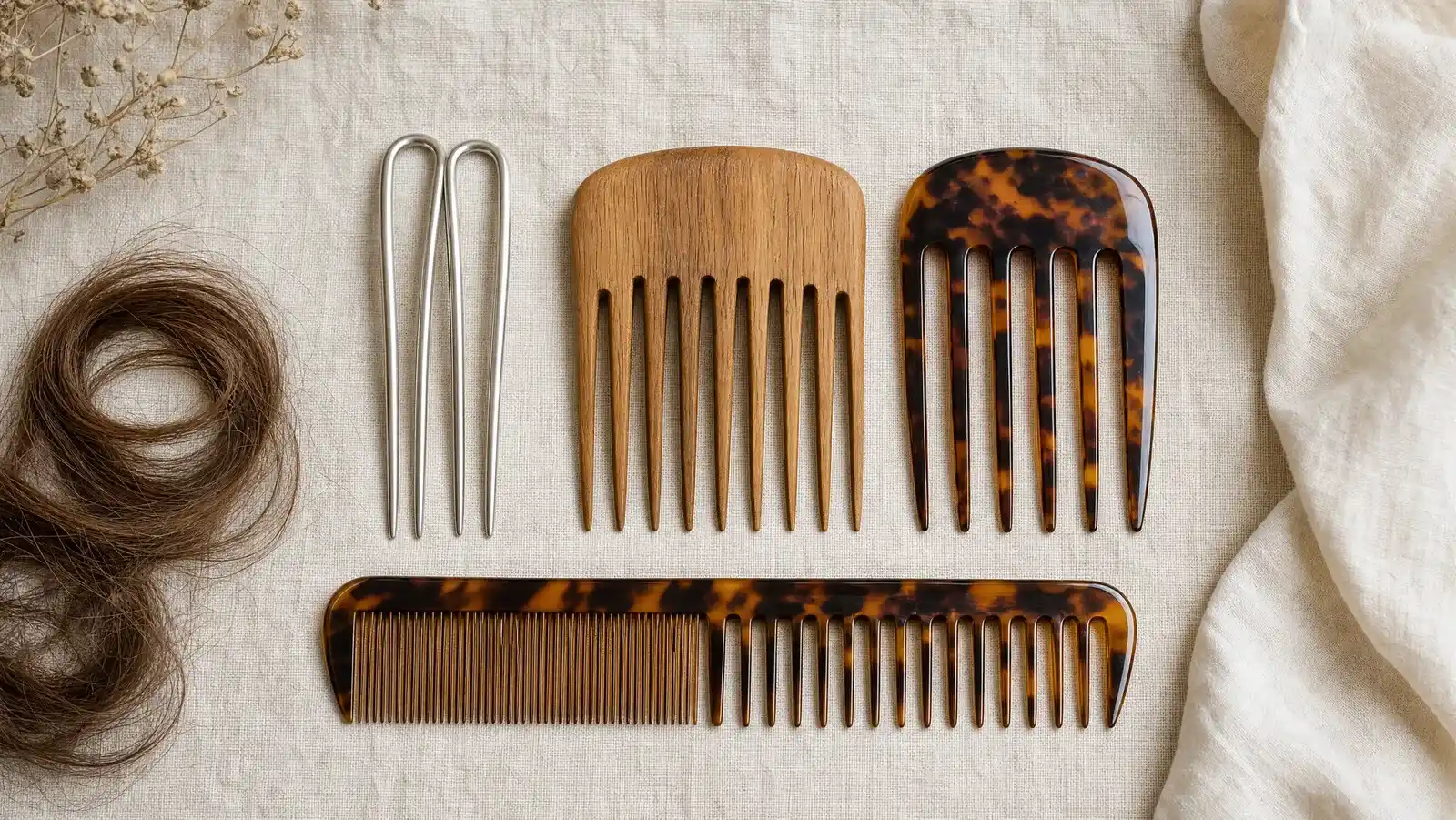
- Ornament or grooming tool? Decide that before material
- Metal decorative hair combs: the thinnest hold, the worst failure
- Wooden combs for hair: warm, quiet, and not waterproof
- Cellulose acetate and the plastic decorative hair combs it gets confused with
- The claims we are not repeating
- Metal vs wooden hair combs head to head
- What we would buy
Metal vs wooden hair combs is really two questions in one search. If you want an ornament that holds a French twist all day, metal gives you the thinnest fork that will not flex. If you want something to detangle with, buy wood or cellulose acetate and leave metal alone. Acetate is the only one of the three that does both jobs well.
Some links below are affiliate links, which means we may earn a commission at no cost to you.
Combs are sold on colour: gold, tortoiseshell, sandalwood. Material is not a finish, though. It sets how thin a tooth can be before it bends, whether the comb fails by bending or by snapping, how much it snags, how much static it kicks up, what it weighs on your head at 5pm, and what you pay. If you want the wider picture on decorative hair comb materials before narrowing to one, start there. What follows is the material argument on its own.
Ornament or grooming tool? Decide that before material
Two very different objects share the word "comb".
- The ornamental comb is a short U-shaped fork or side comb, five to fifteen teeth, worn in a twist or a half-up and expected to hold against gravity for hours. It is jewellery doing structural work.
- The grooming comb is a long dressing comb, usually fine teeth at one end and wide teeth at the other, held in your hand, pulled through wet or dry hair, and judged on one thing: whether it snags.
Material changes sides depending on which you are buying. Alloy is the best ornamental material and a poor grooming one. Wood is a good grooming material and almost never a good ornament. The reason is how the load arrives. A worn comb holds hair under steady, modest tension for hours. A grooming comb hits hair in short bursts.
Those bursts do more than people assume. In a 2006 Journal of Cosmetic Science study of hair breakage during combing, Clarence Robbins found that the size of the broken fragments pointed to breakage happening at or near the hair-comb interface, and that combing more closely resembles impact loading than slow stretching. Whatever your comb's teeth are made of, they are striking your hair rather than easing through it. Tooth finish is therefore not a luxury detail. It is the main event.
Metal decorative hair combs: the thinnest hold, the worst failure
Metal ornamental combs at this price are usually described simply as alloy rather than as steel or brass. The LAPOHI Metal U-Shape Hair Side Combs set is typical of the category: seven pieces in different shapes and sizes, U-shaped fork profiles meant for French twists and low buns, about $8.99 as of November 2026. The maker states that the alloy is smooth and the body is not easy to break. That is a listing description, not a test result, and we would read it as such.
Alloy earns its place on stiffness. A metal fork can be slimmer than an acetate or wooden one and still refuse to flex while it levers hair down into a twist. Slimness is what lets it reach into a small twist, which is exactly what fine or shoulder-length hair produces. Nothing else here competes on that axis.
The same thinness is the catch. Robbins' combing work found that the force per unit area impacted is critical to hair breakage, and that a thinner comb tooth produced breakage in fewer impacts than a thicker one under an identical load. A thin alloy tooth concentrates force. For holding hair that is already sitting still, that is fine and we wear metal combs happily. For dragging through tangles it is the wrong instrument, and no amount of polish fixes it.
Metal also fails in its own particular way. It bends, usually at the curve of the U, usually after being sat on or crushed at the bottom of a bag, and it stays bent. Sometimes you can press it back into line, which is more than wood or acetate will offer you. Against that, alloy is the heaviest of the three for the same amount of comb, and you feel that by late afternoon. Prong stiffness drives the same argument even harder in two-prong accessories, which is why we ran the same comparison for French pins separately.
Wooden combs for hair: warm, quiet, and not waterproof
Are wooden combs good for hair? For grooming, yes, with one condition attached.
The case starts with tooth geometry rather than the timber. The Louise Maelys Sandalwood Wide-Tooth Comb is 7.8 by 2.1 inches with wide-set rounded teeth, a polished finish and an ergonomic handle, about $8.99 as of November 2026. Wide-set teeth are what the dermatology advice asks for. According to the American Academy of Dermatology, hair is delicate when wet, so a wide-tooth comb is preferred over a brush to detangle it, and the AAD's guidance on habits that damage hair tells people with textured hair or tight curls to comb while damp with a wide-tooth comb, tells straight-haired people to let hair dry a little first, and tells everyone to avoid pulling and tugging while brushing, combing or styling.
Wood is also what people buy to escape static. Louise Maelys claims reduced static versus an "average comb", which is the maker talking. Cellulose acetate is widely described as generating less static than petroleum plastics, and wood as generating less still, but we could not find independent testing of static by comb material in any journal or lab source. Our own experience matches the claim. Treat it as plausible, not proven.
The condition on wood is water. According to the US Forest Service Wood Handbook, wood changes dimension as it gains moisture (swells) or loses it (shrinks), moving most in the direction of the annual growth rings, about half as much across the rings, and only slightly along the grain. A comb is a thin piece of wood with long slots cut into it, which is close to the worst possible shape for that kind of movement. Do not soak a wooden comb, do not store it in the shower, and dry it if it gets wet. Unsealed or poorly sanded grain can also roughen with repeated wetting, and a roughened tooth is a snagging tooth. Natural grain and scent vary piece to piece, so the comb that arrives will not match the photo exactly.
Wood is rare as an ornament for a related reason. To be stiff enough to hold a twist, a wooden fork has to be thick, and a thick tooth needs a bigger section of hair to disappear into.
Cellulose acetate and the plastic decorative hair combs it gets confused with
This distinction matters more than metal versus wood.
Cellulose acetate is a plastic. It is not a petroleum plastic. According to Britannica, it is produced by acetylating cellulose, the naturally occurring plant polymer obtained from wood fibres or from the short linters that cling to cotton seeds. The TaShow Cellulose Acetate Wide-Tooth Comb arrives as a 2 pack at 5.9 by 2.36 inches, wide-spaced with smooth rounded teeth and listed as usable wet or dry, about $9.99 as of November 2026. Being happy wet is the thing wood cannot offer.
What separates a good acetate comb from a bad moulded one is how the teeth were formed.
- Saw-cut from sheet, then polished. Kent's listing for the Kent 16T Tortoise Dressing Comb describes exactly this: a 7.2 inch double comb, fine teeth at one end and wide teeth at the other, saw-cut from sheet cellulose acetate rather than moulded, then hand polished and buffed to rounded teeth. It is about $9.99 as of November 2026. Kent's own heritage page says the company was founded in London in 1777 and has held a Royal Warrant through nine consecutive serving monarchs, which tells you about longevity rather than about your cuticle.
- Moulded in a cavity. A moulded tooth can carry a parting line or ridge where the two halves of the mould meet, and a ridge at the point of contact is what catches a cuticle. Camila Paris, which makes acetate side combs, says in its own listings that its combs are hand made from a cellulose acetate sheet, and that other materials have small ridges on each tooth that can easily damage hair and cause breakage. That is a seller's claim about rival construction rather than an independent finding, but it describes a real difference in manufacturing.
The test costs nothing and takes twenty seconds. Run a fingernail up the inside edge of a tooth, then across the tooth tip. Polished saw-cut acetate feels like one continuous curve. A cheap moulded comb catches your nail at the same place on every tooth, and that place is the seam. Do the same check along the spine where the teeth meet it, which is where moulding flash collects. The same split runs through clips, and we tested it there in acetate versus plastic in claw clips.
Acetate's weaknesses are heat and solvents rather than water: the CAMEO materials database maintained by the Museum of Fine Arts, Boston lists cellulose acetate as soluble in acetone, phenol and chloroform, and notes that it degrades in sunlight, heat and high humidity. In our experience it snaps rather than staying bent when it goes. On price it sits level with the others at this end of the market: all four combs here are under ten dollars.
The claims we are not repeating
Both the Kent and the TaShow listings state that their combs help stimulate hair follicles, improve blood circulation and reduce hair loss. We are flagging those as marketing claims rather than facts. We searched for supporting evidence and found none, and the AAD's own hair-damage guidance is about handling, tension and tool choice rather than about stimulation. Buy either comb because its teeth are smooth and well spaced. Do not buy one as a treatment for hair loss, and if you are losing hair, that is a conversation for a dermatologist rather than a comb purchase.
Metal vs wooden hair combs head to head
- Fine or slippery hair. Metal to wear, because a slim alloy fork fits a twist that has barely any volume in it. Acetate to groom with, because its teeth can be rounded and polished without being thick.
- Thick or heavy hair. Wood to groom with, since wide-set teeth part a dense section instead of forcing it. Metal to wear, since an alloy fork will not splay when the weight of the hair tries to open it.
- All-day wear. Acetate. It is lighter than alloy for the same bulk, and it reaches skin temperature rather than sitting cold against the scalp. That gap widens over a long event, which is where we take it up in how material choice plays out for a wedding comb.
- Wet detangling. Acetate, every time. Wood should not live in the shower and metal has the wrong tooth profile for hair at its most fragile.
- Static on a dry day. Wood first, acetate second, moulded plastic last, on the strength of maker claims and our own use rather than measurement.
- How it dies. Metal bends and can sometimes be bent back. Acetate and wood break outright. In our experience all three outlast a cheap moulded comb, whose teeth roughen.
One rule overrides the material table. The AAD lists pulling your hair back tightly, such as in a ponytail, bun or cornrows, among the habits that damage hair, and says that if we continue to damage our hair, we may eventually see thinning hair or even bald spots. A sandalwood comb twisted brutally tight is likelier to do you harm than an alloy one worn loosely.
What we would buy
Buy one comb to groom with and one to wear, and buy them in different materials.
To groom with, buy the Kent 16T at about $9.99 as of November 2026. Saw-cut and hand polished is the construction that decides whether a comb snags, and the fine-plus-wide double head covers both ends of a routine. If your hair is thick, coarse or curly and you detangle wet, buy the TaShow 2 pack instead at about $9.99 as of November 2026 and keep one comb in the bathroom. If you detangle dry and want the warmest tool in the hand, the Louise Maelys sandalwood comb at about $8.99 as of November 2026 is the one, as long as you keep it out of the water.
To wear, buy alloy, and buy a mixed set rather than a single comb while you work out which profile your hair takes: the LAPOHI 7 pack at about $8.99 as of November 2026 gives you seven shapes for the price of one. Full placement technique, sizing and shape advice sits in our complete decorative hair comb guide.
If you only want to spend ten dollars today, spend it on the Kent. A grooming comb touches your hair every single day, and a seam on a tooth costs you more over a year than any ornament will.
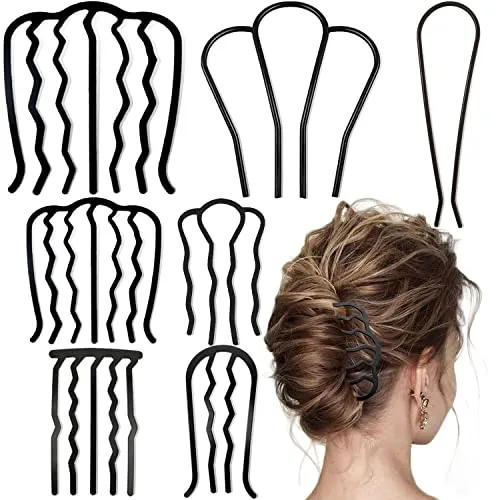
LAPOHI Metal U-Shape Hair Side Combs, 7 Pack
Seven alloy U-shaped forks in different shapes and sizes, which is the cheapest way to find out which metal profile your twist actually needs. Buy these to wear, not to detangle with.
We tested dozens of claw clips to find the very best options. Below you'll find our complete ranking, with detailed reviews and real customer feedback for each pick.
The Complete Ranking
Seven alloy U-shaped forks in different shapes and sizes, which is the cheapest way to find out which metal profile your twist actually needs. Buy these to wear, not to detangle with.
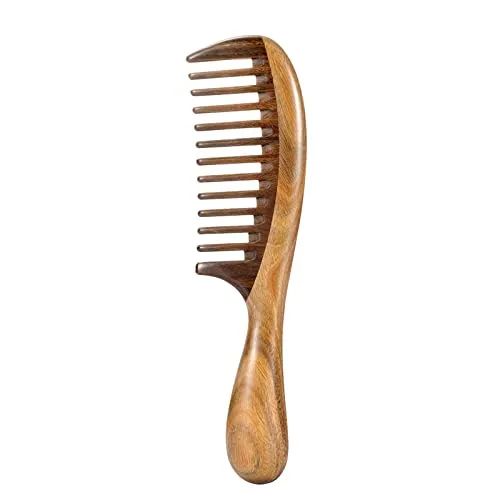
A 7.8 by 2.1 inch sandalwood comb with wide-set rounded teeth and a handle, which is the tooth geometry dermatologists ask for on wet or textured hair. Keep it out of the shower.
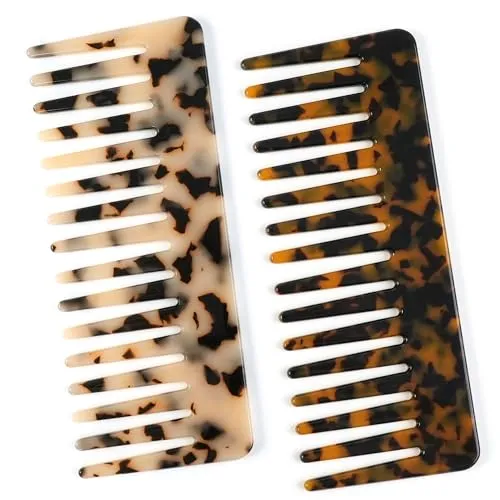
Two 5.9 by 2.36 inch combs in plant-derived cellulose acetate, wide-spaced and listed as usable wet or dry. The pack of two means one can live wherever you actually detangle.
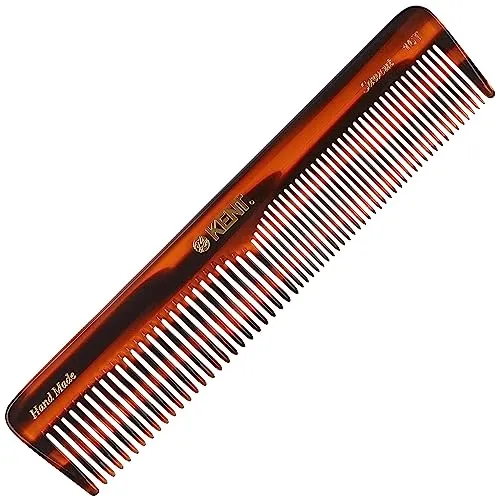
A 7.2 inch double comb with fine teeth one end and wide teeth the other, saw-cut from sheet acetate and then hand polished rather than moulded. That construction is the whole argument of this article.
Quick Comparison
A side-by-side look at our top picks
Frequently Asked Questions
Are wooden combs good for hair?
Do metal hair combs damage hair?
Is cellulose acetate the same as plastic?

Donna Miller
Enjoyed This Guide?
Get more hair tips and product recommendations delivered weekly.