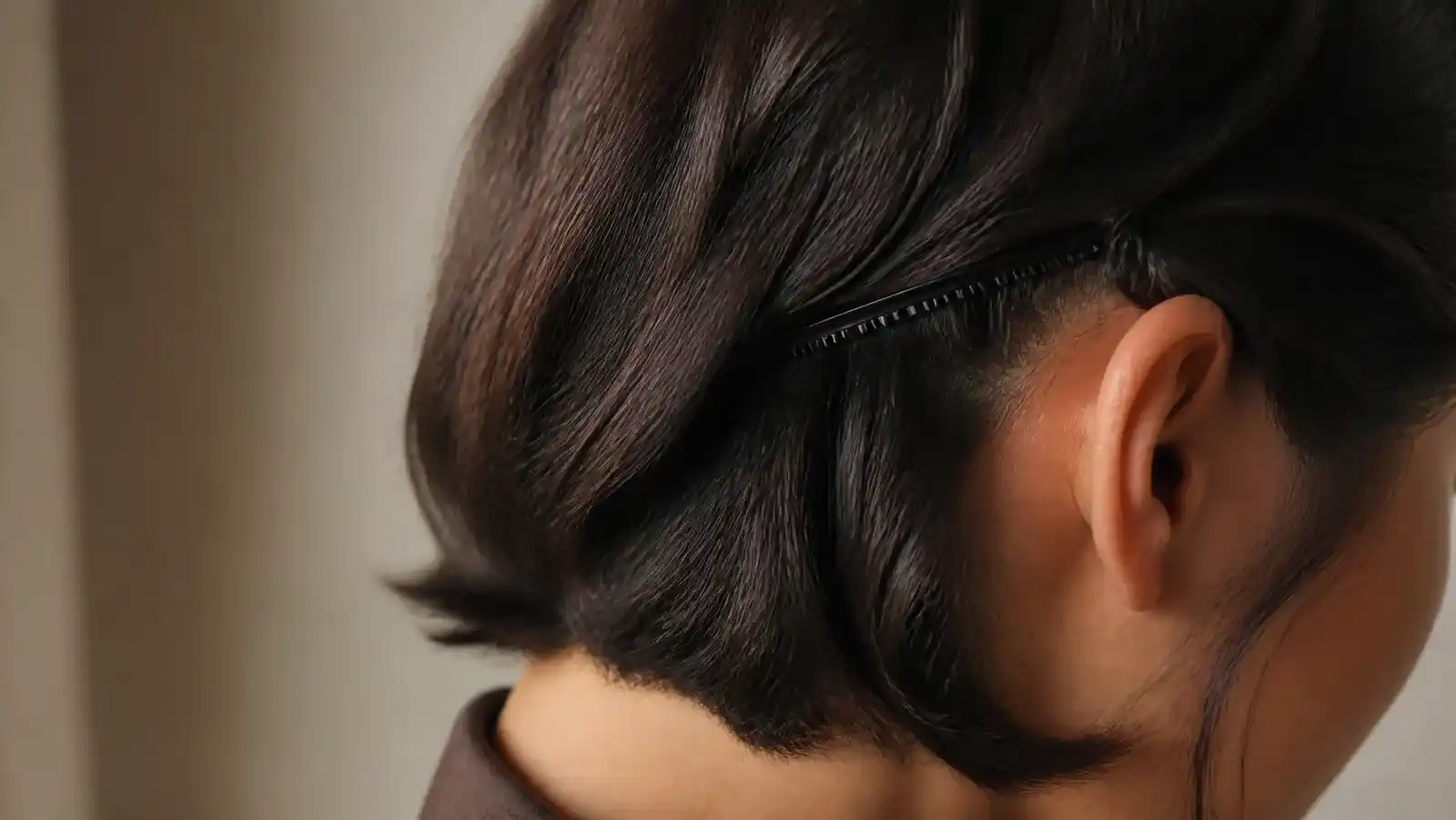
- Why a headband slides off short hair
- Headbands for women with short hair usually need teeth
- Width is a proportion problem, not just a comfort one
- Bob, lob or pixie: what will actually hold
- How far back to place it, and why pushing it back guarantees slip
- The flip-and-tuck that hides the front edge
- What to do with the ends that stick out at the nape
- Two more bands worth knowing about
- When a band is the wrong tool entirely
- The short version
Headbands for short hair have to hold mechanically, with teeth or a comb edge, because there is not enough hair below the band for friction alone to grip. That is the whole answer. A smooth fabric band needs a long column of hair to press against, and a bob gives it two or three inches, so the band walks up the back of your head and eventually clears it. We earn a commission from links on this page, at no cost to you.
Below: why short hair defeats a friction band, how wide a band should be on a bob, where to place it, and the two small tricks that hide the front edge and deal with the ends at the nape. If you want the wider view first, our pillar guide to the best headbands for different hair types covers widths, materials and shapes across the category. This page is only about short lengths.
Why a headband slides off short hair
A headband is a hoop under tension, and a hoop under tension migrates toward the smallest circumference it can find. On a human head, that is up and back, toward the crown. Hair length does not change that force at all. It only changes what resists it.
On long hair, three things resist. There is a thick column of fibre sitting under the band's lower edge, which means a large contact area. There is weight below the band. And the band ends up gripping hair against hair, not hair against plastic.
On a bob, the band's lower edge lands close to the ends. Below it there is an inch or two of hair, almost no mass, and a fraction of the contact area. Same upward force, far less holding it back. So the band walks: every nod and tilt moves it a step toward the crown, until it is over the high point and off.
Friction direction matters here too, and not in the way you would guess. According to the 2025 review of hair friction by Erik Weiand and colleagues in Advances in Colloid and Interface Science, hair shows anisotropic friction because the protruding edges of the cuticle can interlock when something slides toward the root. A band travelling upward is moving in the grippier direction, and it still gets away. That is the tell: the problem is not how slippery each hair is, it is how few of them are in contact.
The same review notes that hair friction rises as the protective 18-MEA layer on the surface is lost, a loss accelerated by bleaching, colouring, heat styling and brushing. Which is part of why a freshly washed, conditioned, smoothed bob is the hardest case of all. The surface you have just spent twenty minutes perfecting is the surface the band needs to catch on.
Headbands for women with short hair usually need teeth
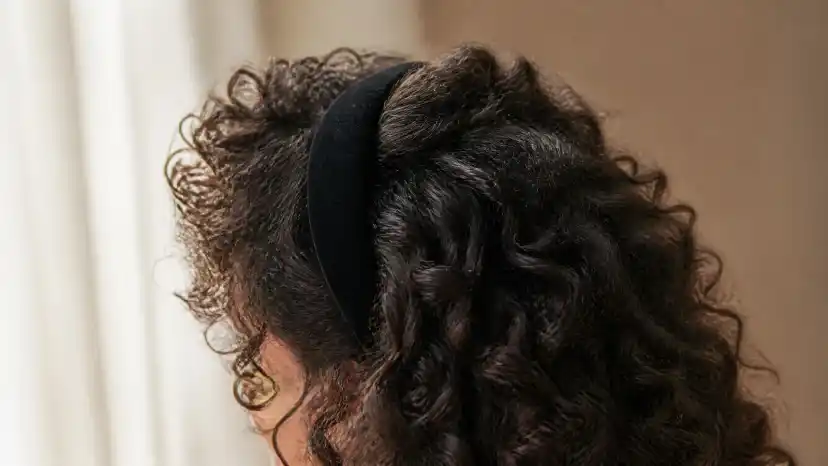
This is the point where our advice flips. On curly hair we argue the other way round, because teeth snag, split the curl pattern and leave a visible dent, and a wide smooth band is generally the better tool. That case is worked through in headbands for curly hair. Short hair inverts it.
When there is not enough fibre for friction to work with, you need a band that physically hooks into the hair rather than resting on top of it. A comb of teeth enters the hair closer to the roots, where the density is, and holds by interlocking. A smooth arc can only hold by pressing. On short hair, teeth are closer to a requirement than a preference, and anyone telling you otherwise has probably not tried a satin band on a chin-length cut.
Two honest costs. Teeth funnel the band's force into a row of hard points a millimetre or two wide, which is the most reliable way to give yourself a headband headache: the International Classification of Headache Disorders, code 4.6.1, defines external-compression headache as headache from sustained compression of the pericranial soft tissues, naming a tight band around the head as an example, and notes that it happens without any damage to the scalp. Teeth also drag at the hairline, and the hairline is exactly where the American Academy of Dermatology says to look for trouble: it lists broken hairs around the forehead and a receding hairline among the signs of traction alopecia in styles that pull.
So: teeth, but worn loose, and not the same band in the same position every single day.
Width is a proportion problem, not just a comfort one
On long hair, width is mostly about pressure. Once your hair is short it is also about how much of your hair the band is covering.
Run the proportions: on a chin-length bob there are only a few inches of hair between crown and jaw. A two-inch band set across the top takes a large share of everything visible, and the result reads as headgear rather than as a hair accessory. The same band on hair past the shoulders is a detail.
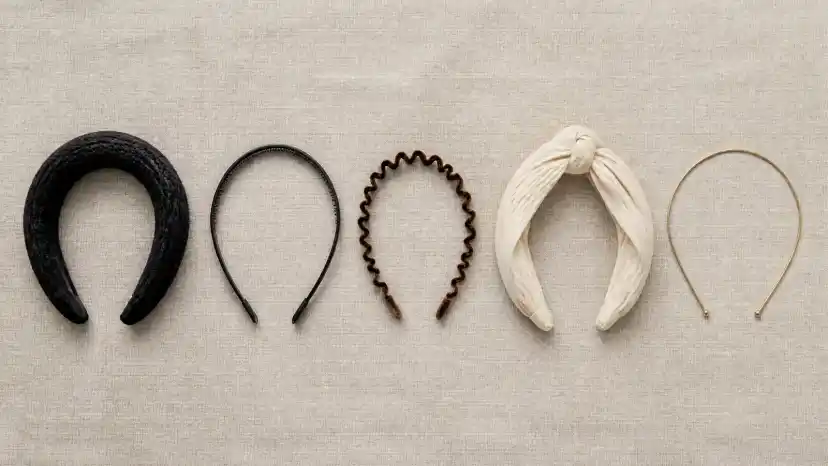
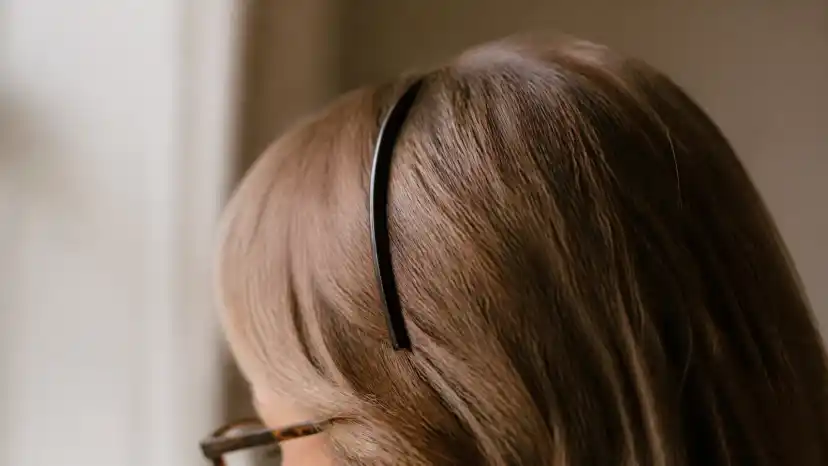
Our default on short hair is narrow to medium: roughly half an inch to an inch. Go wider only when you want the coverage for a reason, such as disguising a fringe in an awkward stage or a regrowth line.
That is the argument for the Duufin twelve-pack. Duufin lists them at approximately 1cm, or 0.4 inch, wide with a diameter of about 12cm, and at that width the band sits as a line rather than a panel. Twelve colours for $9.99 as of September 2026 also means you can afford to find the one that vanishes into your own hair colour, which matters far more at this width than at three inches.
If you want the shapes compared rather than the widths, the main headband shapes sets out which builds hold and which only decorate.
Bob, lob or pixie: what will actually hold
These are three different mechanical problems, not three lengths of the same one.
A lob, at or below the collarbone, is almost a long-hair problem. There is enough fibre below the band for friction to do real work, so a wide padded band can hold, and teeth become optional.
A classic chin-length bob is the case this article exists for. Teeth, narrow, and placed carefully. Expect to reset it once or twice a day rather than never, because your ends are short enough to slide out of anything.
A pixie is where a band can stop being the right answer. If the hair at your temples and nape is an inch or two long, a comb has very little to bite, and the band ends up held by tension against your skull alone. That is the setup that produces the pressure line and the ache, and no grippier band fixes it.
One thing worth knowing if you are growing out of that stage: hair grows slowly. The review of hair and scalp disease by Hans Wolff and colleagues in Deutsches Ärzteblatt International puts growth at about 0.3mm a day, or roughly a centimetre a month. The gap between a pixie and a bob is closer to a year than a season, so buy for the hair you have.
How far back to place it, and why pushing it back guarantees slip
Most short-hair slip is a placement error rather than a product error.
Set the band on the flat of the crown, roughly an inch behind your hairline, where the skull is still rising or level. Past the high point, the surface starts falling away toward the nape, and a hoop on a falling surface has both geometry and its own tension pulling it backward off your head. The further back you push it, the shorter the distance it has to travel before it is gone.
The instinct works against you, because pushing the band back does make it feel more secure. That feeling is tension, not position: the head is narrower back there, so the band grips harder, in the worst possible place. Bring it forward, accept that it feels looser, and it will stay longer.
If your band slides no matter where you set it, the problem is probably its surface rather than your placement, and how to stop a headband sliding back works through texture and tension separately.
The flip-and-tuck that hides the front edge
Short hair makes the front edge of a band obvious: there is not much hair in front of it to soften the line. The fix takes five seconds.
Set the band where you want it. Then lift a small amount of hair from just in front of the band with your fingertips and let it fall forward over the edge. You are hiding the hard line, not restyling, so a half-inch of hair is plenty.
On a bob this does a second job. A band flattens the crown, and pulling a little hair forward over the edge lifts the roots back up at the front, which is the part anyone looking at you actually sees.
What to do with the ends that stick out at the nape
Short hair pushed back by a band has nowhere to go, so the ends fan out below it. Three workable answers, in the order we would try them.
Tuck the sides behind your ears, which shortens the visible fan. Cross two pins at the nape to hold the ends flat against the hair underneath. Or leave it, because a short piecey nape is a look and a band pushed over the top of it is not automatically untidy.
The one response that reliably makes things worse is tightening the band to flatten the ends. It does not flatten them, and you have just added force to the row of teeth.
Two more bands worth knowing about
The JJUNW Toothed Plastic Headbands are our pick because they are the cheapest honest version of the mechanism above: a lightweight plastic frame with a comb of teeth. JJUNW describes the teeth as precision-placed for a firm, non-slip grip, which is maker copy, but comb geometry is the correct geometry for short hair. Four bands for $5.99 as of September 2026, which matters because a band you have four of is a band you wear.
The AUDTOPE Velvet Padded No-Teeth Headbands are the exception to the teeth rule, for hair that snags or a hairline that is already thinning. AUDTOPE describes the velvet surface as creating gentle friction to hold hair without teeth and says the build avoids pulling and tangling. The pack covers a listed 0.6, 0.8 and 1.2 inch, so you can start at the narrowest, which is usually right on short hair. The trade is honest: without teeth on a bob, you will be resetting it. Three bands, $7.99 as of September 2026.
When a band is the wrong tool entirely
If teeth cannot find purchase, or the band only stays put at a tension that leaves a pressure line, stop shopping for headbands.
A claw clip holds by clamping a section between two jaws and twisting it against the hold, which works on far less hair than a band needs, and the small sizes are genuinely usable on a bob. We went through the sizing in claw clips sized for a bob, and the claw-clip technique for shorter lengths covers the twist itself.
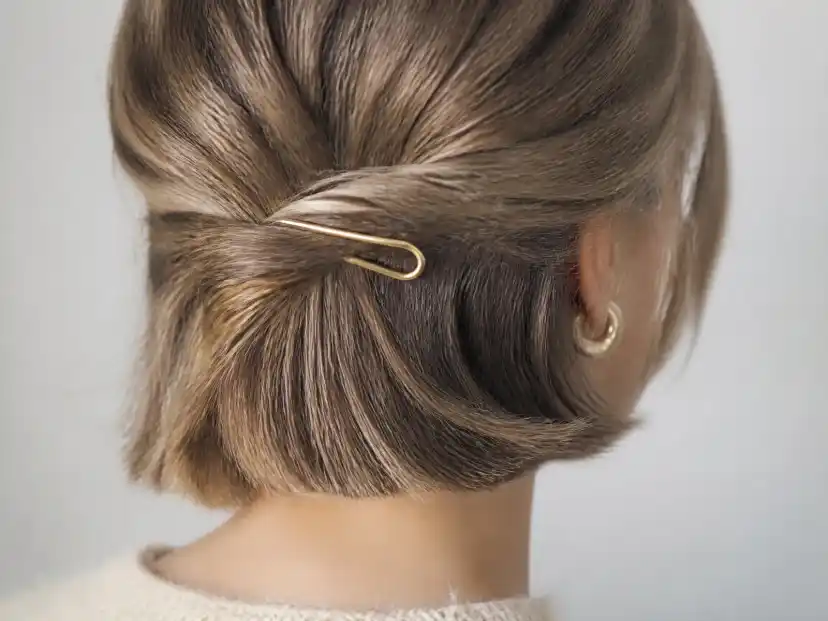
A single pin does something a band cannot do at all: it holds one section without touching the rest, so your hairline stays out of it completely.
The short version
Teeth, narrow, forward. Short hair does not give a band enough fibre to grip by friction, so you need a comb edge that hooks in instead; a bob does not have enough visible hair to spare for a wide band, so narrow reads better; and the flat of the crown holds where the back of the skull cannot. Reset it once during the day and stop treating that as failure.
If you are replacing rather than adjusting, start from the mechanism instead of the photograph. Our guide to the best headbands for women sets out which widths, surfaces and fittings are worth paying for across every hair length.
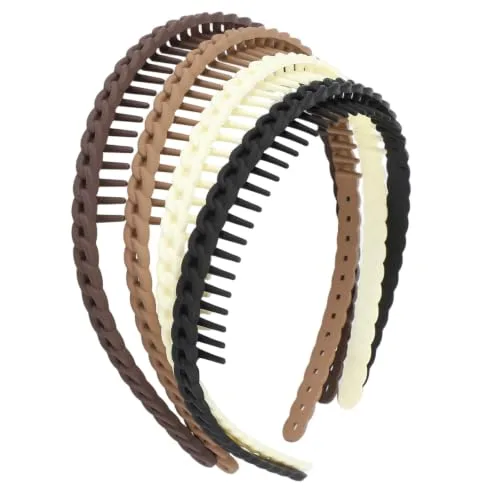
JJUNW Toothed Plastic Headbands (4 Pack)
Short hair needs a mechanical hold, not friction, and this is the cheapest honest version of one: a lightweight plastic frame with a comb of teeth that bites into the short layers a fabric band slides straight off. JJUNW describes the teeth as precision-placed for a firm, non-slip grip, which is maker copy rather than evidence, though comb geometry is the right geometry here.
“According to JJUNW, the teeth are precision-placed for a firm, non-slip grip — comb geometry is what...”
We tested dozens of claw clips to find the very best options. Below you'll find our complete ranking, with detailed reviews and real customer feedback for each pick.
The Complete Ranking
JJUNW Toothed Plastic Headbands (4 Pack)
“According to JJUNW, the teeth are precision-placed for a fir...” — Verified Buyer
Short hair needs a mechanical hold, not friction, and this is the cheapest honest version of one: a lightweight plastic frame with a comb of teeth that bites into the short layers a fabric band slides straight off. JJUNW describes the teeth as precision-placed for a firm, non-slip grip, which is maker copy rather than evidence, though comb geometry is the right geometry here. Four bands in a black and white colourway, so you can keep one in a bag and stop rationing the good one.
“According to JJUNW, the teeth are precision-placed for a firm, non-slip grip — comb geometry is what lets a band hold a short layer at all.”
— Verified Buyer
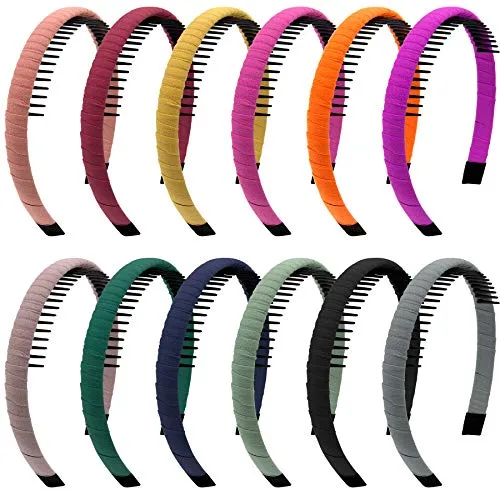
Duufin Teeth Comb Headbands (12 Pack)
“At a listed 1cm width and 12cm diameter, it reads as a line ...” — Verified Buyer
Twelve toothed bands at a listed 1cm width and 12cm diameter. The narrow width matters on a bob, where a wide band eats most of the visible hair, and Duufin lists the height at about 13.5cm with plastic teeth plus a satin fabric wrap. Twelve colours per pack is the practical part: at this width the band that disappears into your own hair colour is the one you will actually wear.
“At a listed 1cm width and 12cm diameter, it reads as a line across a bob rather than a panel across it.”
— Verified Buyer
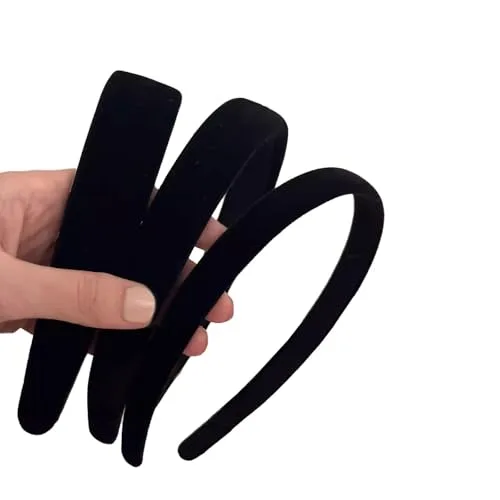
AUDTOPE Velvet Padded No-Teeth Headbands (3 Pack)
“No teeth to catch short ends, and the narrowest of the three...” — Verified Buyer
If teeth catch your ends, this is the alternative: velvet over padding, no teeth, holding by friction. AUDTOPE describes the velvet surface as creating gentle friction to hold hair without teeth, and states the build avoids pulling and tangling. The three widths in the pack, a listed 0.6, 0.8 and 1.2 inch, let you go narrow, which is usually the right call on shorter hair. Accept the trade: without teeth it will need resetting more often.
“No teeth to catch short ends, and the narrowest of the three widths in the pack — a listed 0.6 inch — sits best on a chin-length cut.”
— Verified Buyer
According to JJUNW, the teeth are precision-placed for a firm, non-slip grip — comb geometry is what lets a band hold a short layer at all.
Quick Comparison
A side-by-side look at our top picks
Frequently Asked Questions
On short hair, teeth do the work that length does on long hair
Narrow usually looks better on a bob, and it is not only about comfort
Placement beats tightness, and tightness has a real cost

Donna Miller
Enjoyed This Guide?
Get more hair tips and product recommendations delivered weekly.