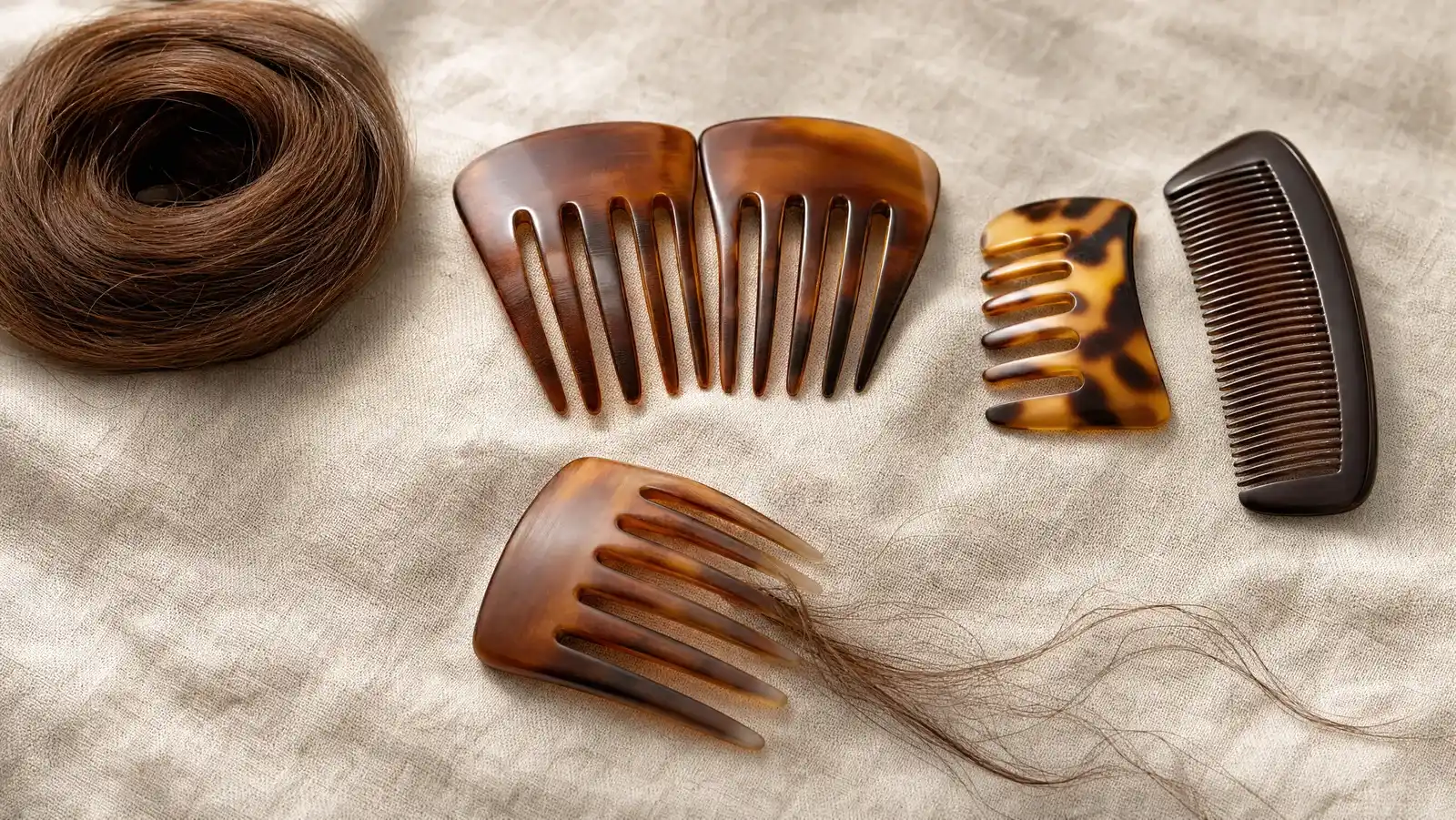
- Why does my hair comb keep falling out? Grip is friction plus leverage
- 1. You pushed it straight in instead of rotating it upright
- 2. Your hair is too clean to grip — when decorative hair combs fall out most
- 3. Too few teeth, or gaps between the teeth
- 4. The comb is too short for the section
- 5. The curve does not match your head
- 6. You put it somewhere nothing supports it
- 7. Wrong weight of comb: when a hair comb slips out of fine hair
- How to put in a hair comb so it stays: the 30-second drill
- When slipping is not the real problem
- Decorative hair combs to hold hair: what we would change first
Why does my hair comb keep falling out? Nearly always for one of two reasons: you pushed it straight in instead of rotating it upright, or your hair is too clean and smooth for the teeth to grip. A comb holds by leverage and friction, not by clamping force.
Some links below are affiliate links, which means we may earn a commission at no cost to you.
Below are the seven causes we see most, in rough order of how often they are the culprit, each with a fix you can try in the next minute. Nearly all are technique or sizing problems rather than bad combs. If you want the whole picture on shapes, spans and materials first, our guide to decorative hair combs covers it.
Why does my hair comb keep falling out? Grip is friction plus leverage
Two forces hold a comb in your hair. Leverage comes from rotating the spine upright, which pivots the teeth down and presses a bundle of hair against your scalp. Friction is what happens between the teeth and the individual strands once that pressure exists. Lose either one and the comb walks out.
Friction is the half people underestimate, and it is measurable. According to a 2025 study in Tribology in Industry by Sumanta Prasad Dewri and R. Gnanamoorthy, single human hair strands slid against a polyamide cylinder — a common comb material — showed a higher friction coefficient in wet conditions than in dry ones, and the coefficient fell as the load on the strand increased. So the grip your comb has is not a fixed property of the comb. It changes with how wet your hair is and how hard the teeth are pressing.
Your comb has probably not worn out. The friction or the leverage has gone missing.
1. You pushed it straight in instead of rotating it upright
This is the single most common cause.
A decorative comb is a lever. Pushed in flat, the teeth simply sit parallel to the hair and nothing presses against the scalp — the comb is resting in the section, held only by the hair lying on top of it. Rotated upright, the teeth swing through an arc and trap hair against your head. The difference in holding power is not subtle.
The fix: insert, push forward about a centimetre, then rotate the spine up until it stands on the teeth. You should feel the section tighten as you rotate. If the spine is still lying flat along the hair, you have not finished the movement. We set out the full insert-push-rotate technique step by step, including which way the teeth face; the hand motion is genuinely unintuitive at first.
2. Your hair is too clean to grip — when decorative hair combs fall out most
Freshly washed, conditioned, blow-dried hair is the worst possible surface for a comb. Conditioner and silicone films are formulated to make strands slide past each other more easily, which is exactly the property you do not want when something has to stay put.
Your scalp supplies its own lubricant too. According to StatPearls on the NCBI Bookshelf, sebaceous glands almost always develop alongside a hair follicle and empty into the follicular canal — the pilosebaceous unit — which is how oil reaches the shaft. A little of that oil helps a comb; a conditioner film on top of it does not.
The fix: work with day-two hair where you can. On clean hair, mist texture spray or dry shampoo at the roots of the section, scrunch it in and let it sit a minute before you insert. Keep conditioner and leave-in off the stretch of hair the teeth will sit in.
3. Too few teeth, or gaps between the teeth
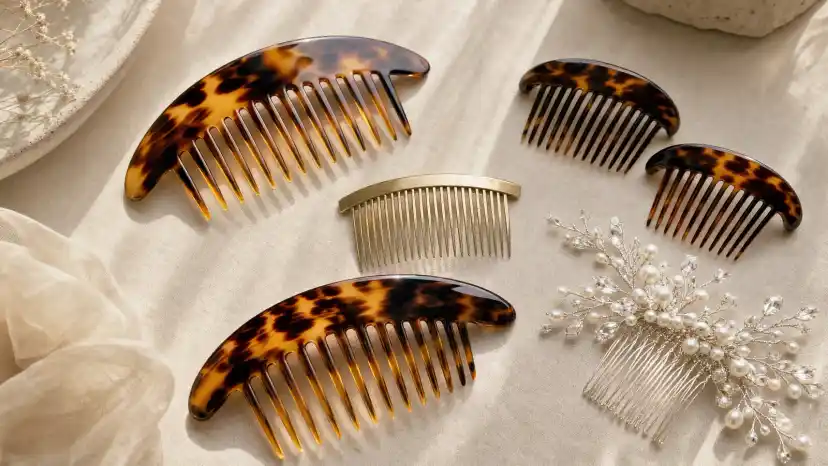
Plenty of inexpensive decorative combs carry only five to eight widely spaced teeth. Wide gaps mean each tooth carries a large bundle of hair, and hair in a gap is free to migrate sideways and out. Strand by strand, the section unloads itself.
Tooth count stops being cosmetic here. The Ruwado French side combs carry 14 teeth each, the highest count in this guide, spreading the hold across many more strands.
The more interesting design answer is the Grip-Tuth. Good Hair Days describes the teeth on its Grip-Tuth combs as touching each other, so that hair is locked in above the teeth and cannot slip past them; on the 3.25-inch styling size the maker describes that touching-teeth row as working like a flexible spring, and contrasts it with imitations whose spaced teeth let hair slide out strand by strand. That is the maker's account of its own design, not a lab result. Mechanically it holds up: no gap means no escape route, and the row flexes as one piece rather than letting single teeth splay.
The fix: count the teeth on the comb that keeps failing you. Under about eight on a comb wider than two inches, and the gaps are your problem. Material plays a part as well — we compared which material grips best across metal, wood and acetate.
4. The comb is too short for the section
A comb has to span the section it is holding. Put a 1.5-inch comb across a three-inch roll of hair and the ends of that roll have nothing above them, so the roll sags, the tension at the comb drops and out it comes.
The three Grip-Tuth sizes make the ladder easy to see: 1 1/2 inches for a single tucked piece, 2 3/4 inches for a half-up or side sweep, 3.25 inches for a thick twist or full roll. The Ruwado combs sit at 7 x 5 cm, in the middle.
The fix: measure the section, not your hair. Pinch the hair you want to hold, note how wide the pinch is, and buy a comb at least that wide. If you are between sizes, go wider; an over-long comb looks deliberate, an over-short one looks like it is escaping.
5. The curve does not match your head
Side combs are moulded with a curve, and head shapes differ. If the comb's arc is flatter than the spot where you are wearing it, the two ends dig in and the centre lifts away from the scalp. If it is more curved than your head, the centre bites and the ends stand off. Either way, only part of the tooth row is pressing hair, so only part of it is holding.
You notice this as a comb that holds for ten minutes, then springs out.
The fix: try the same comb in three positions — higher, lower, further back — before you blame it. A spot where your skull curves to match the comb exists on nearly every head. Failing that, buy a set with more than one profile and keep the one that sits flush. Multipacks earn their keep here: six Ruwado combs cost 5.99 dollars as of November 2026, which is cheaper than guessing.
6. You put it somewhere nothing supports it
A comb needs hair underneath it as well as in it. Set one into loose hair halfway down the back of your head, with nothing anchoring it to the scalp and no supporting section beneath, and you have asked a lever to work without a fulcrum.
Two placement rules we rely on. The teeth should finish angled slightly toward the scalp and touching it, not floating in the middle of the hair mass. And there should be a gathered section below the comb — a twist, a roll, a tucked tail — for it to press down onto.
The fix: anchor against the scalp and build the section before you insert, not after. The same geometry decides whether a French pin holds, and we worked through the same problem with French pins in more detail there; the diagnosis transfers almost unchanged.
7. Wrong weight of comb: when a hair comb slips out of fine hair
Fine and thick hair fail in opposite directions, and the same comb cannot fix both.
Fine hair needs a narrower bite. There is less bulk for the teeth to compress, so a wide comb on a thin section barely grips. Take a smaller section and a shorter comb, so what hair there is gets held firmly rather than spread thin. Good Hair Days calls out fine, hard-to-manage hair for its Grip-Tuth side combs; in our experience the 1 1/2-inch tuck size is what finally held a fine front section.
Thick hair needs span and stiffness. A short comb cannot reach across the mass, and a flimsy one splays open under the load. The 3.25-inch size exists for this.
One more mechanical oddity worth knowing: hair is not equally slippery in both directions. According to a review of the human hair cuticle in the Journal of Cosmetic Science, hair's directional friction effect comes from surface asymmetry — cuticle scales that overlap like tiles on a roof. Separately, a 2006 study by LaTorre and Bhushan in Ultramicroscopy reports that hair's friction coefficient changes substantially depending on whether the direction of motion runs along or against those scales. That is one reason a comb inserted against the fall of the hair tends to grip better than one slid in with it.
How to put in a hair comb so it stays: the 30-second drill
Practise this a few times on dry, slightly textured hair before you need it to work.
- Section first. Gather and twist or roll the hair you want held. No section, no fulcrum.
- Mist the roots. Texture spray or dry shampoo where the teeth will sit, scrunched in with your fingers.
- Insert at a shallow angle, teeth facing the hair you want to hold, against the direction the hair falls.
- Push forward about a centimetre. This is the step most people skip; it is what loads hair onto the teeth.
- Rotate the spine upright until the comb stands on its teeth and you feel the section tighten.
- Check the spine. It should lie flush as a smooth ridge, with no tooth tips poking up through the surface.
When slipping is not the real problem
There is one way to make almost any comb hold, and it is the wrong one: more tension. If your fix is to crank it tighter until your scalp pulls, stop.
The American Academy of Dermatology includes tightly pulled hairstyles among the causes of traction alopecia, and says to change your hairstyle immediately if you notice pain from tightly pulled hair, stinging on the scalp, or crusts on the scalp. The AAD also advises looking every month for broken hairs around the forehead and a receding hairline, and says to avoid frequently wearing hairstyles that pull on your hair — every once in a while is fine, often is not. Nothing in that guidance singles out combs, and we have not seen a dermatological source that ranks combs as gentler or harsher than clips — the risk tracks tension and wear time, not the accessory.
So treat comfort as the constraint. A comb that only stays in when it hurts is the wrong comb, the wrong size or the wrong spot.
Decorative hair combs to hold hair: what we would change first
Run the list in order. Rotate the spine properly, then add texture at the roots — those two fix most slipping combs without spending anything. If the comb still goes, count the teeth and measure your section before you buy a replacement.
When you do replace it, the touching-teeth construction is the one genuine mechanical difference we would pay for: 2 3/4 inches for a half-up section, 3.25 inches for a thick twist, 1 1/2 inches for a fine front piece. If you would rather test tooth count and arc cheaply, six Ruwado combs cost 5.99 dollars as of November 2026. Our pillar guide goes deeper on fitting a decorative hair comb if you want the sizing charts alongside this diagnosis.
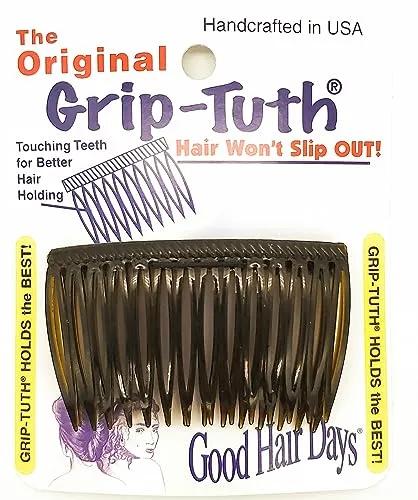
Good Hair Days Grip-Tuth Side Combs, 2 3/4 inch, 2 Pack
At 2 3/4 inches this is the middle size and the one we reach for on a half-up section. Good Hair Days says the teeth touch each other, so hair locks in above them instead of sliding back out between the gaps.
We tested dozens of claw clips to find the very best options. Below you'll find our complete ranking, with detailed reviews and real customer feedback for each pick.
The Complete Ranking
At 2 3/4 inches this is the middle size and the one we reach for on a half-up section. Good Hair Days says the teeth touch each other, so hair locks in above them instead of sliding back out between the gaps.
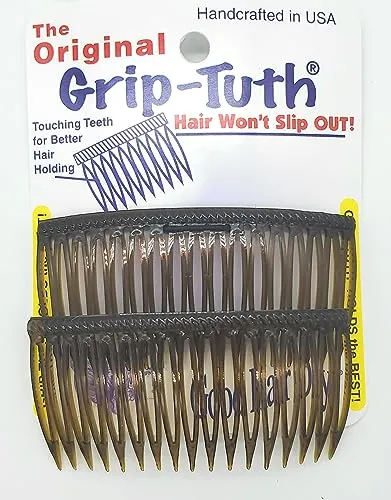
The large size at 3.25 inches wide, which is the span you need before a comb can bite into a heavy section rather than skate over it. The maker describes the touching teeth as working like a flexible spring.
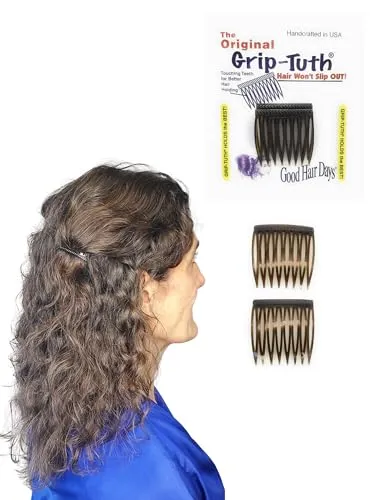
The smallest of the three at 1 1/2 inches wide, in tortoise shell colour, built for pinning one small piece rather than holding a whole section. It uses the same touching-teeth construction as the bigger sizes, so grip is not what you trade away for the shorter span.
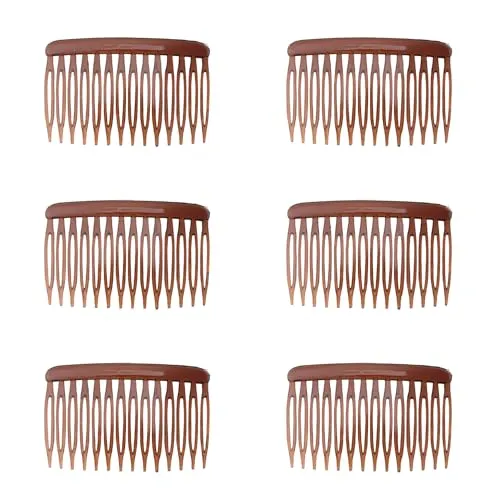
Fourteen teeth per comb is the highest count in this set, and more teeth spread the hold across more strands instead of loading three or four. Six polycarbonate combs at 7 x 5 cm for 5.99 dollars, as of November 2026, is the cheapest way to test whether tooth count was your problem.
Quick Comparison
A side-by-side look at our top picks
Frequently Asked Questions
How do you put in a hair comb so it stays?
Why does a hair comb slip out of fine hair?
Can a hair comb that keeps slipping damage my hair?

Donna Miller
Enjoyed This Guide?
Get more hair tips and product recommendations delivered weekly.