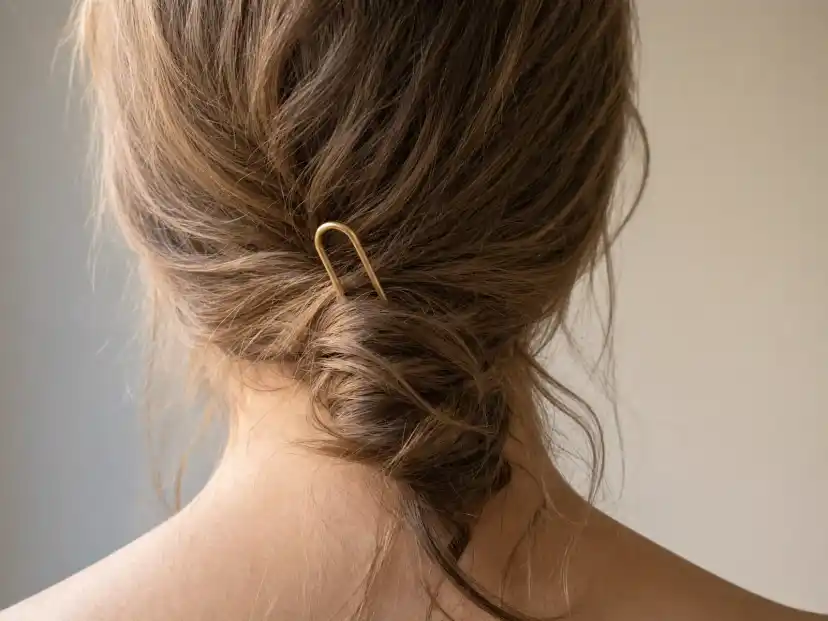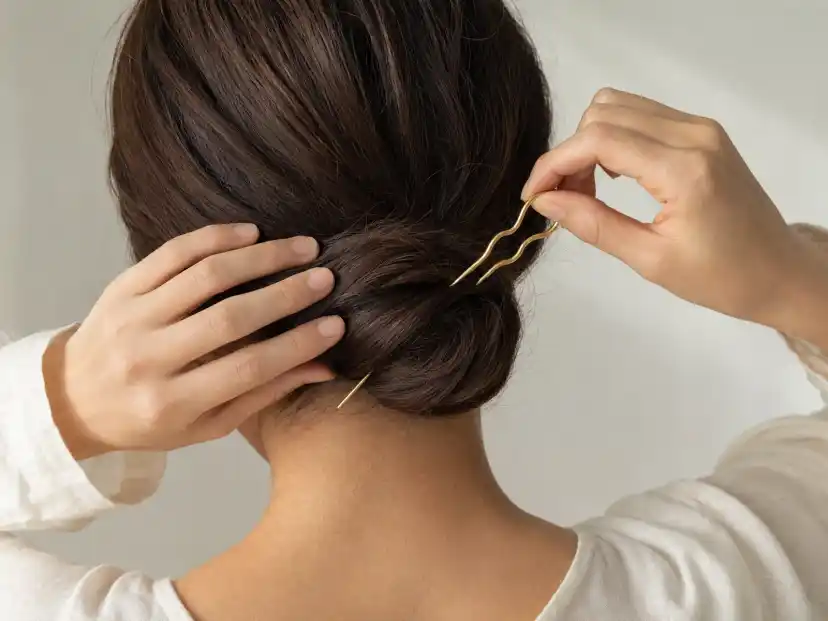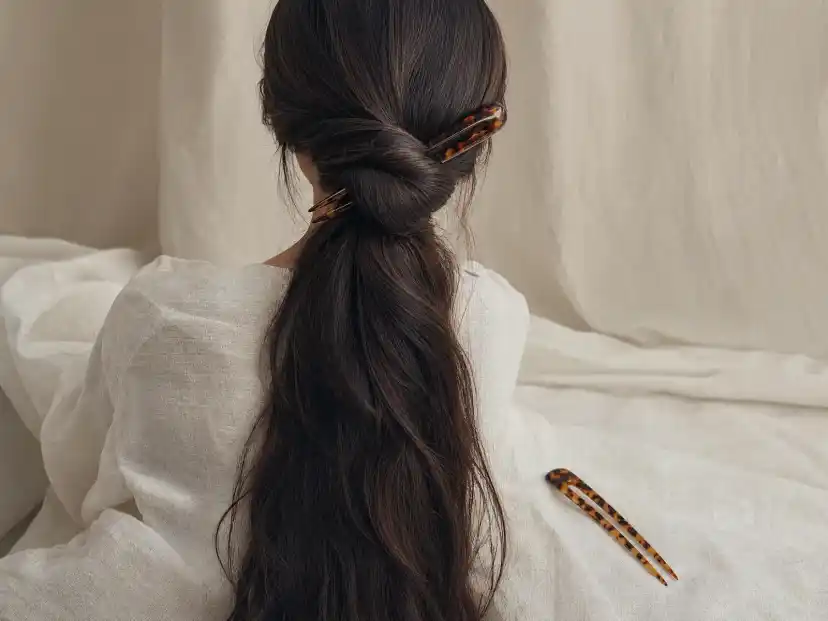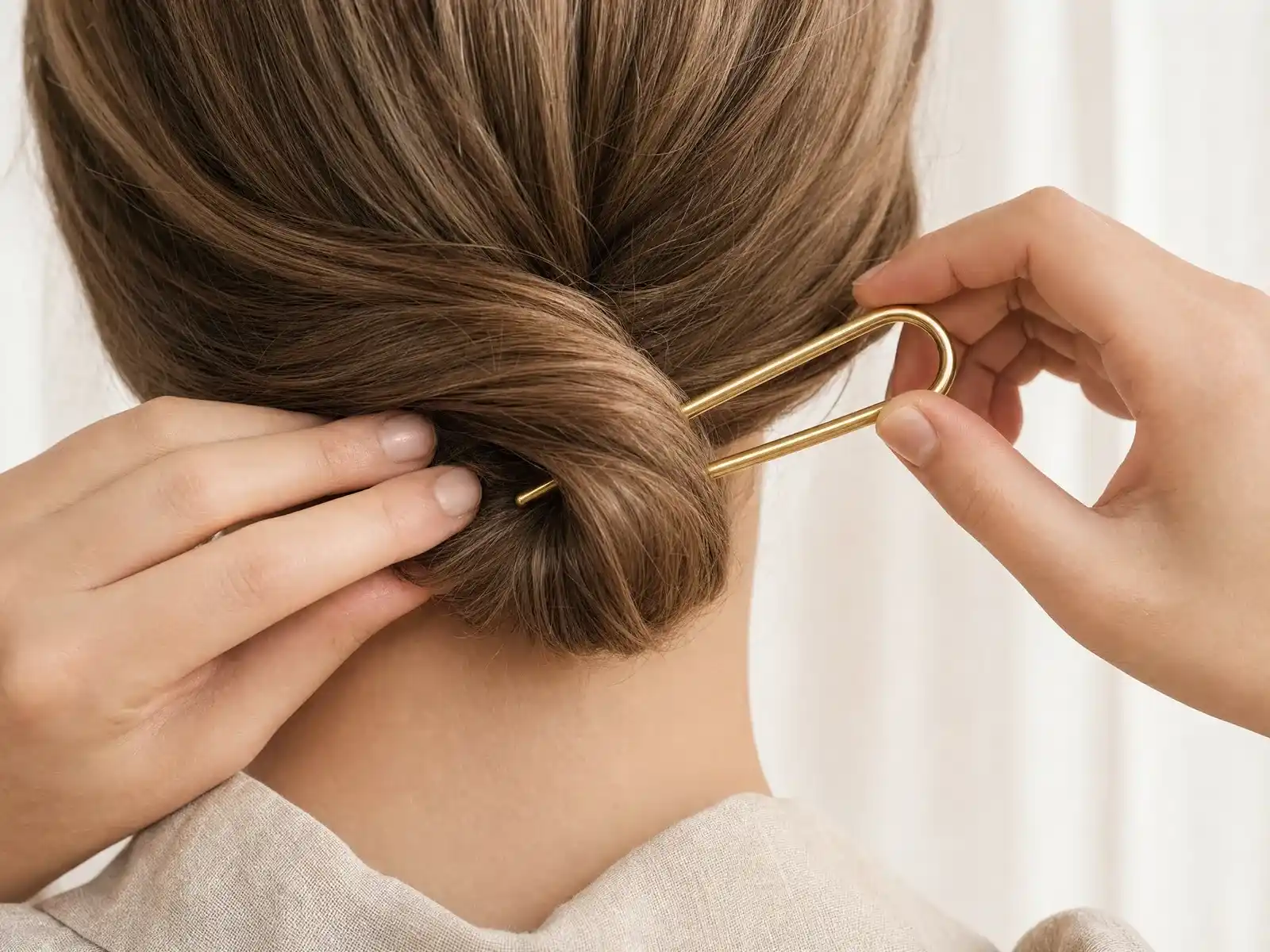
Short answer: a French hair pin does not go straight in like a bobby pin. Twist your hair into a coil, slide one prong into the twist at a shallow angle, rotate the pin roughly a half-turn while you push, then drive both prongs home so they sit flat against the scalp. That rotation is the technique. Skip it and the pin falls out within a minute.
Best Claw Clips is reader-supported. When you buy through links on our site, we may earn an affiliate commission at no extra cost to you.
Almost every beginner we hand a pin to does the same thing: aims it at the bun and pushes. Thirty seconds later it is on the floor and they conclude french hair pins are a styling-video illusion. They are not. The pin is behaving as designed — it is being used like a bobby pin, and it is not one. How to use a French hair pin comes down to that one wrist movement, plus the three styles it unlocks.
How a French hair pin actually holds your hair
This is the part the slideshows skip, and it makes every troubleshooting tip below obvious.
A bobby pin clamps. According to France Luxe, it is flat metal folded in half to press back against itself, holding hair between the two sides with slight pressure. A French pin does none of that — France Luxe describes hair pins as not pressurised together but open in more of a U shape, most commonly used to hold a bun or updo in place. We compare the family in bobby pins vs hair pins; the short version is that an open pin cannot squeeze.
So what holds it up? Leverage and friction against the hair beneath it. As you rotate the pin inside a twist, you wrap a little hair around the near prong and lever the far prong down through the mass of the bun. The pin ends up trapped, because the straight path it entered by no longer exists.
Two consequences follow.
- It needs a base to bite into. A twist, a coil, a roll. Loose hair gives the prongs nothing to lever against, which is why the pin that holds a chignon all day slides straight out of a ponytail.
- Nothing clamps, so there is far less to crease. BEoffer markets its pins on exactly that point, pitching them as not leaving the creases a claw clip does. If you would rather have the faster, more forgiving version and can live with a crease, how to style a claw clip is the honest alternative.
French hair pin instructions: the five-step motion
Practise on dry, day-two hair first. Each step has a cue for what it should feel like, since the feel is how you know it worked.
- Build the base. Gather your hair as if starting a low ponytail, then twist the length around two fingers until the coil turns in on itself against your head. It should feel like a firm rope you could tug on, not a soft loop. If a finger pushes through the middle, it is too loose.
- Load one prong at a shallow angle. Hold the pin almost flat to your head. Van Hong, the stylist and Mint Tools cofounder quoted by Glamour South Africa, inserts it with the curve facing outward and the points up, into the top layer of the roll — and warns against going too close to the scalp yet, because that creates tension when you rotate. The prong should slide between layers of hair, never scrape skin.
- Scoop. Once most of the prong is buried, dip the tip toward the scalp and pick up a thin section from the underside of the twist. Teleties, in its own how-to guide, advises anchoring close to the scalp and catching a small section of hair underneath, and calls the sequence stab, hook and flip. The pin should snag lightly and stop travelling freely.
- Rotate roughly a half-turn. The step everyone misses. Van Hong's instruction via Glamour South Africa is to rotate the pin 180 degrees, or until you feel resistance, then push it back into the twist; Glamour is blunt that sticking it in without that rotation will cause it to fall. Resistance should build smoothly, and the twist should visibly pull tighter as you turn.
- Push both prongs home. Follow the curve of your skull so the prongs travel parallel to it and exit under the twist. The pin should lie flat, and the style should feel like one object rather than hair plus an accessory.
Then test it: nod twice, shake your head once, look at your feet. Survive that and you survive a commute.
One rule sits above the rest: it should not hurt. Van Hong's guidance in Glamour South Africa is that a French pin should never cause pain, on insertion or in the wear, and that excessive tightness means reinserting it closer to the surface. The American Academy of Dermatology lists pain from tightly pulled hair, stinging, crusts and scalp tenting among the signs a style is too tight, and says to change it immediately.
How to wear a French hair pin: the French twist
The French twist is the style the pin was made for: a vertical roll gives the prongs the deepest base.
- Gather the hair low at the nape.
- Twist upward, rotating your hand so the hair rolls in on itself and lies vertically against the back of your head.
- Tuck the ends down into the top of the roll with your thumb, keeping hold of the roll.
- Insert the pin horizontally into the outer layer, a third of the way down, then scoop, rotate and push through so the prongs cross the roll and pin it to the hair beneath.
If the roll unravels before the pin is in, you are twisting too much length. Fold the ends in earlier and the roll shortens into something you can hold in one hand.
The low chignon
Easier than the twist, and a good first success. Twist the length into a rope at the nape, then coil that rope around its own base until you have a flat disc sitting on your neck. Hold it with your non-dominant thumb. Insert the pin into the side of the coil, aiming at the centre, then scoop, rotate and drive it through so both prongs exit the far side having crossed two layers of the coil. In our experience two layers is the difference between a chignon that lasts an hour and one that lasts a day.
The half-up
Take the top third of your hair, temple to temple. Twist it once or twice into a small rope, then fold the rope up on itself into a loop. Pin through the loop and into the hair behind it with the same scoop-rotate-push. The loose length below hides the exit points, and this is the one style that works on very little hair — the fastest way to build confidence in the motion.
Three mistakes beginners make
Pushing straight in
If the pin goes in and comes out along the same axis, the only thing holding it is friction on two smooth prongs, and that loses to gravity. It has to change direction inside the hair. When we teach this in the chair we tell people to say the word "turn" out loud between insertion and push, because the omission is that automatic.
Taking too much hair in one pass
A prong loaded with a thick fistful jams instead of rotating, and a pin that cannot rotate cannot lock. Teleties' fine-hair advice runs the same way in reverse: create tighter twists and use smaller sections so the pin has more grip. If the half-turn feels blocked rather than progressively tighter, back out and take a thinner bite.
Pinning loose hair instead of twisted hair
A pin pushed into an untwisted bundle has nothing to lever against, so it slides down the strands. Twist first, always. Teleties makes the same point from the other end: insufficient twisting creates inadequate tension, and failing to execute the flip causes slippage.
Choosing a pin you can actually learn on
Size is the main lever. Celebrity hairstylist TEMUR, speaking to PureWow, recommends small pins of one to two inches for short hair and larger three- to four-inch pins for long, thick or curlier strands.
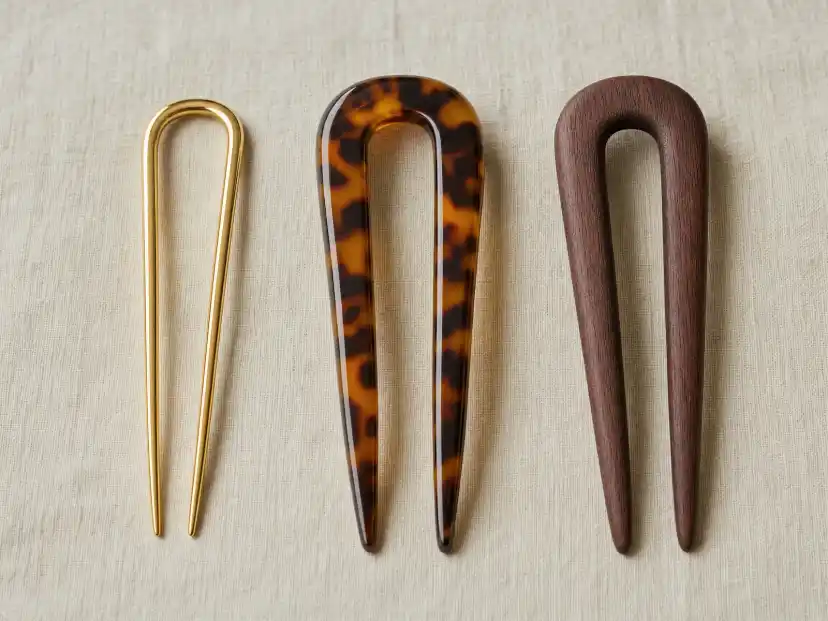
Stiffness matters more than looks while you are learning. A rigid pin transmits the resistance of step four back to your fingers, so you can feel the lock happen; a whippy one absorbs it. So we point beginners at one solid metal pin, such as the Kitsch French Hair Pin at around eight dollars as of August 2026. According to Kitsch, it is zinc alloy with a smooth anti-rust finish that glides without snagging — so a failed attempt slides back out rather than dragging.
Buy spares. The classic beginner loss is putting the pin down mid-twist and losing it. The BEoffer three-pack, under seven dollars as of August 2026, gives you gold, silver and black; BEoffer specifies a U-shaped curved profile designed to sit against the head, and positions the set for heavy, textured or long hair.
If your hair is fragile, start with acetate. Plated metal on bleached or fine hair is where repeated reinsertion is most likely to snag, and you will be reinserting a lot. Benefree lists its cellulose acetate pins as a two-piece tortoiseshell set with a smooth, scratch-free edge designed to slide into a bun without hair damage. Its listing gives conflicting lengths, so treat it as roughly four and a half inches rather than an exact figure.
Long or heavy hair changes both halves — the longer pin TEMUR describes, plus a differently built twist, since a rope that thick will not fold into one coil. More on that in french hair pin styles for long hair.
When a French hair pin will not work
- Very short hair. If your length will not hold a coil unaided for two seconds, there is no base, and no technique compensates.
- Freshly washed, very silky hair. Friction is the mechanism, and conditioner cuts it right down. TEMUR's fix, via PureWow, is to apply texture or hairspray to build grip and stop the pin slipping out; Teleties suggests teasing, texturising spray or powder for the same reason.
- Heavily layered hair. Short layers escape the twist, so the pin holds only the long section and the style sits lopsided.
- Anyone already dealing with tension damage. A French pin may well put less sustained pull on the follicle than a tight elastic, though we have not seen that measured, and the AAD's advice still applies: switch up your hairstyle regularly so your hair can recover, rather than loading the same anchor point daily.
Textured hair is the easy case: Teleties notes that curly and textured hair works exceptionally well with these pins, because natural texture provides the grip the mechanism depends on.
The bottom line
A French hair pin is not a difficult tool. It is a tool with one non-obvious motion: shallow insertion, scoop a thin section near the scalp, half-turn, push flat. Get that into your hands on a twist you have deliberately made too tight, and the styles take care of themselves.
Give it three attempts on a day you are going nowhere. Most people find the fourth is where they feel the lock engage and stop thinking about it. After that the only variable left is the pin itself — length, stiffness and finish — which is what choosing the right french hair pin is for.
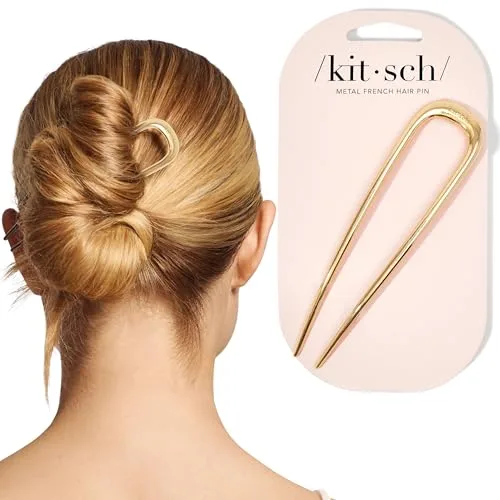
Kitsch French Hair Pin (Gold)
One rigid metal pin, which is exactly what you want while learning the wrist motion. A floppy pin makes the scoop-and-rotate step harder to feel.
We tested dozens of claw clips to find the very best options. Below you'll find our complete ranking, with detailed reviews and real customer feedback for each pick.
The Complete Ranking
One rigid metal pin, which is exactly what you want while learning the wrist motion. A floppy pin makes the scoop-and-rotate step harder to feel. Smooth electroplated finish so a failed attempt slides back out instead of snagging.
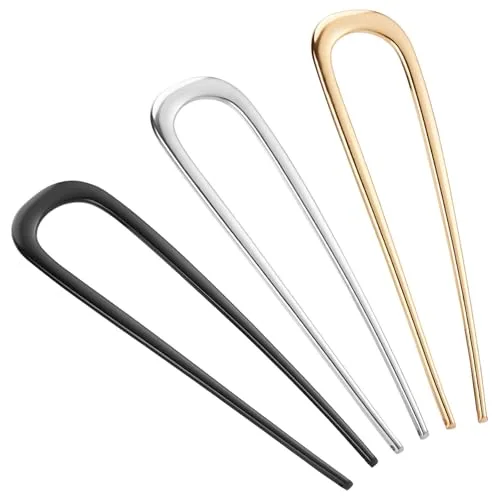
Three pins in gold, silver and black. Having spares matters more than it sounds while you are learning, because the usual beginner failure is putting the pin down mid-twist and losing it. The seller specifically pitches these for heavy, textured or long hair.
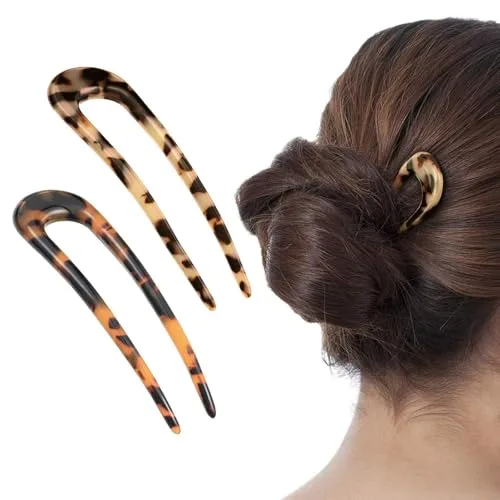
Acetate rather than plated metal, with a smooth edge that slides into a bun without catching. Worth starting here if your hair is fine, bleached or prone to snagging, because a rough prong is what turns a learning curve into breakage.
Quick Comparison
A side-by-side look at our top picks
Frequently Asked Questions
The half-turn nobody tells you about
It held for ten minutes, then slipped
How much hair should the prong catch?

Donna Miller
Enjoyed This Guide?
Get more hair tips and product recommendations delivered weekly.