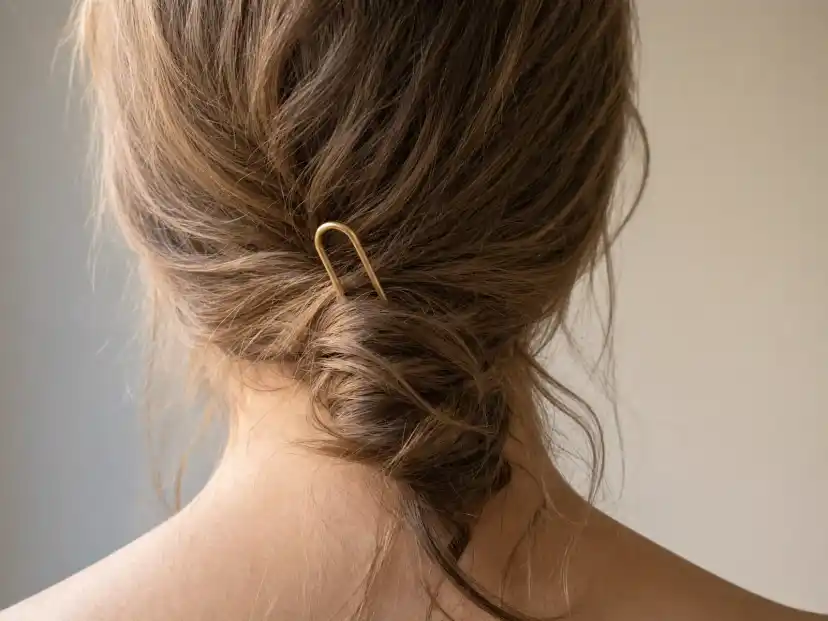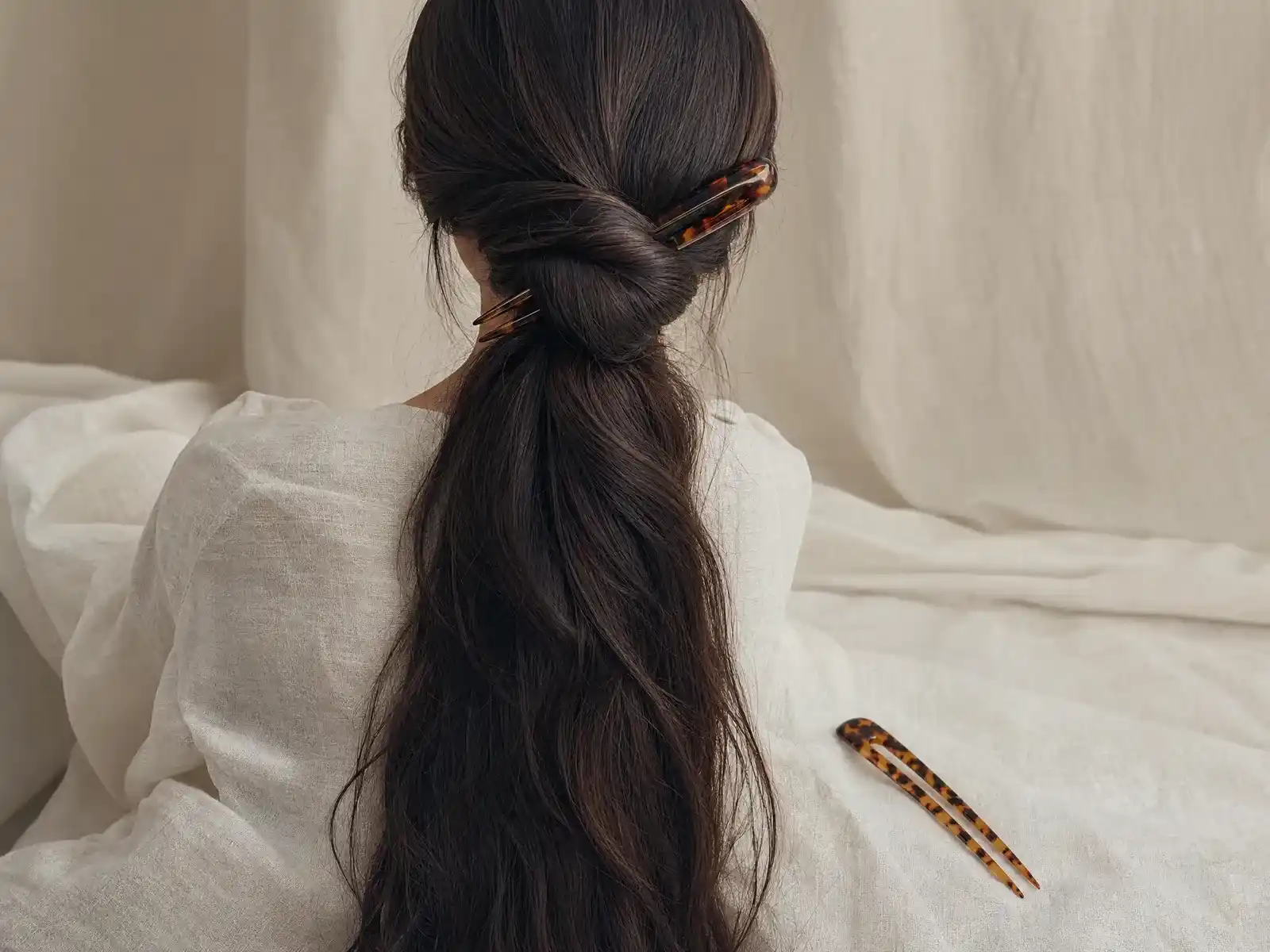
Short answer: a french pin holds long hair by levering against the hair underneath it, so the prongs have to be long enough to cross the twist and bite back into hair on the far side. For most long hair that means roughly four inches of pin or more. Pin length and the weight of the section you lift decide everything else.
Best Claw Clips is reader-supported. When you buy through links on our site, we may earn an affiliate commission at no extra cost to you.
The complaint we hear most behind the chair is one sentence long: it looked perfect for ten minutes, then it slid out. In our experience the technique is usually fine and the pin is simply too short for the weight it held. If the tool is new to you, start with french hair pin basics, then read how to use a french hair pin for the insert-and-rotate motion. This piece stays on the long-hair problem: which styles survive real length, which pin, and how each fails.
Who What Wear named french pins among the hair accessories about to pop off in 2026, and Vogue Scandinavia traces the wave to The Row's spring/summer 2026 show, where models wore sculptural twists secured with decorative pins and combs. In that piece, creator Sanna Jörnvik Déman calls the pin "much more practical than a hair tie or a claw clip" and says it "doesn't ruin a blow-out, but rather enhances and protects it".
Why a french pin slips out of long hair
A french pin, or hair fork, is not a clamp. Nothing on it closes. TELETIES describes the motion as inserting the pin against the direction of the twist, then flipping it inwards towards the scalp, and is explicit that the secret to a lasting style is where the pin goes: anchor it close to the scalp and catch a small section of hair underneath.
That captured section is the whole mechanism: a lever with the twist on one side and a bite of anchor hair on the other. Take the anchor hair away and you have a decorative stick resting in a bun.
Pin length is the spec that decides it
Long hair defeats a short pin geometrically, not by strength. A thick twist might be an inch and a half deep. A 3-inch pin entering at an angle spends most of its length inside that mass and emerges with barely a quarter inch left to catch anything, so every head movement rotates it further out until gravity finishes the job. Our rule of thumb: once hair passes the shoulder blades, look for about four inches of prong. MindFood's french pin guide gives the same steer, advising that you opt for a larger pin for thick or long hair.
Weight counts as much as length: density and coarseness change the mass hanging off that anchor point, so if your ponytail feels heavy in your hand, size up.
Choosing a french hair pin for long, thick hair
Length. The HYFEEL cellulose acetate french hair forks are what we reach for on genuinely long hair: HYFEEL lists these at 4.3 inches, enough to cross a thick chignon and still bite. A caveat on listings: the same HYFEEL copy calls the pin a medium-large hairpin suitable for thick or fine, long and shorter hair, which is broad enough to be meaningless. Act on the measurement, not the hair-type language.
Stiffness. MindFood notes that metal pins offer the best hold, while plastic ones are slightly more lightweight but may not grip as tightly. That is why the hisial alloy pins still earn a place at 3.9 inches: hisial lists them as a durable alloy that is not easy to deform, and a stiffer prong buys back some of what you lose in length. Be honest, though: 3.9 inches sits on the line. Good for mid-back hair, but past the waist go longer.
Finish and colourway. For an office twist that should not announce itself, a dark pin beats a gold one in brown and black hair. The Kitsch hematite french hair pin is our kit-drawer choice there, and Kitsch specifies ergonomic curves that distribute tension evenly for all-day wear. It was $7.98 as of August 2026.
Seven french pin styles for long hair, and how each one fails
Every method assumes hair with a little grip. If yours is freshly washed, read the last section first.
1. The classic french twist
The vertical roll up the back of the head, and the best use of a long pin.
- Brush the hair to one side at the nape, as if starting a low side ponytail.
- Twist the length upwards against the head until the roll sits flat and the tail tucks inside it.
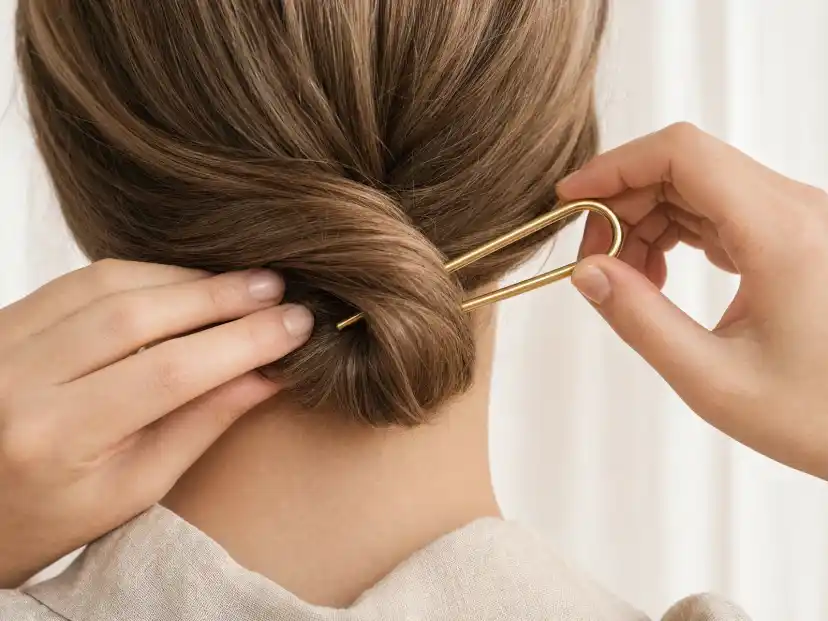
- Push the pin horizontally through the outer edge of the roll, catch hair underneath, and rotate it towards the scalp.
Hair needed: shoulder length and beyond. Pin: 4 inches or more. Failure mode: the tail working loose at the top — tuck it deeper rather than pinning harder. The same style is easier to learn with a clip, and we walk through the french twist with a claw clip: the clip forgives a loose roll, the pin does not.
2. The low nape chignon
The softest option, and in our experience the one that asks least of the hairline.
- Gather a low ponytail at the nape without an elastic.
- Wind the length into a flat coil against the neck.
- Pin upwards through the coil from below, so gravity presses the twist onto the prongs rather than off them.
Hair needed: anything past the collarbone. Pin: 4 inches. Failure mode: pinning downwards. Per The Right Hairstyles, a chignon takes its name from the French for nape and sits low on the neck while a french twist sits high; let the pin angle follow.
3. The figure-eight fold
For hair too long to coil once without building a heavy lump.
- Twist the length loosely, then fold it in half back on itself.
- Fold again the other way, so the mass sits as a flat figure-eight rather than a ball.
- Pin through the waist of the eight, where the folds cross.
Hair needed: waist length and beyond. Pin: 4.3 inches. Failure mode: a lump instead of a flat stack. A stack gives the prongs layers to cross; a lump gives them a bulge to slide off.
4. The half-up twist with the tail left down
The one most long-haired clients actually wear day to day.
- Take the top third of the hair, temple to temple.
- Twist it once, snugly, at the back of the head.
- Pin through the twist and into the hair beneath the parting, leaving the length hanging.
Hair needed: any. Pin: 3.9 inches is fine, as the section is light. Failure mode: taking too much hair. The heavier the half-up section, the faster it sags.
5. The high bun for thick length
- Gather high at the crown and twist firmly all the way to the ends.
- Wrap the twist around its own base, keeping the bun flat rather than tall.
- Pin from the underside upwards, through the bun and into the base.
TELETIES advises exactly this for thick hair: twist firmly and anchor the pin into a larger section, with a discreet elastic as backup. Failure mode: a tall bun. Height is leverage working against you, and a proud bun leans and drops by lunchtime.
6. The crossed two-pin hold
The technique that makes past-the-waist hair viable.
- Build any twist or chignon above.
- Insert pin one low, prongs angled upwards.
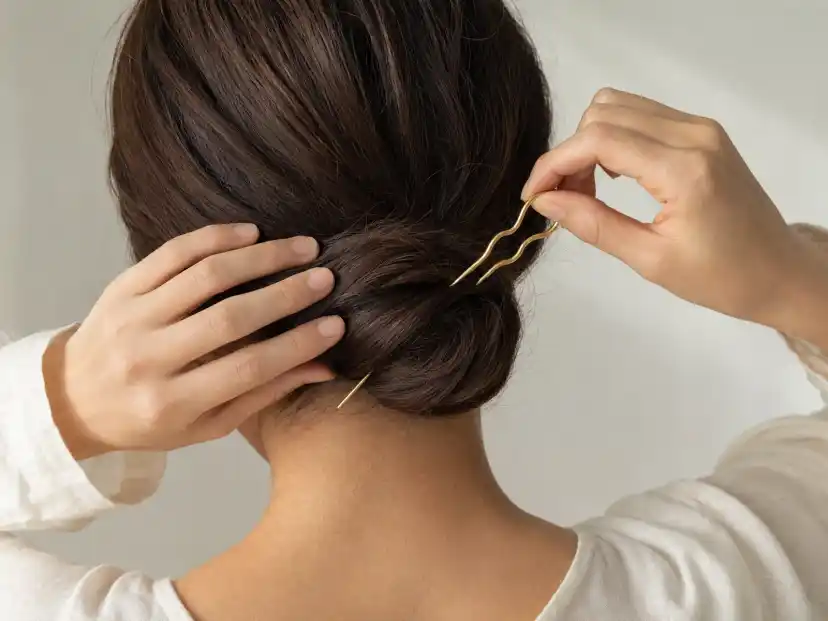
- Insert pin two higher, prongs angled downwards, so both sets cross inside the mass like an X.
Kov Essentials recommends two pins crossing at a slight angle through the bun for extra hold on thicker hair, or when the bun is on the larger side. Failure mode: both pins at the same angle, which is one pin twice.
7. The lived-in messy twist
Marie Claire's write-up of Martha Stewart's french updo is the reference for the register: piled up, a few loose pieces, deliberately imperfect. Twist loosely, pin, then pull out a quarter inch of hair at the crown and around the face. Failure mode: loosening the twist before pinning instead of after. Pin firm, then break it up.
French pin or claw clip for a heavy length?
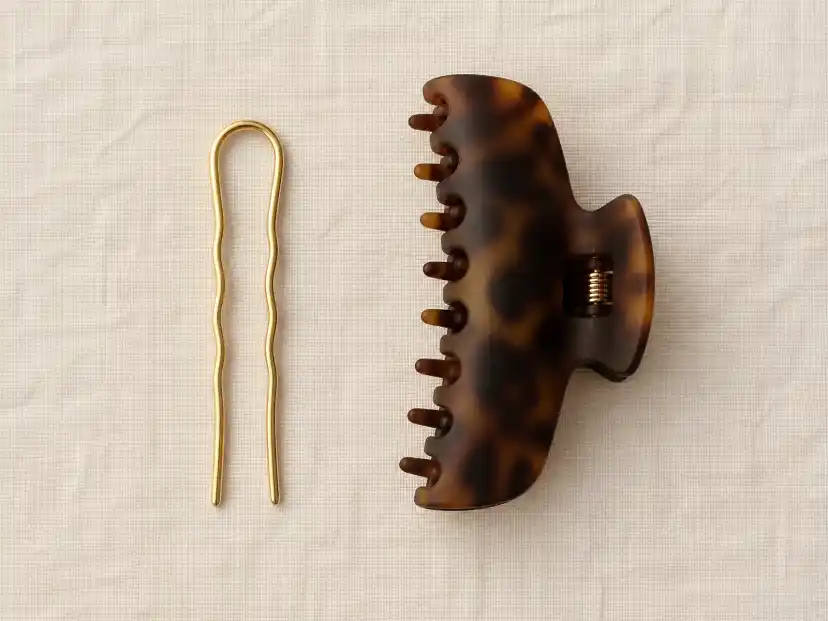
A clip clamps a section between two jaws, so its hold scales with spring strength and jaw width — and a clip genuinely big enough for long hair is a substantial object on the back of your head. We compare the sizes that work in our roundup of the best claw clips for long hair. A pin adds almost no bulk and no clamping force, which is why it feels lighter and why it needs a real twist to bite. One qualification: a clip will hold badly prepared hair, a pin will not.
One word about tension on long, heavy hair
According to the American Academy of Dermatology, hairstyles that pull on your hair can cause hair loss, and its list of styles names buns, ponytails and up-dos that are tightly pulled alongside cornrows, locs and tight braids. The AAD advises avoiding styles that pull frequently and switching up your hairstyle regularly so your hair can recover. It also gives a blunt test: if your hairstyle feels painful, the style is too tight. Change it immediately, the AAD says, if you notice pain from tightly pulled hair, stinging, crusts, or tenting — sections of scalp pulled up like a tent.
A french pin is low-tension by design, holding a twist rather than cinching the whole head into one anchor. But long hair is heavy hair, and a firm high bun worn in the same spot daily is still a pulled up-do. Rotate between a high bun, a nape chignon and a half-up across the week, and if a style aches, take it out.
When a french pin is the wrong tool for long hair
Sometimes it will not work today, and we would rather say so.
- Freshly washed, silky hair. Kov Essentials says a french pin works best on second-day hair or hair with a little texture, because freshly washed, slippery hair is harder to grip. Day Rate Beauty's stylist guide agrees that freshly washed, very smooth hair is harder to pin, and recommends a light texturising spray or a little dry shampoo at the roots before you gather.
- Heavily layered long hair. Short layers will not stay in a twist. Kov Essentials' nearest workaround is aimed at bulk rather than layers — divide the hair into two sections before twisting, layer them into the bun shape, then pin through both layers — but if half your length is face-framing layers, a clip is less of a fight.
- Fine hair past the waist. The worst combination: a lot of weight, not much fibre to bite. TELETIES recommends tighter twists and smaller sections for fine hair so the pin has more grip, plus texturising spray or teasing beforehand. Take that offer.
- An existing traction problem. If a dermatologist has flagged tension breakage or loss at your hairline, that is a conversation for them.
The bottom line
Long hair needs a longer pin and a firmer twist more than a special technique. Measure before you buy, size up when the section feels heavy, cross two pins past the waist, and give the prongs a bite of anchor hair to lever against every time.
For the full picture on shapes, materials and sizing, start with our complete guide to french hair pins — and if a style hurts, it is too tight. That part is not a matter of taste.
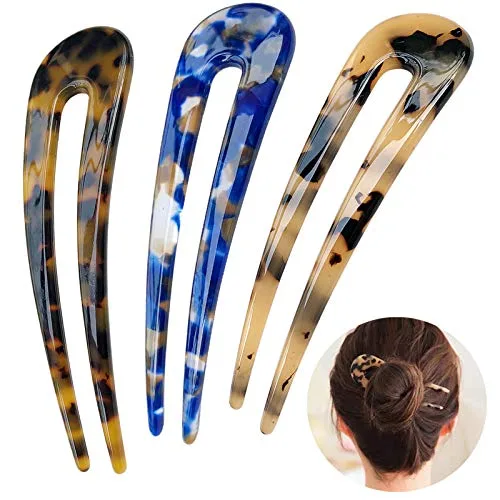
HYFEEL French Hair Forks, Cellulose Acetate (3 Pack)
At 4.3 inches these are the longest pins in our kit, and length is the single spec that decides whether a pin can cross a thick bun and re-enter the hair on the far side.
We tested dozens of claw clips to find the very best options. Below you'll find our complete ranking, with detailed reviews and real customer feedback for each pick.
The Complete Ranking
At 4.3 inches these are the longest pins in our kit, and length is the single spec that decides whether a pin can cross a thick bun and re-enter the hair on the far side. Below about four inches, long hair simply pivots out.
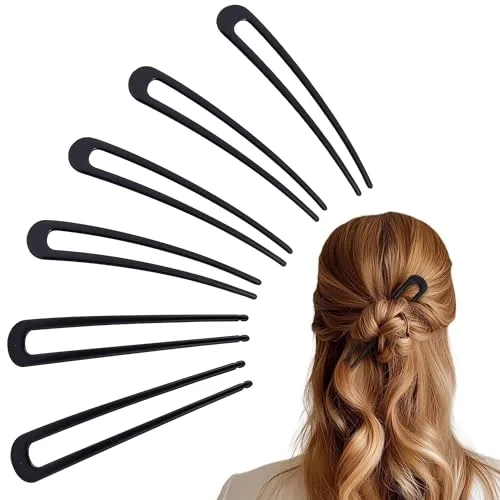
Slightly shorter at 3.9 inches, but alloy is stiffer than acetate at the same thickness, which buys back some of the holding power you lose in length. Six of them means one lives in every bag you own.
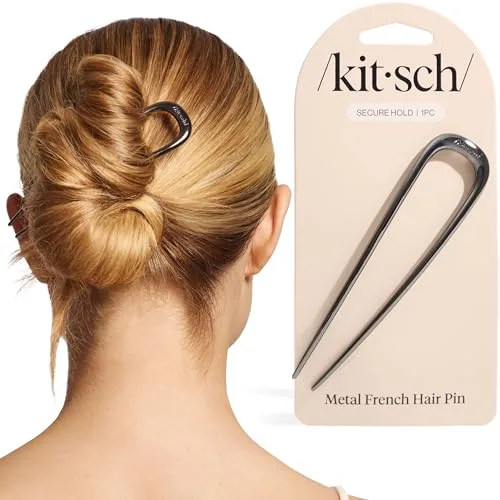
The dark hematite finish disappears into brown and black hair in a way gold does not, which matters for an office twist. One pin, zinc alloy, and the ergonomic curve is the reason it stays comfortable through a long day of heavy hair.
Quick Comparison
A side-by-side look at our top picks
Frequently Asked Questions
How long does a french pin need to be for long hair?
The two-pin cross for waist-length hair
Why yesterday's pin slid out today

Donna Miller
Enjoyed This Guide?
Get more hair tips and product recommendations delivered weekly.