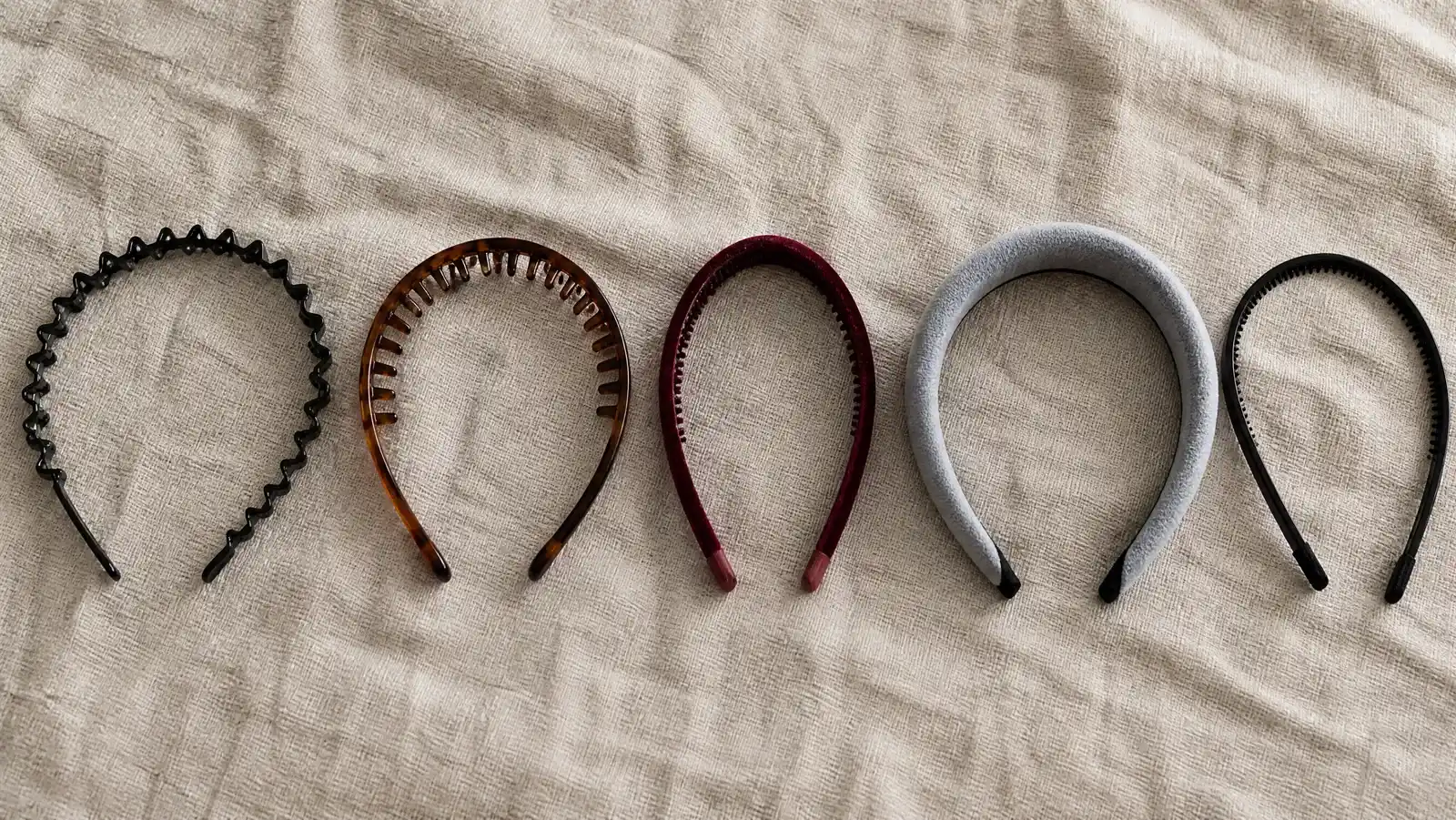
- The three grip mechanisms, and there is no fourth
- Friction has a direction, which is why bands creep backwards
- Diagnose your slip first, because headbands that don't slip are matched, not tighter
- Best overall non-slip: teeth you can re-aim
- Silicone grip headbands: hold without a hotspot
- Best budget non-slip: the cheapest way to test whether teeth are your answer
- Best for fine hair: headbands with teeth, wrapped in velvet
- Best multipack: twelve bands so you can move the pressure line
- Best fabric non-slip: grip with no teeth at all
- If it hurts, the answer is not a tighter band
- Buy two mechanisms, not two of the same band
The best non-slip headbands for women hold in one of three ways: teeth that bite mechanically into the hair, a high-friction surface such as velvet or silicone that grips the hair shaft, or a fit shaped closely enough to your head that it stays put without squeezing. Work out which of the three your current band is missing and the fix is usually one purchase rather than five. We may earn a commission from links on this page, at no cost to you.
The instinct nearly everyone follows is to buy something tighter. Tension is only one of the three mechanisms, and it is the one that leaves a sore hairline behind. Below: the three grip routes, how to tell which one your hair needs, and six bands that each do one of them well, with the trade-off each asks you to accept. If you want the underlying fit rules from our guide to the best headbands for women before you shop, start there and come back.
The three grip mechanisms, and there is no fourth
A headband has the hardest job in hair accessories and almost no leverage to do it with. It has to hold across the whole skull on nothing but its own spring, stretch or bite. Every non-slip claim on every listing comes down to one of these three things:
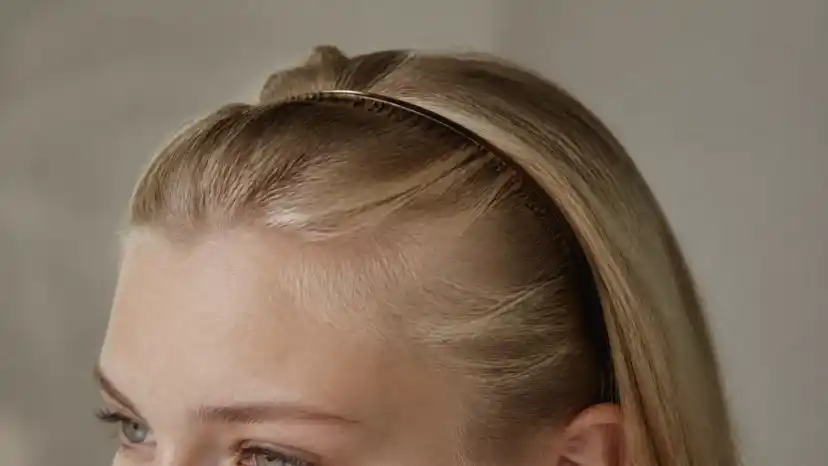
- Teeth. A comb along the inside edge that reaches through the hair and anchors near the scalp. This is mechanical grip — the band is not pressing hair flat, it is hooked into it. Strongest hold of the three, and the only one that works reliably on hair too short for a band to rest on.
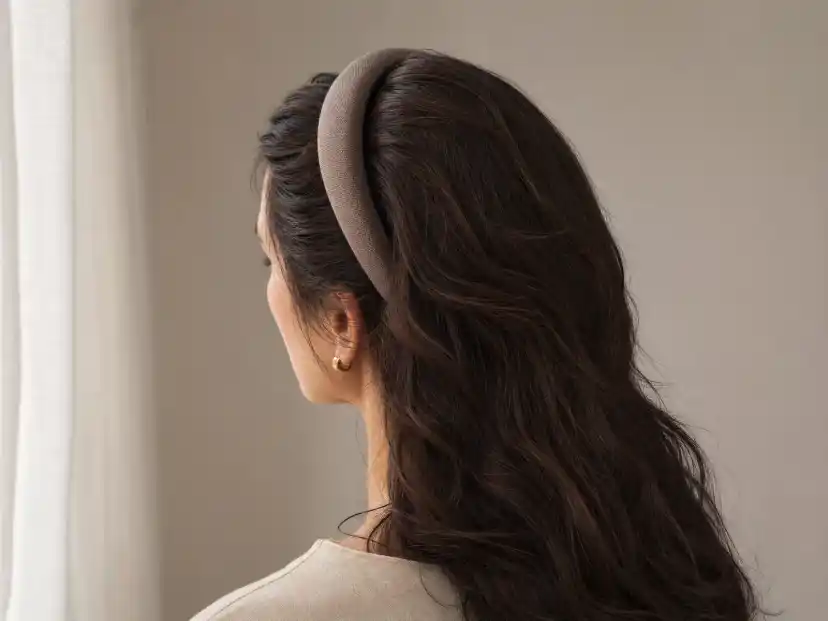
- A high-friction surface. Velvet, ribbed knit or silicone holding the hair shaft by contact rather than by biting. Weakest per square centimetre, gentlest on the hairline, and it scales with area, so a wide textured band can hold as well as a narrow toothed one.
- Fit and tension. A band that matches the arc of your head, either because it stretches to your circumference or because its shape was close to right out of the packet. Done well this is the mechanism you never notice. Done badly it is a tourniquet.
Most bands on sale combine two of the three, which is why the listings all read the same. The useful question is never which band is best. It is which mechanism was missing from the one that failed you.
Friction has a direction, which is why bands creep backwards
There is a physical reason a headband slides toward your crown and never toward your face. Hair is not a smooth fibre. Its surface is shingled with cuticle scales that point from root to tip, so anything sliding along a strand meets a different texture depending on which way it travels.
In a study of hair friction using atomic force microscopy and a macroscale friction test apparatus, published in Ultramicroscopy in 2006, Carmen LaTorre and Bharat Bhushan reported that the coefficient of friction changes drastically, on any scale, depending on whether the direction of motion is along or against the cuticle scales, and that friction is markedly higher in the tip-to-root direction, because the protruding edges of the cuticle scales resist motion in the against-scale direction.
Hair swept back from your hairline runs tip-ward toward the back of your head, so a band drifting backwards may be drifting the easier way along the scales rather than against them — that is an extension of the friction work rather than something anyone has measured on headbands. Either way, you can stop depending on surface friction: teeth bypass surface friction entirely by hooking through the hair, and a textured surface raises friction in both directions at once.
Diagnose your slip first, because headbands that don't slip are matched, not tighter
Five minutes of honesty here saves two more purchases:
- Fine or thin hair, band slides off entirely. You have a friction problem — there is simply not enough fibre for a smooth band to grip. Go to surface texture, or to fine teeth on a covered frame rather than bare plastic. Our picks for grip on fine and thin hair go deeper on this.
- Thick or dense hair, band pops off. You have a geometry problem. Volume lifts a rigid arc off the scalp so it perches on a cushion of hair, and it needs depth and stretch rather than grip. See bands with enough room for dense hair.
- Short hair or a bob. Teeth, almost always. There is not enough length for friction to work with, and a comb that anchors near the scalp is doing something no fabric band can.
- It stays put but your head aches. Your band is holding by tension, and tension is the mechanism to abandon. Swap to teeth or texture and you can wear the same band genuinely loose.
- It creeps back within the hour. Try placement before products — seating the band nearer the hairline gives it much farther to travel before it falls, which we work through in how to stop a headband sliding off the back of your head.
Best overall non-slip: teeth you can re-aim
The JOBAND Non-Slip Zig Zag Teeth Headbands are our pick because they are the only band here you can tune. JOBAND lists the band at about 0.8cm wide with teeth of roughly 1.5cm, and says the tooth position can be adjusted, and that adjusting is easier after warming the band with a hair dryer. Treat that as maker copy rather than a tested claim, though the listed construction — a resin cotton blend — is at least consistent with a band you can reshape.
That matters more than it sounds. A toothed band is a shape argument with your skull: the teeth either engage your hair at the angle they arrived at, or they do not. Being able to bend them in or out converts the usual gamble into a fitting. Four bands cost $13.88 as of September 2026, or about $3.50 each.
The trade-off is the trade-off for all teeth: at 0.8cm the band is narrow, so its holding force lands on a thin strip, and a comb of hard points is the format most likely to catch fine hair. If your hair snags easily, read the velvet pick below before this one.
Silicone grip headbands: hold without a hotspot
Silicone is the rare material that can do two of the three mechanisms at once. It has a high-friction surface, and it can be moulded into teeth and grip points, so it grips twice while staying soft against the scalp.
The lumitrail Silicone Comb Headbands are the version of that worth owning. lumitrail describes silicone over a memory metal wire core that holds its shape without cracking or bending out of true, comb teeth combined with anti-slip points, micro-fold ends it describes as having no pressure points during extended wear, and a tightness you can adjust to your own head. That is manufacturer copy, but the adjustable, shape-retaining combination is unusual, and it is why this is the pick for anyone whose last band gripped well and hurt.
The trade-off is cost per band. Two bands are $13.99 as of September 2026, about $7 each — more than four times the per-band price of the budget pick below, in tortoise and black only.
Best budget non-slip: the cheapest way to test whether teeth are your answer
Before spending real money on a mechanism, buy the cheap version and find out whether your hair likes it. The JJUNW Toothed Plastic Headbands are a lightweight plastic frame with a comb of teeth that JJUNW describes as precision-placed for a firm, non-slip grip, four to a pack for $5.99 as of September 2026. That is about $1.50 a band, which makes this an experiment rather than a purchase.
The trade-off is that bare plastic is bare plastic. There is no velvet or satin over the frame to soften the contact, so this is the format most likely to drag at the hairline, and the narrow frame concentrates pressure. Buy it to answer the question, then buy the nicer version of whichever answer you get.
Best for fine hair: headbands with teeth, wrapped in velvet
Fine hair puts you in an awkward spot. It needs the strongest mechanism, because there is not enough fibre for friction alone to hold, and it is the hair type least able to tolerate hard teeth.
The Thin Velvet Headbands with Teeth solve that by doing both mechanisms in one band: a plastic zig-zag frame covered in velvet, which the maker describes as an anti-slip surface that holds hair in place. The teeth supply the anchor, and the velvet raises the friction around them so the teeth do not have to do all the work — which in practice means the band can sit looser, and a looser band pulls less at the hairline. Three bands, in black, wine red and brown, cost $7.99 as of September 2026.
The trade-off is durability. Velvet is a nap, and a nap flattens with wear, so the friction half of this band may fade over months in a way a bare plastic comb will not.
Best multipack: twelve bands so you can move the pressure line
Rotation is not indulgence, it is maintenance. The American Academy of Dermatology, in its guidance on hairstyles that pull, advises changing your hairstyle regularly so your hair gets time to recover, and warns that the hairline is one of the first places hair loss from pulling becomes visible. Wearing the same band in the same line every day is the one habit worth breaking.
The Duufin Teeth Comb Headbands make that cheap. Duufin lists twelve bands at about 1cm wide and 12cm across, built from plastic with teeth backed by satin fabric, for $9.99 as of September 2026 — roughly 83 cents a band. The satin backing is what lifts this above a novelty pack, since it gives the frame something softer than moulded plastic to sit against your hair.
The trade-off is width. At a listed 1cm these are narrow bands, so they concentrate whatever force they apply. Twelve of them is a rotation, not twelve days of the same pressure line.
Best fabric non-slip: grip with no teeth at all
If teeth are out — your hair snags, your scalp is sensitive, or you have tried three toothed bands and disliked all of them — the friction route is the whole answer, and it needs width to work.
The DiyJibb Thick Non-Slip Headbands are the straightforward version: polyester with soft padding in a listed 1-inch width, which DiyJibb describes as stretchable and elastic, and markets as non-slip for long wear without hair strain. The mechanism is honest — a wide padded band grips by contact area and holds its position by stretch, not by biting. Six colours cost $8.99 as of September 2026, about $1.50 a band.
The trade-off is the fate of all elastic. Fabric bands stretch out. The usual failure is not day-one slipping but the slow sag that comes months later, once the elastic has been pulled past its recovery point every morning, and no amount of padding prevents that.
If it hurts, the answer is not a tighter band
A band that hurts is a band relying on the wrong mechanism, and the discomfort has a clinical name. The International Classification of Headache Disorders defines external-compression headache as headache resulting from sustained compression of the pericranial soft tissues — by a tight band around the head, a hat or helmet, for example — without damage to the scalp, and its criteria require the headache to resolve within one hour after the compression is relieved.
That one-hour window is a free diagnostic. Take the band off, note the time, and if your head clears inside the hour you have been squeezing rather than gripping. The fix is to move to teeth or texture so the band can be loose, which is the argument we make at length in why a headband leaves your scalp aching.
Glasses complicate this, because the arms of your frames and the ends of your band want the same strip of skin behind each ear, and stacking two pressure sources on one spot is how a tolerable band becomes an intolerable one. We cover the bands shaped to avoid that collision in headbands that work around glasses arms.
Buy two mechanisms, not two of the same band
The most common mistake we see is replacing a band that failed with a nicer version of the same band. Nothing on a listing tells you whether your hair responds better to a comb or to a textured surface — that depends on your density, how clean your hair is, and how much your head moves.
So buy across the mechanisms rather than up the price ladder. A toothed four-pack and a padded fabric six-pack together come to about fifteen dollars at the prices above, and one of them will become the band you actually wear. Then buy the good version of that mechanism.
And whichever you land on, judge it loose. A band that only holds when it is tight has not solved your slipping problem, it has postponed it onto your hairline. If you are starting the category from scratch rather than replacing one band, our headband buying guide sets out the widths, shapes and materials worth paying for.
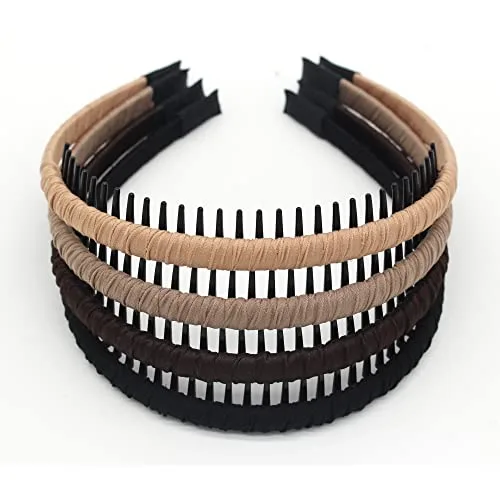
JOBAND Non-Slip Zig Zag Teeth Headbands (4 Pack)
The adjustable-teeth band. JOBAND lists a 0.
“According to JOBAND, the tooth position can be adjusted, and is easier to adjust after warming the b...”
We tested dozens of claw clips to find the very best options. Below you'll find our complete ranking, with detailed reviews and real customer feedback for each pick.
The Complete Ranking
JOBAND Non-Slip Zig Zag Teeth Headbands (4 Pack)
“According to JOBAND, the tooth position can be adjusted, and...” — Verified Buyer
The adjustable-teeth band. JOBAND lists a 0.8cm band width with roughly 1.5cm teeth, and says the teeth can be repositioned — warmed with a hair dryer — so you can tune the bite to your own head rather than living with the shape it shipped in.
“According to JOBAND, the tooth position can be adjusted, and is easier to adjust after warming the band with a hair dryer — the only band here you can re-aim.”
— Verified Buyer
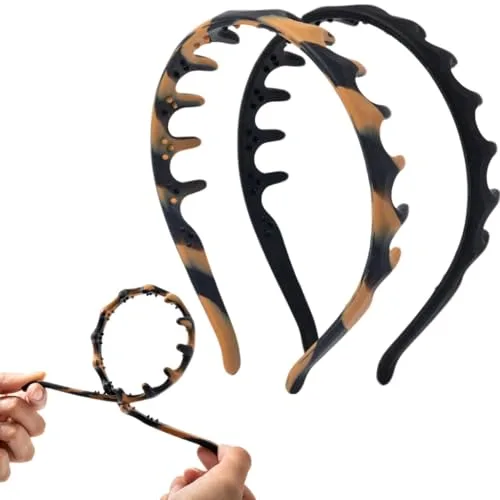
lumitrail Silicone Comb Headbands (2 Pack)
“According to lumitrail, the comb teeth are paired with anti-...” — Verified Buyer
Silicone over a memory-wire core, so it keeps its shape instead of snapping. lumitrail combines comb teeth with anti-slip points and micro-fold ends, and the tightness is adjustable — the pick when you want grip without a hotspot.
“According to lumitrail, the comb teeth are paired with anti-slip points and micro-fold ends intended to avoid pressure points during extended wear.”
— Verified Buyer
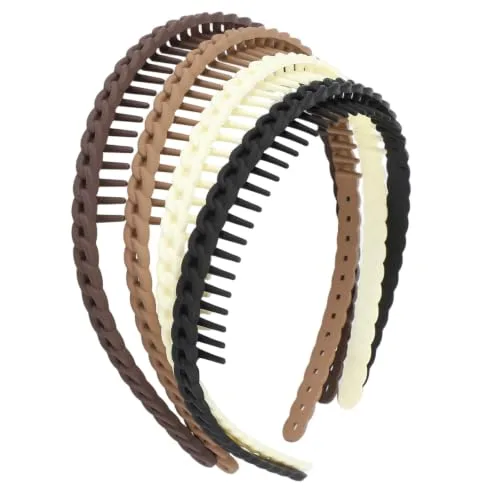
JJUNW Toothed Plastic Headbands (4 Pack)
“Four toothed bands for $5.99 as of September 2026, which mak...” — Verified Buyer
The cheapest way to test whether teeth are what your hair actually needs. A lightweight plastic frame with a comb of teeth, four to a pack, at well under two dollars a band.
“Four toothed bands for $5.99 as of September 2026, which makes this the cheapest way to find out whether teeth are the mechanism your hair needs.”
— Verified Buyer
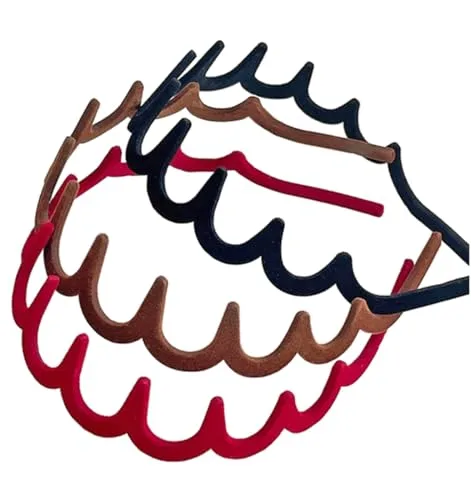
Thin Velvet Headbands with Teeth (3 Pack)
“The maker describes the velvet over the plastic frame as an ...” — Verified Buyer
Teeth for grip, velvet for kindness. The plastic frame is wrapped in velvet, which adds surface friction on top of the teeth — a gentler bite than bare plastic on hair that snags easily.
“The maker describes the velvet over the plastic frame as an anti-slip surface, which puts fabric rather than bare plastic against hair that snags easily.”
— Verified Buyer
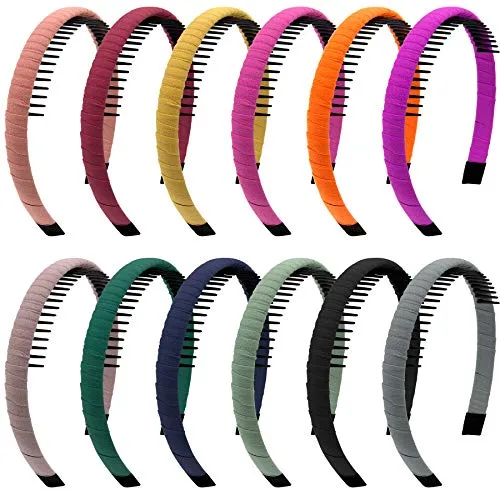
Duufin Teeth Comb Headbands (12 Pack)
“Twelve bands to a pack, which is enough of a rotation to sto...” — Verified Buyer
Twelve toothed bands at a listed 1cm width and 12cm diameter. Plastic teeth backed with satin fabric, which is what makes this a reasonable everyday rotation rather than a novelty pack.
“Twelve bands to a pack, which is enough of a rotation to stop wearing the same band in the same line every day.”
— Verified Buyer
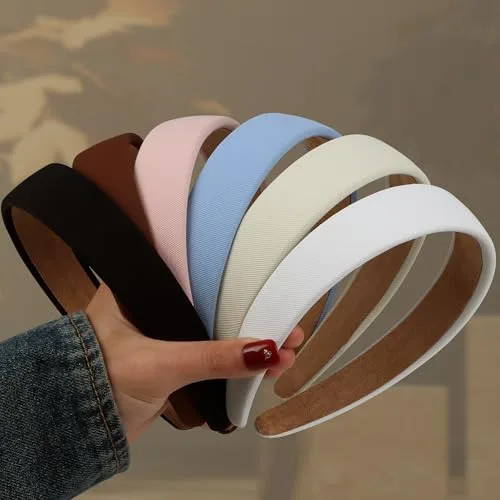
DiyJibb Thick Non-Slip Headbands (6 Pack)
“No teeth at all, so there is nothing to catch, and DiyJibb d...” — Verified Buyer
For anyone who wants grip without teeth at all. A 1-inch padded polyester band that holds by friction and stretch, six colours to a pack — the friction route rather than the mechanical one.
“No teeth at all, so there is nothing to catch, and DiyJibb describes the padded 1-inch band as stretchable and non-slip for long wear without hair strain.”
— Verified Buyer
According to JOBAND, the tooth position can be adjusted, and is easier to adjust after warming the band with a hair dryer — the only band here you can re-aim.
Quick Comparison
A side-by-side look at our top picks
Frequently Asked Questions
Buy two different grip mechanisms, not two of the same band
A visible dent means the band is too tight, not that your hair is too slippery
Friction on hair works in one direction better than the other

Donna Miller
Enjoyed This Guide?
Get more hair tips and product recommendations delivered weekly.